


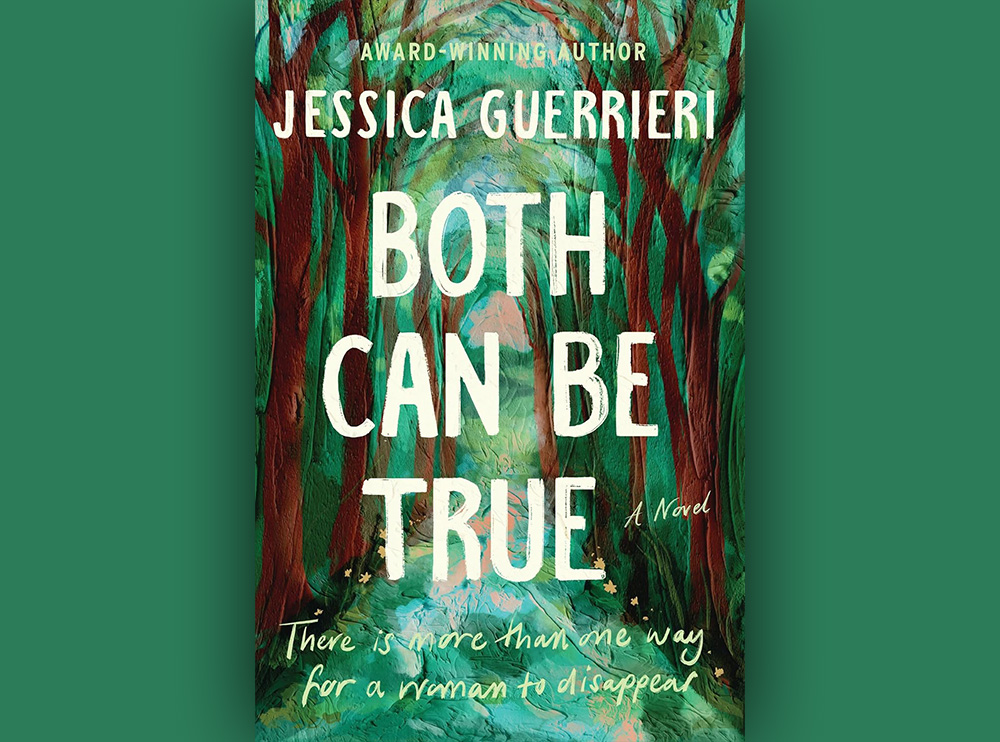
When a local mother goes missing, two estranged sisters are pulled back into each other’s lives and forced to confront old wounds, fractured trust, and the many ways a woman can disappear in plain sight.
Intrigued? Read on to discover the synopsis and an excerpt from Both Can Be True by Jessica Guerrieri, which is out now.
Frankie is the funny one, full of restless energy and sharp edges, the sister who got sober, opened a bookstore, and slipped into a version of domestic life without ever fully confronting the past. Mere is the steady one, the caretaker, a mother quietly unraveling under the demands of her neurodivergent daughter and the loneliness of a marriage to a husband who sees the world through an entirely different lens.
For the Gilmore sisters, losing their mother to cancer at a young age gave them a brief window of closeness they’ve never been able to reclaim. But over the years, a mentally ill father, the unspoken trauma of sexual violence, and the different vices they turned to for survival fractured their bond and created a divide of resentment neither of them could bring themselves to cross. When a woman in Frankie’s social circle disappears, the sisters are pulled into a shared reckoning and can no longer deny the past that has shaped so much of their present.
Set against the backdrop of a quiet Northern California mountain town, this gripping and emotionally layered novel unfolds in alternating perspectives, revealing the many ways women vanish inside motherhood, addiction, marriage, and shame. Told with raw honesty and wry compassion, Jessica Guerrieri’s sophomore novel is a story of sisterhood, acceptance, the unspoken truths we carry, and the redemptive power of bridging pain into connection.
EXCERPT
Friday, March 15, 2024
Frankie found her beneath the incense cedars. Here, campus and community blurred at the edges, academia brushing against small-town living like colors bleeding on wet paper.
The trees leaned close, weaving a canopy that softened the noise beyond, as if sheltering the secrets beneath them—a fragile kind of tenderness.
On a bench under the twiggy arch sat Brie, a waif of a woman whose blunt bob framed her face like parentheses.
A pair of crutches slumped against the wood, an ACE bandage hastily wrapped and already loosening around her ankle.
Frankie barely registered it—injuries happened. What held her was the smile: too quick, too brittle, the kind of expression she knew by now was a costume. Something slipped on, like dress-up.
She hadn’t always known Brie well. At first it was in the shallow way that mothers tend to become acquainted with one another—faces recognized in pickup lines, hellos exchanged at birthday parties, small talk at school fundraisers. When their older girls became friends, forced proximity tugged Brie a little closer into Frankie’s orbit. Then, finally, there was the unmistakable shift at the start of this school year, the night Brie showed up drunk to chaperone a school dance. Frankie had stepped in to help, and afterward, Brie asked Frankie to sponsor her. They’d been meeting weekly at the arboretum, usually just the two of them, and sometimes at Frankie’s Sunday women’s AA meeting when she managed to get Brie to come along.
Frankie had to remind herself constantly that a sponsor wasn’t a savior or a warden—Frankie’s own sponsor, Pearl, had been saying it for nearly a decade. A sponsor was a guide with a flashlight. We cannot walk the path for one another, but we can light the way so none of us stumbles alone in the dark, as Pearl would say. For six months now, though, Brie had been stuck at Step One: admitting she was powerless over alcohol and that her life had become unmanageable. Frankie understood; she, too, had choked on the word “powerless” at the beginning.
For women, surrender was never neutral; powerlessness was too often forced on them by men, by circumstance, by the sheer weight of expectation. Still, Step One had to be faced, and Brie couldn’t get past it.
So here they were again, sponsor and sponsee, seated beneath the cedars, their branches bowing toward each other in quiet surrender, mirroring the first step Brie could not yet take.
“What happened?” Frankie asked, tilting her chin toward Brie’s ankle as she settled beside her.
“Can you believe I tripped going up the stairs? Apparently, aging is really agreeing with me.” Brie’s line sounded as rehearsed as her smile looked.
Frankie crouched down, tugging gently at the wrap. The ACE bandage made more of a fuss than whatever injury was hiding beneath it, all loose ends and overcompensation.
“I once painted my entire kitchen blackout drunk,” Frankie said. “Fell straight off the ladder, tore up my knee in three places. When I got my brace off, I was practically an expert at
using these things.”
Brie laughed. The sound was sharp at first, but it soon softened into something real. Then she reached into her bag and pulled out a round metal object. A small tin dropped into Frankie’s hands, the muted thud startling in the quiet.
“I don’t trust myself. I need you to take these,” Brie said in a whisper.
Frankie lingered on the packaging, too much like the candy her daughters once begged for at every checkout, sweet little bribes that clung to their teeth and filled the car ride with the wet sound of sugar being sucked clean. The THC leaf on the tin was so subtle, it could easily be overlooked.
“You okay?” Frankie asked.
“Fine,” Brie answered, the word Frankie’s daughters used when they were anything but. “I’m fine,” she repeated.
Frankie knew enough from sitting around tables of sober women, from raising two daughters, and from her own lived experience that by the time a woman says she’s fine, all her petals have already been plucked and she’s a single sneeze away from being scattered to the wind.
“I thought I’d try a couple of gummies instead of the painkillers the doctor prescribed,” Brie added, her voice sliding into false casualness. “You know, something more natural to take the edge off. But they didn’t help.”
“Your doctor prescribed painkillers for your ankle?”
Brie’s answer came too fast. “Yeah, oxy. At home. Haven’t touched any, though.” She pressed her lips together, then added, “I just . . . wanted something that felt easier.”
Frankie studied her, not sure if she believed it—if, in her vulnerable state, Brie didn’t have the bottle stashed somewhere on her person, as physically close to her body as she could get the pills without ingesting them. The story wobbled at the edges. Why bring the gummies here and not also the pills? Why confess to Frankie in half-truths? She tucked the tin into her purse to throw away later. Whatever Brie’s motive, at least she had handed over the gummies.
“I get it. Glad you haven’t taken anything stronger,” Frankie said carefully. “It’s all a slippery slope, and together, we gotta figure out a healthy form of escape.”
Frankie had sponsored other women before, but Brie was the most reluctant. Still, Frankie couldn’t ignore how the injury and the tin didn’t line up.
“Tell me how it’s been since Margaret’s surgery,” Frankie said, wanting to steer them toward something brighter. Margaret, Brie’s older daughter, had been born deaf, and just weeks earlier she’d undergone a cochlear implant procedure. “Chloe told me Margaret said it’s been life-changing.”
The dimness left Brie, replaced with a maternal radiance.
“It has been. For our entire family. The first thing she said she loved was the sound of the coffee maker. Can you imagine?”
Her laugh broke in the middle, turning wet. “It’s all so loud, she said, and at night I asked if maybe she wanted to just switch it off, but she doesn’t want to miss any of it. She keeps saying, I don’t want to miss a thing.” Brie took a deep breath, steadying herself. “The other morning, I was humming without even realizing it—just folding laundry, humming the Aerosmith song from that insane save-the-world movie where they blow up an asteroid—and Margaret stopped what she was doing and said, That’s you, Mama. I can hear you.” Brie blinked quickly, as if the memory itself might tip her over. “I’ve been her mother her whole life, but that was the first time she’d ever heard the sound of me. My voice. Not just the shape of my words on my lips, but the music of it. And she smiled like she’d been waiting for it forever.”
“That’s recovery too,” Frankie said, barreling forward, excited to help Brie recognize the correlation between those precious moments she no longer missed out on. “Learning to tune in instead of numbing out. It’s painful, yeah. But it’s also—”
“No.” Brie cut her off, shaking her head. “It’s not the same. Margaret hears my voice now. My actual voice. You don’t get that in recovery. You don’t get back the thing you lost.”
Brie was so wrong, but Frankie was losing the steam to fight her. Brie turned her gaze to the path, where a group of students drifted past, earbuds in, shouting, disrupting the entire ecosystem of the trees. “Margaret has spent her whole life longing for noise. But sometimes I just want quiet,” Brie whispered. “To escape someplace with opaque water. No reception. A stack of the trashiest gossip magazines.”

Frankie sighed, trying desperately to meet her where she was. “That sounds kind of perfect,” she said. “You could find me on the beaches of Tahiti, in one of those enormous floppy hats that shades basically your entire body. From above I’d look like a giant tortilla chip and dip holder.”
Brie closed her eyes, breathing deep as though she could catch salt air here in the middle of the Northern California mountains. For a flicker, Frankie let herself imagine it too.
“Do you ever regret it?” Brie asked, her eyes still closed.
“Regret what?” Frankie asked.
“All of it,” Brie exhaled, sharp and unsteady. “Marriage, kids, the whole thing. Do you ever wonder if you missed a turn somewhere? Like it started out as the magic of sleepaway camp for grown-ups—messy, loud, fun—and then, without warning, something shifted. Or maybe it didn’t. Maybe you did. And the drinking made it easier. It was always five o’clock somewhere because we were needed everywhere. And now it just feels like a place you can’t ever leave. Like you’re dissolving inside of it, piece by piece, until the person you were disappears.”
The answer should have been a resounding yes—Frankie had felt that way a million times over—but she had grown weary of Brie’s resistance. Frankie felt herself pulling away, saving what little stamina she had for later that evening, when she’d meet her sister, Mere, for dinner. It was the twenty-seventh anniversary of their mother’s death, and still they kept the tradition, even if Frankie approached it with a kind of practiced restraint, the quiet distance she’d learned to keep so her sister could never again get close enough to wound her.
“I hope I see you Sunday morning,” Frankie said, leaving it there like an open door. Another invitation to another Sunday women’s group. Based on how their conversation had gone today, she wasn’t holding her breath that Brie would accept it.
“Yeah, I dunno. It’s hard to get around.” Brie’s tone was evasive.
Frankie was familiar with all the excuses; she’d used them herself from time to time, usually when she felt herself slipping out of that pocket of serenity. Sometimes it happened so suddenly she could hardly believe how quickly her “isms” from alcoholism could sink their teeth back in, like a rabid dog with a taste for flesh—relentless and unyielding, gnawing away at the marrow of bone until nothing was left of the good parts of her she’d worked so hard for.
“Still, you should come,” Frankie said again, forcing herself to keep trying. “I’ll pick you up.”
Brie kept her eyes fixed on the middle distance, silent, while Frankie heard Pearl’s voice in her head: You can lead a horse to water . . .
Frankie had bristled at that line her first month sober. Isn’t the entire point not to drink? she’d shot back, all sharp edges.
Pearl had only laughed, her smoker’s cough rattling like gravel in her chest. Oh, I see how it’s going to be with you.
Frankie checked her watch. Pearl would be arriving any minute for their check-in, and Frankie swore she’d hand off the gummies before they piqued her curiosity any further. THC was a gray area she’d only dabbled in as a teenager, nothing she wanted to play around with now. Better to pass them on. She decided she’d bring Pearl along to dinner too—her own kind of emotional support person. Mere would be annoyed, but Frankie figured she’d survive.
Brie stood then, shifting her weight absentmindedly onto her bad ankle, rebuffing Frankie’s offer. “If I’m coming, I’ll get there myself.”
“You sure you’re good?” Frankie tried again.
“Fine,” Brie repeated, gathering her things to leave.
Frankie studied her, tempted to push but knowing better. Fine was the armor you wore until it cracked. Brie was the most stubborn of horses.
Taken from Both Can Be True by Jessica Guerrieri. Copyright © 2026 by Jessica Guerrieri. Used by permission of Harper Muse.