


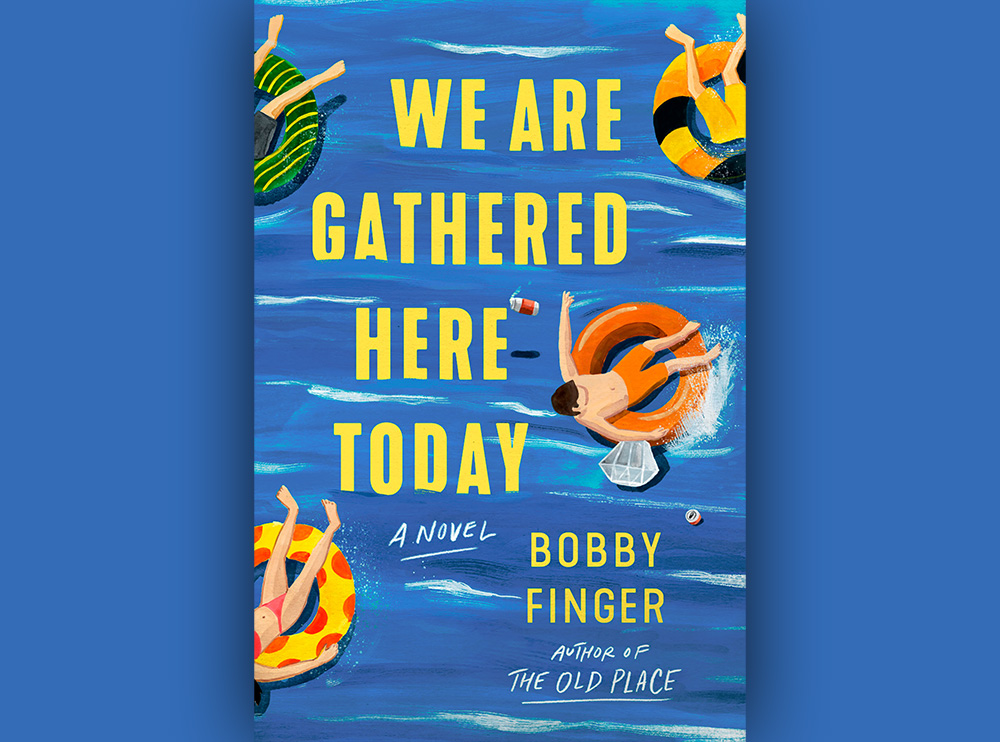
The Wedding People meets The Celebrants in this hilarious and profound novel about a recently engaged gay man second guessing marriage, and his cousin’s chaotic Texas wedding weekend with old friends and unexpected strangers that will help guide him to the truth, from the beloved author of The Old Place.
Intrigued? Read on to discover the synopsis and an excerpt from We Are Gathered Here Today by Bobby Finger, which releases on June 16th 2026.
At 36, Finlay Hightower has attended countless incredible, cringe-worthy, and disastrous wedding celebrations with his best friends. Their secret to surviving wedding chaos? The Hour of Disrespect—a pact to reserve judgement to one hour after the couple’s Big Day, protecting the wedding glow and leaving only with the good memories.
But this next wedding will test their decade-old tradition in more ways than one. Now, one of their own is getting married—Fin’s beloved cousin, Elaine—at a Wild West-themed venue in the sweltering Texas summer heat that is as meticulously itineraried as it is kitchy. Reserving opinions won’t be easy, and on top of that Fin has a secret that threatens his officiant duties: he’s just gotten engaged to the man of his dreams, and a sense of unease has him questioning if he believes in the institution of marriage at all.
As Fin joins the rambunctious and increasingly unhinged “queer table”, old friendships are tested and new relationships are formed. Will each guest hold back their particular views on love, commitment, and the wedding before Elaine can say “I do”? And if not, could those confessions ultimately give Fin the courage to uncover his truth?
Like any good wedding, We Are Gathered Here Today is funny, heartfelt, and full of surprises. Like any terrible wedding, it’s something you’ll never forget.
EXCERPT
THURSDAY
June 6
The frequency of receiving wedding invitations had slowed down just as everything else in Fin’s life seemed to be speeding up. Algorithmically recommended content displayed on every app in-
stalled on his phone constantly reminded him that time moved faster as you got older, not that he needed a stranger’s insistence for him to notice something so grimly, crushingly obvious. The planet was getting hotter more quickly. The threat of fascism was rising. Even the lines around his eyes were deepening over time, a fairly recent change that made Fin realize his own vanity was dwindling quicker than he ever predicted it would. So much was happening all of the time, so little of it could be ignored, and the gravest irony was how quickly everyone—himself included—was able to forget. Minds could only hold so much information, Fin often thought, and at some point in the past ten years the human brain had reached its biological limit. Old data was forcefully purged in order to make room for new entries, and in just under a
decade his and everyone else’s brains had transformed into perpetually revolving doors that took in new visitors as swiftly as they spit old ones out. There had to be a reason for the way everyone was feeling, he decided, and it might as well be that.
Well before the great quickening, weddings were a balm to Fin because they were a pause. A time to sit at a big round table with the past, present, and future, holding all three tight before they inevitably went back to where they belonged. That they were also a place to hear “I Wanna Dance with Somebody” in its most satisfying, hopeful context was the icing on the fondant on the cake. To Fin, leaving a wedding—even a terrible one—was always a moment of profound, all-encompassing sadness. A wedding bouquet ascended into a world at a standstill and was caught in fast-forward. But, oh, what it felt like for a wedding to
begin—especially a wedding weekend. The gift of stretched-out time was, to the wedding guest, greater than any KitchenAid mixer or honeymoon fund contribution could be to the wedding couple, and more meaningful than any speech or heartfelt, handwritten card. For Finlay Hightower, it was a one that opened itself the moment his plane touched down on the weekend of his cousin Elaine’s wedding. He’d spent the morning moving at five hundred miles an hour, and with the piercing screech of rubber on tarmac, he’d abruptly come to a complete stop.
The flight arrived ten minutes early, after one full The Devil Wears Prada and roughly one-third of The Fugitive—post-bus crash but before anyone actually believes Dr. Richard Kimble’s wife was killed by a one-armed man. Fin transferred the unopened novel he’d bought at a LaGuardia Hudson News and the
empty notebook he’d packed—with the sole purpose of filling it with his officiant speech—from the seat pocket to his backpack. He quickly disembarked the plane, grimacing at the instant oppressiveness of the central Texas heat he’d escaped over fifteen years ago that pierced through the gaps of the jet bridge before inhaling it deeply and deciding it was, actually, not that bad every once in a while. He pulled out his phone and sent a text to Jacque, his closest friend, who’d also been forged in fire.
Here! No bags! Terminal A!
I think I literally watched your plane land. Leaving the cell phone lot shortly. Pee now if you have to. I come bearing snacks and drinks for the ride so we won’t have to stop.
Fin smiled at her thoughtfulness. Jacque Aguilar. Funnier, smarter, sillier, kinder, and easier to love than he; she was his favorite person to be in a car with. He didn’t miss driving, and often pointed out New York City’s mostly efficient public transportation system as the fundamental reason he could never see him-
self living anywhere else, but he did miss riding shotgun with Jacque at the wheel. During their time in college in the mid-aughts, back when gas was cheap, they’d often just hop in her Chevrolet Cavalier and go for a drive. From Austin to New Braunfels and back, stopping for snacks and soda somewhere in
between, or toward Johnson City in the Hill Country. Sometimes they’d just loop around the city, from I-35 to Ben White, north on MoPac, and 183 back toward the highway. It was a time for them to relax and to catch up on the day, divulge their latest unrequited crush, and with any luck, grab dinner at the end of Martin Luther King Jr. Boulevard, a busy intersection in Austin’s east side with their favorite fast food filling every quadrant. A little Popeyes, a little Taco Cabana, a Frosty from Wendy’s, eaten together in the final choice’s parking lot before returning to the apartment complex where they shared a staircase and a wall, tucked into a million sprawling live oak trees that, he figured now, had probably been ripped out of the ground to make way for a high-rise.
When the window rolled down he saw the Styrofoam cup first; Jacque held it over the passenger seat, shaking it slightly, tauntingly, as if it were a beverage he was forbidden from ever tasting. She was in a T-shirt and shorts, the same as he, and her long black hair was pulled into a crisp, shiny ponytail held by a white tie. “Welcome to hell,” she said, finally revealing her face from behind the cup as the cold escaped through the window. “I got it sweet, because I knew you wouldn’t have ordered it that way yourself.”
Jacque was right about the sugar because she tended to be right about everything involving Fin. Since they’d met due to a militant tenth grade English teacher’s unwavering semester-long seating chart, during which they began passing notes back and forth to each other with sleights of hand that made them both feel like David Copperfield, she had him all figured out. When he came out to her the following year, while thumbing a wall of DVDs at Hollywood Video and desperately avoiding any and all eye contact, she congratulated him for finally working up the nerve, and then, to his shock, proceeded to come out herself. “But what about Manny?” he said after she used the word “lesbian,” referring to her on-again/off-again who graduated the previous year.
“Manny’s just a dildo with a disgusting man attached,” she said, pulling a copy of Under the Tuscan Sun from the wall. “Plus,the only other dykes around here don’t know they’re dykes, and
I don’t want to be any closet case’s first. Second, sure. That’s fun. But not first.”
Just before heading up to Austin for college, he came out to a second person: his beloved second cousin Elaine, with whom he shared a sibling-like friendship that, while close, lacked the un-
burdened freedom that he could have with someone outside of his family—someone like Jacque. It never felt worthwhile to tell his parents, whom he assumed already knew, or his other high school friends, none of whom he cared about all that much. They were straight women, most of them, and he feared the conversations that would ensue from any kind of dramatic sit-down event. They would be too excited, perhaps grimly so, and worse, they may even make it about themselves. He feared the why didn’t you tell mes or I always suspecteds and every reaction in between, so he swerved himself away from such conversations entirely. In college—ninety miles away in the liberal, notably “weird” city of Austin—he would be gay from the jump, a man crisply, confidently defined, and his life would finally begin. Not anew, exactly, as Elaine and Jacque would be right there beside him, perpetual reminders of his past, the only friends who had the privilege of knowing his prologue, and the only ones who seemed to give more than half a shit about all the chapters that would be written later.
He made other friends in college, of course. Good friends, though no other bond ever quite matched the one he shared with Jacque and Elaine, and Fin barely kept up with any of them after leaving town. It wasn’t codependency, exactly, but it was profound, unwavering comfort. They were each other’s home base.
After every hookup—good or bad—party—good or bad—and most days of classes—always awful—they relied on each other to listen, usually briefly, and then, simply, to be there. Fin’s decision to move away after college came as a shock to both of them, but was never discussed with bombast or fear. The two most important women in his life had no interest in joining, but the invitation was more than enough, and Fin was confident that they knew that Fin knew the two of them would always be around if and when he were to return without ever saying the words out loud.
“Be safe and be happy,” Elaine said to him as he lugged his two rolling suitcases into the airport more than fifteen years earlier. Then Jacque tearfully yelled, “I love you! Make good choices!”
“T love you too,” he said right back, eyes on the doors sliding open with a whirr before he was in range of their sensor, beckoning him in and far, far away. He and Jacque had never used the word “love” to each other until that very moment—it was never their little clique’s style—but once released into their personal lexicon it became the closing assertion of their every conversation. The love had always been there, something totally opaque hovering in the space between them, but it just hadn’t ever felt like something worth addressing until the space was about to become as vast and painfully stretched as it felt like it would then. Since then he couldn’t remember a conversation they’d had that didn’t end with a “love you.”
Jacque waited until they headed west to ask the question. As the surface beneath her tires transitioned from the smooth, recently repaved Interstate 35 to Highway 90’s lighter, coarser grit—the kind that made the spinning of a car’s wheels suddenly, almost violently apparent—she turned down the radio and cleared her throat. “So how’s Mark? WillI ever meet him or should I start worrying that he’s a figment of your imagination?”

Fin took a long sip from his cup, sucking the remaining ounce or so of tea from the bottom until making a noise he’d wished could act as the entirety of his response. Thinking of Mark then, that rattling, cacophonous whoosh of a straw’s last gasp for liquid was just about representative of how he felt. “He’s good. We’re good. Living together is surprisingly good. But I’d rather talk about you,” he said, sipping from the empty cup with even more force. Jacque shook her head and made Shania Twain’s voice louder than either of them could ever hope to overpower. When she rolled down the windows, Fin reached his hand out and grabbed the upper part of the passenger door, where it met the roof. Country music sounded better in the country—the actual country—and all music sounded better on the open road. With what looked like miles of long, nearly empty highway in front of them, he tapped his fingers to the beat and realized that even though he’d heard this song a thousand times before, it’d never sounded better than it did right then.
“What’s there to say?” Jacque said. “Work is busy and depressing, just like it always is.” Jacque began working at the public defender’s office immediately after graduating from law school,a job she took for its security as much as she did for its virtues. She explained that it offered her little free time to do much at all, let alone date, but that she’d been going to the gym every morning for the past year, which had done wonders for her mental health.
“How’s your mom?”
“A total mess, as usual,” Jacque said. “But ultimately fine, also as usual. My dad ended up giving her some money so the threat of her moving in with me has been lifted. At least for the next six months.” She kept her eyes on the road as she spoke, the joy in her voice suddenly absent now that her parents had been brought up. “He’s still an asshole and so is his girlfriend—he’s back with Monica, by the way—but he’d never let my mom down. I do believe that. And if he dies first, she’ll still get money, despite Monica’s resounding objections.”
“How do you know for sure?”
“Because I drew up the will,” she said proudly. “It’s so fucking funny that he didn’t take his wedding vows seriously until after breaking them. Or maybe it’s just tragic.”
“Well I’m glad she’s okay. I wish we had time to see her.”
“You just wish we had time for her to cook menudo for you.”
“Of course I do.” Growing up, Nora and Samuel offered Fin the closest glimpse into the intricacies of marriage apart from his own parents. Their marriage was the polar opposite of his own parents’ in every possible way—they were divorced, outgoing, talkative, and honest—and he’d been fascinated by their relationship from the moment Jacque introduced them. They’d only been married for the first five years of Jacque’s life. After the divorce, caused in part by Samuel’s affair, and in part because they finally understood they weren’t the right people for each other, there was a simmering period where they co-parented from afar, taking the time they each needed to lick their wounds.
By the time Fin came into the picture they had eased into a life of being, simply, best friends of one amazing daughter they created together. When Fin came over to watch a movie, as he did most weekends, Samuel would usually be there, milling about in the kitchen, eagerly accepting a meal, and talking about work and, eventually, complaining about his relationship with Monica, the woman he’d had an affair with. They kissed each other goodbye on the cheek, then the moment he was out the door Nora would collapse on her recliner and vent to both Jacque and Fin about whatever he’d said that had annoyed her. Nora and Samuel spoke more to each other as a divorced couple than Fin’s own parents did as a married one, and when alone in his own bedroom listening to the rustlings of their wordless evening routine through the
crack under his door, he wondered if they’d be happier divorced. They never fought, but Fin always interpreted their silence as pain. How strange that, in those moments, neither of the fullest examples of marriage in Fin’s young life seemed to make any damned sense.
From WE ARE GATHERED HERE TODAY by Bobby Finger, published by G.P. Putnam’s Sons, an imprint of Penguin Publishing Group, a division of Penguin Random House, LLC. Copyright © 2026 by Bobby Finger.