
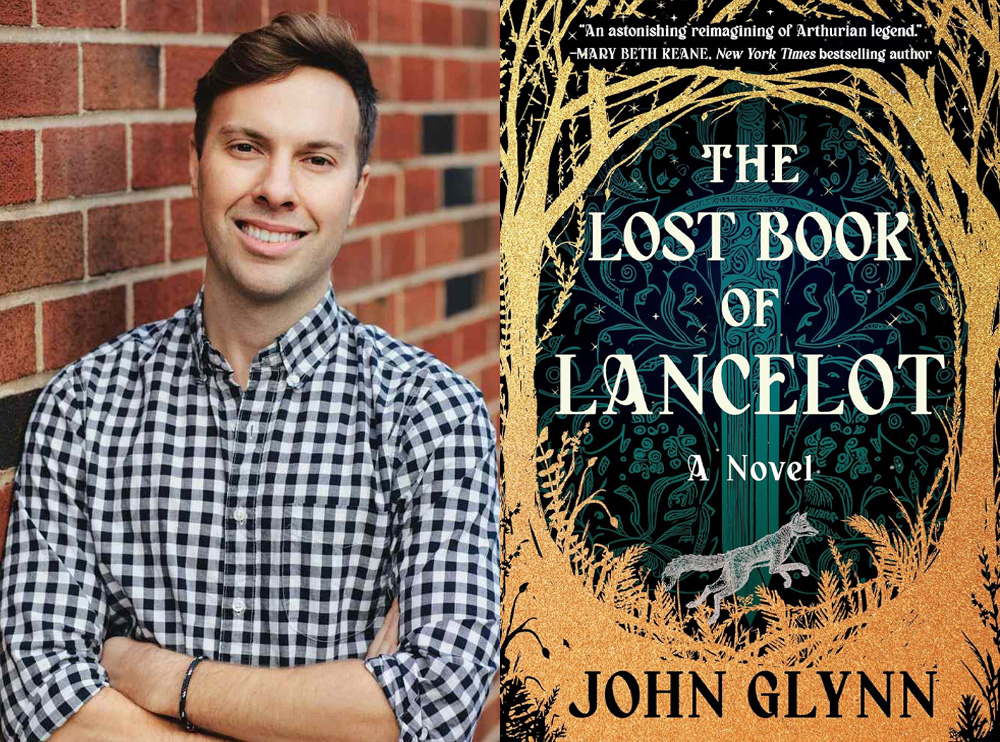
We chat with author John Glynn about The Lost Book of Lancelot, which is a breathtaking reimagining of the legend of Sir Lancelot—an epic Arthurian fantasy about destiny, identity, and forbidden love at the heart of Camelot.
Hi, John! Can you tell our readers a bit about yourself?
Hi, Nerd Daily! I’m an editorial director at Hanover Square Press, an imprint of HarperCollins, and I also write my own books. I live in New York and have a dog named Whitman.
When did you first discover your love for writing and stories?
As early as I can remember! My mom is a voracious reader and she’d read stories to me every night before bed when I was little. We’d go to the library each week and I’d look for book spines with the Reading Rainbow sticker on them. Growing up I had some great teachers who encouraged me to write my own stories. It’s always been with me.
Quick lightning round! Tell us:
- The first book you ever remember reading: James and the Giant Peach by Roald Dahl
- The one that made you want to become an author: The Poisonwood Bible by Barbara Kingsolver
- The one that you can’t stop thinking about: Piranesi by Susanna Clarke
Your debut novel, The Lost Book of Lancelot, is out now! If you could only describe it in five words, what would they be?
Song of Achilles, but Camelot
What can readers expect?
It’s a retelling of Lancelot’s story and his place in Arthurian legend. But I draw on a queer thread of lore, which upends a lot of the traditional beats of the story and gives readers what I hope feels like a fresh and fun way in.
Where did the inspiration for The Lost Book of Lancelot come from?
I’d read The Song of Achilles by Madeline Miller and loved it. That novel is a retelling of The Iliad, and it centers a gay love story between Achilles and Patroclus. It got me wondering about other queer stories that had always been available, kinda hiding in plain sight. That’s when I learned of Lancelot and a fellow knight named Galehaut. In the 13th Century Old French version of Arthurian legend known as The Vulgate Cyle, there’s an amazing queer-coded love story between them. Though there’s been plenty of scholarly work written about this relationship, it was new to me, and I tossed myself headfirst into the research.
Were there any moments or characters you really enjoyed writing or exploring?
So many! I loved writing the knights of the Round Table, I loved writing Merlin of course, but my favorite characters, aside from Lancelot and Galehaut, were the novel’s powerful women. Lancelot’s surrogate mother The Lady of the Lake, Viviana, possesses an ancient magic. Guinevere is complicated, compassionate and misunderstood by her kingdom. Galehaut’s mother Bagotta is a formidable knight in the vein of Brienne of Tarth. A cool thing about Arthurian legend is that there’s no one single definitive text, so while I really wanted to honor the source material, I also felt comfortable writing into the gaps to bring every character to life.
Can you tell us a bit about your planning and plotting process for The Lost Book of Lancelot?
It really took me a while to feel comfortable tackling a project of this magnitude. I had to dive deep into the source material, The Vulgate Cycle, Chrétien de Troyes, Robert de Boron, Ulrich and so many more to build a base of knowledge from which to write. Even then, I felt plagued by self-doubt. Arthurian legend is so intimidating! But outlining did help. I think in story beats. I like knowing where I’m heading without necessarily mapping out every detail. Sometimes as I write the story takes a surprise turn or an unexpected character steals a scene, and I love those moments.

Did you face any challenges whilst writing? How did you overcome them?
I initially wrote the entire book in the third person. It felt…meh. I knew something wasn’t right, but it wasn’t until I started re-writing it in the first person that emotions really came through. I ended up overhauling everything, not just the perspective, but the plot and the emotional arc, too. It was a massive challenge, but it made all the difference.
This is your debut novel! What was the road to becoming a published author like for you?
It was a rollercoaster! I had published a memoir in 2019 called Out East, and this project was about as big a pivot as you can get. It took me a long time to convince myself I was actually writing this book, and then even more time to convince myself that I might share it with anyone! But so far the reaction from readers has been so heartening.
What’s next for you?
Good question! I’m doing a number of events this summer for Lancelot, and in my day job I’ll continue to edit and publish other authors, a collaborative process I genuinely love. But in terms of my own writing, I’m working through two potential ideas, trying to decide which I’ll dive into next. We’ll see!
Lastly, what books are you looking forward to picking up? Any you’ve read so far this year that you’ve enjoyed?
I’m a huge Shannon Chakraborty fan, and I can’t wait to read her new Amina Al-Sirafi novel, Tapestry of Fate. Right now I’m reading Emma Brodie’s Into the Blue and just loving it. And in nonfiction, Keza Macdonald’s Super Nintendo was a wonderful slice of video game history.