


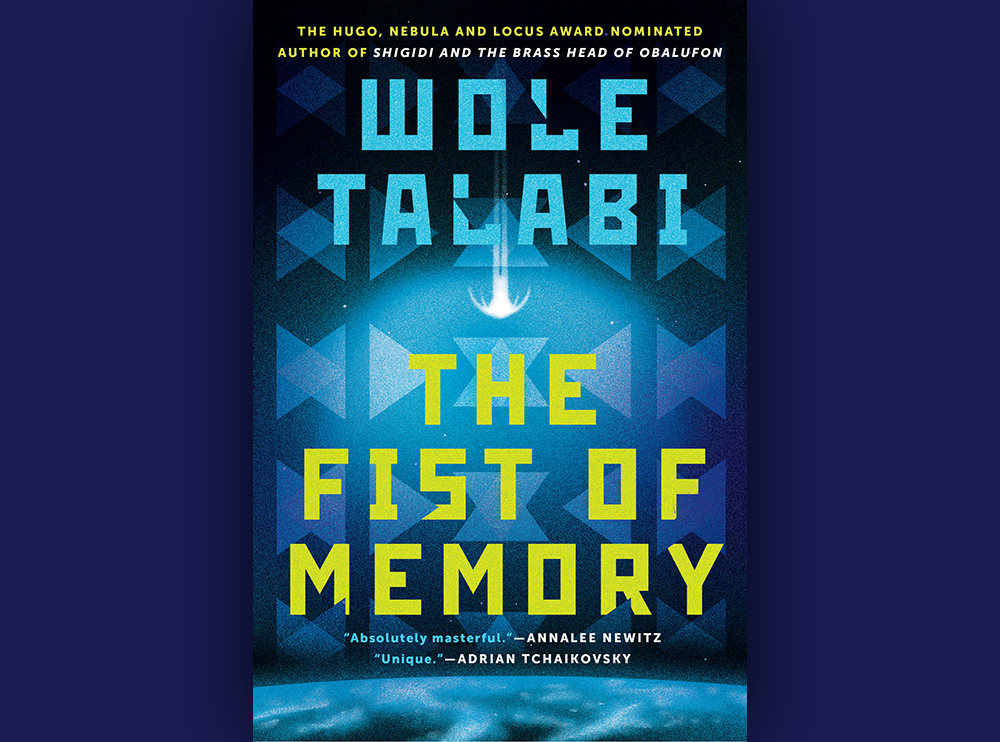
A strange alien spacecraft suddenly appears in the sky in this electrifying, action-packed first contact novel set in near-future Nigeria from award-winning author Wole Talabi.
Intrigued? Read on to discover the synopsis and an excerpt from The Fist of Memory by Wole Talabi, which releases on October 27th 2026.
When a non-communicative alien spacecraft suddenly appears in the sky, global powers are thrown into turmoil.
But for Tope, a principled Nigerian assassin with a talent for lethality in the employ of the mysterious witchdoctor known as “Baba,” it’s all just business as usual. At least until a job goes wrong, and Tope is caught in the scramble—a high stakes game of power and politics for the future that is to come. Joined by Itumeleng, a South African astronomer plagued by mysterious dreams, they must find a way to survive, navigate their complicated pasts, and come to understand how they, and all of humanity, are connected to the alien craft before it lands and the world changes forever. But it won’t be easy. There are sinister forces marshalled against them, including a strange assassin obsessed with a single memory.
The Fist Of Memory is a first contact thriller unlike any other; a meditation on the nature of reality, memory and connectedness.
EXCERPT
THE GREAT WALL OF LAGOS
Lagos, Nigeria
Tope
It’s noon when I wake up, curtain‑ filtered light kissing my eyes.
After six glasses of double‑ oak whiskey, I’d finally drifted off into dream‑ filled slumber. Didn’t really work though. Same dream, as always. Now, I find myself nursing a light hangover and thinking of the men I killed on the road this morning. There is an uncomfortable emotional resonance between the dream, the call from Lolade, and the act of killing those men that I don’t want to dwell on. Thinking too much would lead to drinking too much, and as much as I like the blissful wooziness of being drunk, I can’t afford to incapacitate myself right now, so I get up. Go outside. Think about something else.
Lagos is particularly hot today— weather predictions say it is . . . [39 degrees Celsius,] but it feels like more when I open the sliding glass door and step onto the balcony of my air‑ conditioned, 19th floor studio apartment wearing a blue wrapper tied above my breasts. It is like stepping out of a fridge and into an oven. Oily exhaust fumes float on gusts of humid air. Lagos is the grip of another heat wave, but this has always been a city of extremes, even before climate change made it more so.
Mine is one of the ninety‑ five flats in this high‑ rise building along Kudirat Abiola Way and just one of my many hideouts in this sprawling, disorganized city. Chinedu, my real estate agent, has proven to be astute at obtaining good, discreet accommodation. This high rise with its silver solarskin exterior and rooftop pool like several others around Ikeja, sprouts out of a cluster of older, lower buildings, a network of legacy power lines propped up on wooden poles still running between them. Mostly two to three stories high. The electric cables hang slack, and older towers are beginning to buckle under the sun. Drones buzz high overhead like vultures, and holographic billboards remind people to bring water. The city was not built for this heat. Truth be told, the city wasn’t built for anything at all. Nothing about Lagos was planned. It’s evolved like an organism. Adapting to environmental, social, and political pressures in a desperate bid to survive. Like I have. The city is uncertain of itself, always changing rapidly and unevenly, giving it the quality of a patchwork place, a city assembled from neighborhood pieces that exist in different periods, income brackets, levels of development, security, a place of superposition.
Sweat‑ stained and agitated pedestrians scurry along the roads. It’s not quite lunch time but some early eaters are already leaving their offices, moving along the sidewalks, tending toward a tarpaulin‑ and‑ zinc shack mama‑ put in the corner of an open‑ air car park at the junction. Two heavy‑ set women in black blouses and ankara wrap pers steadily scoop up the soft lumps of eba, fufu and amala, loading them with generous helpings of thick egusi, ewedu or gbegiri soups and meats as customers take seats on the plastic chairs nearby under a crude green holographic projection from a circling ad‑drone. Across the road, there is a competing autonomous food cart selling both jollof and fried rice with chicken, plantain, coleslaw and other accompaniments. Despite the heat, the length and diversity of the queue developing in front of the mama‑ put is impressive. Damn. Now I’m hungry. Haven’t eaten in almost twenty hours.
I close my eyes and lift my face up to the sky, for a few seconds, feeling the sun tighten the skin on my face, and then I reenter the cool air of the apartment.
I can’t run away from my own thoughts forever.
“Ori,” I say, “search for pictures of Lolade Adejuwon.”
[Search results ready. Five hundred and three pictures found. I have prioritized them by resolution and visibility of facial features. Would you like them projected from the quovision panel?]

“ Yes.”
Hololines whizz in front of me resolving into a grid of images. The first ten results are images of Lolade with her husband the Brigadier General, at various state functions and ceremonies, taken by professionals. I pick the first one where she is alone. . It’s a profile shot, taken with a holoscanner so that it can be rotated 360 degrees. She has an oval face, full cheeks and a broad smile that doesn’t extend all the way to her eyes. Pearly white teeth. I rotate the holo‑ image a few times. Dimples on both cheeks. Her hair is bound up in a towering and intricate red and gold gele that matches her red lace blouse and gold jewelry. She looks like she is in her late thirties or early for ties, just like me, even though we look nothing alike.
“Ori, search for all addresses in Nigeria registered to Brigadier General Olatunji Adejuwon or Lolade Adejuwon.”
A list of twenty‑ seven addresses bubble into the air next to the pictures of Lolade.
“Run Spyder.”
The projection background darkens as Ori activates the connection to the darknet through a back door in the carrier network. “Enhanced search. Cross‑ reference with compromised police surveillance and shopping order drone deliveries. Last 6 months. Buyer profile: female, wealthy, age‑ range thirty to fifty.” Addresses on the list shuffle up and down as the program extracts information from a passive malware code embedded in the operating systems of billions of network base stations; it computes and assigns probabilistic matches based on the data. When complete, the top ad dress is in Garden View Estate, Ikoyi. A luxurious suburban area.
I examine the holographic eyes of the woman I am going to meet. Those bright eyes that remind me so much of my mother’s are hiding something. Desperate pain? Or a trap?
I’ll find out soon enough.