


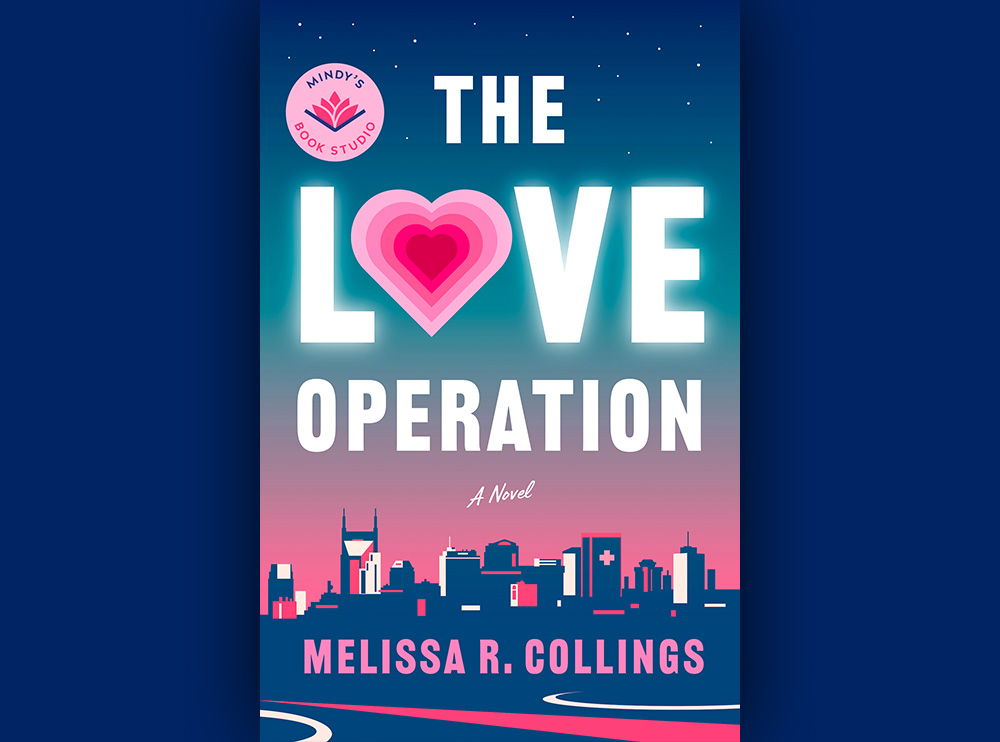
A brilliant spine surgeon gains the power to perfectly recall her past―only to discover that some memories are better left undisturbed. A witty, emotional story about the intersection of medicine, memory, and the messy reality of loving imperfectly.
Intrigued? Read on to discover the synopsis and an excerpt from The Love Operation by Melissa R. Collings, which releases on November 1st 2026.
Dr. Cordelia Wren has always been in control―of her surgical career, her emotions, and especially her memories. But when she joins a cutting-edge memory enhancement study at her hospital, she gains an unexpected ability: the power to vividly relive any moment from her past. It seems like the perfect opportunity to analyze her failed relationships and finally understand why every man she’s ever loved has walked away.
There’s just one problem. Actually, three:
- She may have…borrowed…access to the highly restricted memory study.
- She’s secretly dating the hospital’s new COO while competing for chief of surgery―a relationship that could destroy both their careers if discovered.
- Her first love has just reappeared in her life, stirring up feelings she thought she’d buried.
As Cordelia dives deeper into her past, the lines between memory and reality begin to blur. The truth she uncovers forces her to question everything she thought she knew about love, ambition, and what it means to be “in control.”
With her career hanging in the balance and her heart pulled in two directions, Cordelia must decide: Should she trust the memories that have shaped her life, or finally let go of the past to embrace an uncertain future?
Perfect for fans of Emily Henry and Ali Hazelwood, The Love Operation is a witty, emotional story about the intersection of medicine, memory, and the messy reality of loving imperfectly.
EXCERPT
From Chapter 5 TIME TRAVEL FOR ONE, PLEASE
“I feel like Bruce Banner about to meet his alter ego,” I say, only halfway joking.
A chill races across my skin. I shake it off.
The hospital is a different place at night—emptier, stretched thin, like the walls have loosened their grip on reality. Footsteps echo too long. Shadows stretch too far. The air has a different hum. The after-hours atmosphere verges on creepy.
The lab is dim, lit by work lamps and the glow of the large screen opposite us, where my lesson, the procedure I am to memorize, will soon be displayed.
Delenn dots conductive gel to my scalp, and I inhale at the sudden shock of cool and wet that becomes tacky and mildly unsettling as she presses the electrodes over it. The attached wires brush against my skin like mutant spider legs.
“I hope you’re planning to step away once you apply the electricity, in case I turn into a monster or go berserk.”
A flicker of a smile tugs at Delenn’s lips, but her focus is laser sharp. She’s half with me, half with the machine. I watch the slight crease between her brows, the measured way she checks each electrode, her gaze darting over the setup like she’s triple-checking what she’s already triple-checked, and I think, This is why we’re friends. We ride the same wavelength—driven, ambitious, wired to keep pushing forward. I trust her completely.
Still, a thread of nerves gets tangled beneath my excitement, and doubt wants to scuttle around the forming knots. Electricity will soon be applied to my head, changing things in my brain. What if it changes too much? What if this doesn’t go as planned? Lately nothing has, and this almost feels like tempting fate.
At least I’m not thinking about Isaac. Not about the fact that I haven’t heard from him all day. Not about this morning. That moment.
At least there’s that.
My mind is eased by knowing I’m not the first to have this procedure done. Three other people have gone through it earlier today. The study is officially underway, and even after the first session, it’s promising. Delenn sent me ecstatic messages all day. She couldn’t wait for me to try it.
“So, why do you think the results varied from person to person?” I ask, wanting to hear again that they’re all okay, even though I’ve analyzed all the prestudy data. It’s not like these therapies are novel—it’s only the combination that’s new. I have no reason to be concerned, but I do want to be thorough and cautious, as much as I can be in this scenario.
“It’s not surprising,” she says. “Each person’s brain encodes and stores memory in different ways. There are structural differences—variability in hippocampal volume, synaptic density, neurochemical balances. But more than that, memory retrieval is deeply affected by emotional regulation, prior trauma, and even baseline sleep cycles. And then there’s the added complexity of neuroplasticity—people who’ve trained themselves to remember differently, or repress consistently, have literally rewired how their recall pathways function. The protocol for the study has stimulated heightened recall in everyone we’ve tested so far. Their memory is, as we hoped and hypothesized, better—much better. But the interpretation still happens through the lens of who they are. It’s not just data. It’s identity.”
This explanation takes a hammer to my lingering concerns, and I lean into the anticipation.
“You swallowed all the pills?” Delenn asks, tapping a pen against her clipboard, but it’s not really a question. She watched me do it.
“A half an hour ago,” I say.
She spins away. “Good. I’m going to turn on the diffuser.”
A switch flips, and instantly a thin vapor unfurls from the top of the machine, curling into the air like the first breath of an active volcano.
My heart rate increases. It’s like I’ve just taken a breath of fresh air, but it’s clear, beautiful air, away-from-technology, mountainous air. My mind feels clear and focused—no noise, just sharp clarity.
“I think the med cocktail’s kicking in,” I say, scanning the room as if I’ve just walked into it.
Her eyes go wide and bright. “Yeah? What are you feeling?”
I stretch my hands in front of me, fingers flexing like I could actually hold the sensation in my palms. “More.”
She nods, as if she already understands.
“It’s like . . . paths have opened in my mind that were closed before, that I never even knew existed. I feel like I can breathe better. Like my whole body is processing information faster. Everything’s sharper.”
Her smile grows wider. “Good. Good.”
Something in her eagerness makes me shift. I don’t like feeling like an experiment, but I remind myself—again—to trust this. I trust Delenn. And I want what this can give me—an edge.
“Let’s start the electrical stimulation then. You ready?”
As much as the wires will allow, I shift in the chair and give her a confident “Yes. Absolutely.”
Then, before she even applies the current, something in me opens. My thoughts go clear.
“This drug combination is incredible.”
“It is, isn’t it?” she says, her eyes gleaming as she moves to the machine that controls the current. “It’s only two milliamps,” she explains, gesturing to the control panel. “You should feel a mild tingle, maybe a little warmth. I’ll turn the screen on first.”
She’s in coordinator mode because I already know this. Honestly, I feel confident I could run this experiment without her. “Great. Let’s do it.” I’m ready now. No turning back. It’s time to fully surrender—to receive everything this can offer.
Delenn squares her shoulders like she’s stepping onto a stage. With a click of her remote, the screen lights up, displaying the surgical technique for Chiari malformation type 1, a brain abnormality where the lower part of the brain extends into the spinal canal, where it shouldn’t be.
It’s not a procedure I’d normally perform—it belongs to neurosurgery, not orthopedic spine—but that’s why it’s perfect for testing memory retention outside my typical wheelhouse.
Delenn exhales. “Here we go.” She turns the dial.
A slow warmth blooms across my scalp—like static building before a shock.
“Whoa,” I breathe, because it’s the only word that makes it past the sensation.
Delenn leans in, her pen poised, eyes locked on mine. “What are you feeling? Tell me everything.”
But for a moment, I can’t speak. Everything is too much.
My body tenses, muscles buzzing with unfamiliar energy. The room is suddenly too bright, even though I know the light hasn’t changed. A faint, high-pitched hum rings in my ears.
And then—blueberry pie.
The scent floods my senses, rich and warm, like a memory spilled from another room in my brain. I blink. “Did you put blueberries in the diffuser?”
Delenn frowns. “No. Why?”

I open my mouth to explain, but then—it’s gone. The overstimulation recedes like a wave pulling back from shore, leaving behind perfect stillness. Unshaken clarity.
I exhale, my pulse steadying. I want to bottle this state of mind, keep it forever. But instead, I try to describe it. “I feel . . . open,” I say. “Like everything I take in right now will become part of me. Like I’ve been operating at half capacity, and now my brain is hungry and wants more.”
She looks pleased. “Great. And physically?”
I scan my body. Different. “My senses are heightened. It’s like I can feel the hairs coming out of my skin.”
She skims my forearm with the tip of her pen, and I inhale sharply.
“Okay.” She grins, and I can practically feel the excitement radiating from her skin. “Let’s review the procedure. Read it aloud.”
I zero in on the screen. The words are crisp, immediate.
Most frequent approach: suboccipital craniotomy, usually combined with dural patch grafting and cervical laminectomy of C1 through C2 or C3.
Patient position: prone on chest rolls, head in Mayfield.
Flex neck to open interspace between occiput and posterior arch of C1.
Shoulders retracted inferiorly with tape.
Midline incision . . .
As I speak, it’s like the words aren’t just being read, they’re stamped onto my brain, locked in place. Not just reviewed, but etched.
When I finish, Delenn clicks her pen. “Do you feel like you need to read it again?”
I shake my head. “No. Turn it off.” My lips curl into a grin. “Test me.”
“Cord, that was too fast. There’s no way—”
“Test me.” I feel giddy, restless, completely unmoored by the implications of this. I just absorbed a complex surgical procedure in a fraction of the time it would have taken me without these wires attached to my head and this medication in my bloodstream.
Delenn hesitates, then shuts off the screen. She grabs the physical copy of the procedure, flipping it open. “Okay. Walk me through how you’d operate on someone with Chiari malformation.”
I open my mouth and begin thinking of the first words I saw on screen, but then—
My body locks up.
I . . . I can’t believe it. I can barely process it. My heartbeats tumble over one another as I feel suddenly weightless, unattached from the present. It’s as if I’ve slipped through a crack in reality.
The scene in front of me shifts, and it’s like I’m watching a movie of the past several minutes from the inside.
Delenn paces. Not now, but before, as she did moments ago. She rubs her temple. Drops her pen. Bends to pick it up.
I see myself reading the screen. Except I’m not just remembering what happened or even watching a memory—I’m in it.
THE LOVE OPERATION by Melissa R. Collings, Text copyright © 2026 by Melissa R. Collings, Published by Mindy’s Book Studio