


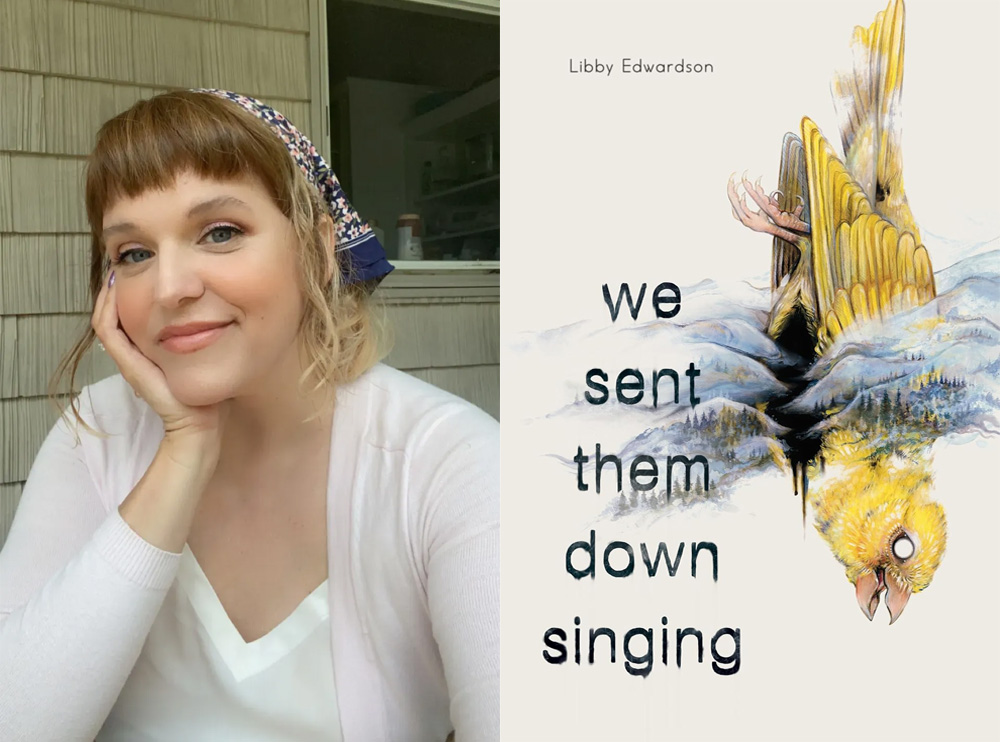
We chat with author Libby Edwardson about We Sent Them Down Singing, which blends Appalachian gothic with visceral body horror to turn the systemic “poisoning” of Appalachia into a literal monster that consumes a small-town community from the inside out.
Hi, Libby! Can you tell our readers a bit about yourself?
I’ve called a lot of places home (Washington, Iowa, Australia, Ireland, NYC, Tennessee) but now I live in a sleepy seaside village in Maine. I was a librarian for 15 years before I wrote my first novel, and without question my favorite job was driving a bookmobile through the hills and hollers of Eastern Kentucky. When I’m not writing, I spend a lot of time painting tiny portraits of ghosts, sculpting creepy-cute dolls, and sitting by the sea.
When did you first discover your love for writing and stories?
When I was in 5th grade, I told my teacher Mrs. Guffy that I was going to write a book. 40 years later, I did! I grew up in a small Midwestern town in the 80s, so I was a latchkey kid. I spent most of my free time in the public library reading any book I could get my hands on.
Quick lightning round! Tell us:
- The first book you ever remember reading:
- Charlotte’s Web by E.B. White (which is ironic as I now live in the town the fair in the book was set in!)
- The one that made you want to become an author:
- Never Let Me Go by Kazuo Ishiguro
- The one that you can’t stop thinking about:
- Earthlings by Sayaka Murata
Your debut novel, We Sent Them Down Singing, is out now! If you could only describe it in five words, what would they be?
Family search take monstrous turn.
What can readers expect?
We Sent Them Down Singing is a cosmic horror novel that pushes back against the harmful tropes about Appalachia. Readers won’t find any inbred, toothless hillbillies (who are probably cannibals) waiting for someone to turn up the wrong holler. The horror is instead rooted in how ancient the Appalachian Mountains are, the greed of the industries that have ravaged the land and its people, and what you might unearth if you dig too deep into hills that old. At its heart, We Sent Them Down Singing is a story about family—the people we come from, the people we choose, and the people we refuse to let go of no matter how hard we have to fight.
Expect characters you will be rooting for, primordial monsters, and so much body horror.
Where did the inspiration for We Sent Them Down Singing come from?
I lived in Appalachia for nearly 15 years and raised my family there. We had to leave under some pretty stressful circumstances. I wrote this book because I needed to reckon with the things our family went through at the end, but it was also out of frustration with the stereotypes the media relies on when setting stories in Appalachia. Especially horror stories. I wanted to write a story that reflected the people and place I knew—bright and full of heart and impossibly complex.
The actual spark for the story came from listening to the podcast Start With This by Joseph Fink and Jeffrey Cranor. Each episode ends with two assignments—something to consume and something to create. The create assignment had us use a random number generator on three lists:
- Most Populated US Cities
- World’s 50 Best Foods
- 100 Greatest Bluegrass Songs
I got Mesa, Arizona, fish and chips, and Steam Powered Aereoplane by John Hartford. I started writing and didn’t stop until I had a full length novel.
Were there any moments or characters you really enjoyed writing or exploring?
Andy Dafoe is probably the character that was the most fun to write. Andy is not a good person. He is morally grey, deeply flawed, and willing to go to really dark places to protect someone he loves. But, in the end, I really identified with his choices. If I was put in the same position as him and given the same choices, I’m not sure I’d be considered a good person, either.
Did you face any challenges whilst writing? How did you overcome them?
Oh lordy, yes. I was lucky because I had a wonderful community of writers who gave me really helpful critique, phenomenal feedback, and who I could brainstorm with whenever I got stuck. I think surrounding yourself with fellow authors is the very best advice I have to give anyone considering writing a book. My name is on the cover, but I know how many people it took for it to be there.
This is your debut novel! What was the road to becoming a published author like for you?
I worked in public libraries for most of my career, but my last job was as a high school librarian. When my position was eliminated due to budgeting constraints, I decided it was finally time to write that novel I promised Mrs. Guffy.

I wrote, then edited, and then RE-edited the same 20,000 words for about a year. The game changer for me was finding a writing group for neurodivergent writers. I joined in March of 2024 and, by October, I had a full length manuscript. I started querying the following January of 2025 and signed with Page Street Publishing in February. If I hadn’t joined a community of writers I would probably still be editing those same 20,000 words.
What’s next for you?
I’m currently writing my second book. This one is set in Iowa, where I grew up. It takes place in a trailer park at the edge of a cornfield and follows the lives of three generations of Iowa women who find themselves pitted against a sinister force lurking deep within the rows of corn.
Lastly, what books are you looking forward to picking up? Any you’ve read so far this year that you’ve enjoyed?
I just started The Sea Hides Its Dead by Megan Bontrager and it is so much fun! I’ve also had The Buffalo Hunter Hunter by Stephen Graham Jones on my tbr since it came out and that will be my next read. A friend recommended This Thing Between Us by Gus Moreno and that one absolutely gutted me (it is also cosmic horror which is, obviously, my favorite!).