


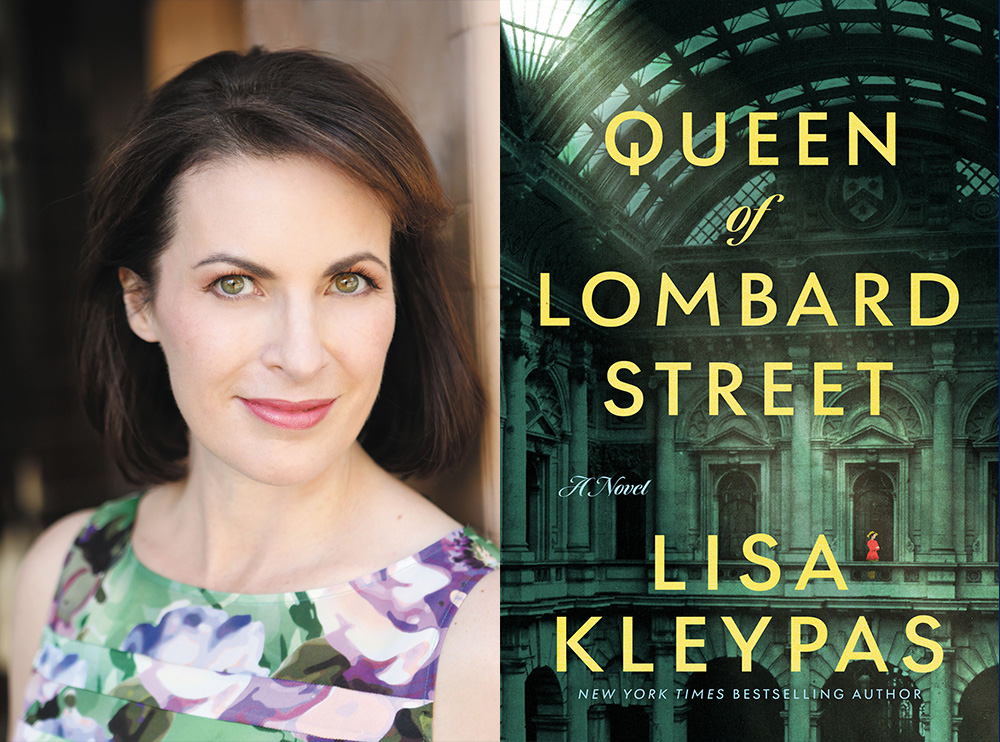
We chat with author Lisa Kleypas about Queen of Lombard Street, which is a sweeping, richly layered Victorian novel about a trailblazing female economist who’s determined to build Britain’s first women’s bank, but she must fight both financial corruption and a system intent on destroying the newly found family she’s created.
Hi, Lisa! Can you tell our readers a bit about yourself?
Hi there! I live in Palm Desert with my husband and two dogs, and I love cooking and gardening. My favorite hobby is miniature gardening: creating little worlds with houses, trees, tiny paved roads, etc. I’ve written romance novels for a long time, but after I realized I was getting burned out, I decided to challenge myself. So I wrote a historical fiction novel, which includes romance, but it’s a bigger story with higher stakes.
When did you first discover your love for writing and stories?
I was always a voracious reader, and whenever I particularly loved a novel, my mind wouldn’t let go of it. I kept imagining new situations for the characters and wondering how they would handle this or that. When I was twelve, I went to an overnight summer camp, and instead of using my stack of letter paper to write to my family, I wrote a little novel. I don’t know why I found such visceral satisfaction in it, but that feeling has never really left me.
Quick lightning round! Tell us:
- The first book you ever remember reading: The Practical Princess by Jay Williams
- The one that made you want to become an author: Little Women
- The one that you can’t stop thinking about: also Little Women! I grew up pretty close to Louisa May Alcott’s Orchard House, and visited there often, and that book was everything to me. I think it’s resonated through my entire career. The interactions between the sisters, Jo March’s struggles, the question of independence vs. love (You could have had it all, Jo! Laurie would have supported your career!).
Your latest novel, Queen of Lombard Street, is out October 20th! If you could only describe it in five words, what would they be?
Funny…enraging…swoony…heartbreaking…joyful
What can readers expect?
It’s a novel about outsiders, helping each other to get ahead, and becoming a family in the process. The heroine, Reina Martin, is a female economist and financial genius, who wants to start England’s first all-women’s bank. She has a household staff of paroled prisoners, all trying to make a new start. But one of them, the enigmatic butler, turns out to be an undercover detective, whose investigation may destroy Reina’s dream.
Where did the inspiration for Queen of Lombard Street come from?
The inspiration came from researching incredible and dynamic professional women of Victorian London, whose achievements were mostly ignored by historians. I realized whenever I’d read a historical novel about a successful woman, it was always “an extraordinary woman ahead of her time.” As if a successful woman back then had to be “not like all the others.” So I wanted to write a story about an amazing woman who was very much of her time—and include a lot of information about other women like her.
Were there any moments or characters you really enjoyed writing or exploring?
I loved discovering all the creative and daring ways women managed to get past the incredible mass of obstacles that were meant to keep them quiet, dependent and housebound. But the most unexpected enjoyment came from writing all the scenes of the paroled prisoners together. I didn’t expect them to be so funny—I mean, they each come from such terrible backgrounds, and a couple of them are genuine dangers to society. But I gave them all the freedom to do or say whatever they wanted, and I think there’s a lot of natural comedy when you put people together in totally unfamiliar circumstances.

Did you face any challenges whilst writing? How did you overcome them?
I was so accustomed to genre writing that it was scary to set the familiar pattern aside. The restrictions of genre writing are what make it great—they force you to be creative within boundaries. But when I removed the boundaries and started venturing in new story directions, I couldn’t stop worrying about people’s eventual reactions. Then my daughter advised me, “Just write it for yourself. As if no one else is ever going to read it.” And that gave me the freedom I needed. I stuck a note to the wall above my desk “This book is for me” which unlocked me whenever I got paralyzed.
What’s next for you?
I’m working on a novel about a college student who’s looking after the matriarch of a Boston Brahmin family, who has congestive heart disease. They start looking into the 1918 death of an heiress who lived in the family mansion, as well as the mysterious disappearance of the heiress’s portrait. It’s a duel timeline novel, so we go into the stories of both these young women—the college student and the heiress. There’s romance in both timelines, of course!
Lastly, what books are you looking forward to picking up? Any you’ve read so far this year that you’ve enjoyed?
Looking forward to The Gilded Rose by Joanna Shupe! And I’ve read The Calamity Club by Kathryn Stockett and LOVED it.