


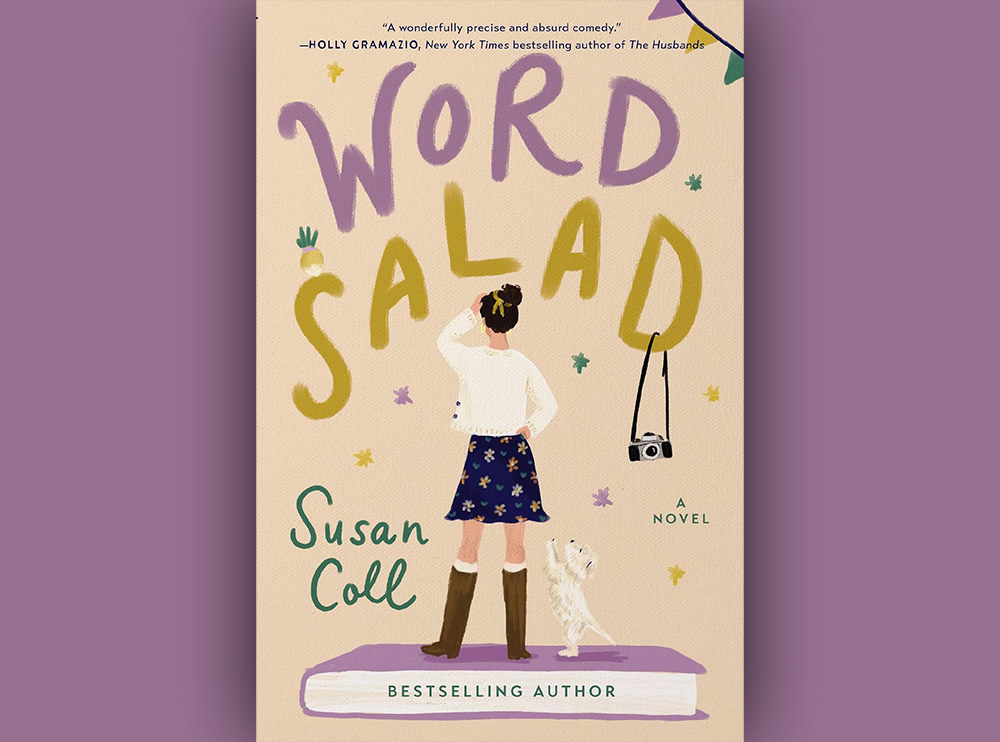
Matilda loves logic and order, and now her structured world is falling apart—in a bookstore. Bestselling author Susan Coll’s gastric, bookish, laugh-out-loud comedy of manners reminds us that sometimes things have to completely fall apart for them to perfectly come together.
Intrigued? Read on to discover the synopsis and an excerpt from Word Salad by Susan Coll, which releases on September 15th 2026.
Former economics major Matilda is moving back to her hometown of Washington D.C. to care for her ailing mother, and she’s desperate for money. She takes a job at her neighborhood bookstore and tries, in vain, to make sense of illogical business of books. To make things worse, she’s forced to team up with a new hire—the enigmatic, flaky, larger-than-life, Sage—who shows up on her first day of work with zero administrative skills and her tiny, puffy, incessantly urinating dog that resembles an underfed rat.
Something in the chaos begins to remind Matilda of her long-neglected creative side, and she starts to rediscover the person she once was before so much got in the way. But things get even more unmanageable when Matilda and Sage are tasked with putting together an event for the reclusive and controversial Dr. Jordan Rutabaga, a windbag of a public intellectual with a cult following that includes a number of people who would like to literally and figuratively see him dead. Rutabaga has a long list of alleged misdeeds, from plagiarism to failure to pay child support to stiffing the nanny.
As the event date approaches, Matilda and Sage discover that Sage and Rutabaga have their own not uncomplicated past, adding yet another person to list of people who do not wish him well. Add in a lawsuit and an impending snowstorm along with the potentially sinister presence of Rutabaga himself, and Matilda is about to come undone.
EXCERPT
I see colors. Letters and numbers, sounds sometimes too.
You say “four,” and there it is in International Klein Blue, hovering just over your left shoulder. The letter O is a rich carbon grey. The fire alarm shrieks in a downward spiral of canary yellow. There is nothing remarkable about this, in my opinion, although I have learned that others find it odd.
Another thing about me: I have a reasonably good sense of how things will unfold. To be clear, I am not clairvoyant, nor do I experience premonitions or any nonsense like that.
Being a logical, detail- oriented, data- driven, and observant person, I tend to see outcomes in an architectural way. Poor design of a foundation causes walls to crack and, over time, the building to fail.
Sage would prove to be the poor foundation, I suppose.
Looking at it through a certain lens, I was arguably the wall.
I had been working at the bookstore for some eighteen months, somewhat frozen in place, when Sage came into my office that first day, a whirlwind of chaos and distraction who brought with her multiple tote bags full of too much stuff. Her mere presence threw off my rhythms, knocked me out of my finely tuned stasis, triggering every one of my senses with her too- bright puffer coat, which made me think of the orange blaze a hunter might wear so as not to be mistaken for a deer.
To be fair, I was predisposed to dislike, or at least to be on guard about, Sage. She had been hired to assist me, yet I had not been consulted about whether she was a good fit. Usually I am brought into conversations about things that affect my workload, but Sage was an exception because her sister was a friend of Mrs. Bernstein, the owner of the bookstore. Our workplace is a fermentation vat of gossip that manages to find its way into the ear of even a person who keeps largely to herself, and I quickly learned that Sage was in the middle of a thermonuclear divorce. Now that her kid had gone off to college, she needed something to do. It didn’t have to be a job, per se, but something that could give her life meaning, a place to go each day.
From our preliminary conversation on the phone a few days earlier, I had sensed that hiring her was a mistake. It seemed clear that Sage did not possess even a trace amount of skill that might enable her to lighten my load. The job isn’t rocket science, but it does require a modicum of basic administrative ability along the lines of responding to emails, creating spreadsheets, and updating the store’s website with the extremely fluid details of our daily author events, as well as entering data on our internal calendars and monitoring the inventory systems and ordering requirements.
There are physical aspects of the job too. Carrying heavy boxes of books, moving shelves out of the way to create space on the sales floor, setting up chairs so event attendees can sit, if they so choose, along with other various and unpredictable tasks.
I do not wish to sound ageist, especially since I, Matilda, have been told that I, myself, am an old soul. But Sage was, I guessed, in her late forties and had apparently been out of the workforce since having her kid. That didn’t necessarily mean she would be without the skills this job requires. But as it happened, she was.
Sage was practically computer illiterate, she had informed me cheerfully, as if this was a good thing. She had never used a spreadsheet, and while she said she was pretty sure she could figure it out herself, her now- off- at- college daughter usually helped her with techy things.
My sense of foreboding about working with her was intensified on that very first day when she walked through the door, flung that aggressively orange coat on the fraying wicker chair in the corner, and set down so many bags full of who- knows- what that I feared she was moving in. Then, without asking who belonged where, she plopped herself down in my chair.

I was determined to be my best self, to not start things off on the wrong foot by being bossy— a word I have heard my colleagues use to describe me on more than one occasion, usually owing to their failure to realize that (1) I was within earshot and (2) I was in a weird headspace, mired in a complicated grief, and certainly did not intend to be gruff.
Hence, instead of pointing out to Sage that her coat belonged in the staff break room, or that she was swiveling about in my chair, I took a deep breath. I would be cheerful and easygoing. I would put an exclamation point at the end of each sentence. I would even begin with a compliment— or at least an attempt at one.
“That coat!” I said, puzzling about how to best frame, in a constructive manner, the rest of my many thoughts about the absurd item of clothing, which seemed better suited for skijoring with reindeer than going to work in an independent, community- minded bookstore with piped- in heat. It was thicker than a bag of marshmallows, and I couldn’t help but wonder how many ducks and geese had been painfully plucked in pursuit of keeping Sage warm.
“I know! Isn’t it gorgeous? It just arrived yesterday,” she explained.
I paused to take her in. Plopped casually and comfortably in my chair, dressed in what one might imagine to be indie bookstore chic— a brown corduroy skirt, a bright white Irish fisherman’s sweater, tall suede boots crossed at the ankle— she had what appeared to be an easy, natural beauty, but I could also tell she had been working to self- improve.
Her teeth, for example, looked a little too white, and her light brown hair seemed to have been brightened or possibly streaked. It occurred to me that in a run- up to her return to the workforce, Sage might have launched an all- out self improvement campaign, engaged a stylist or two, and gone coat- shopping, teeth- whitening, and hair- dyeing. This was a little sad, given that Sage would spend most of her time in this job ensconced here, in a windowless office in the back of the bookstore, with me.
I found myself staring up at James Joyce, who was looking back at me from inside the framed poster of Ulysses that hung in the office. The poster depicted what was evidently a new book jacket meant to commemorate the one hundredth anniversary of the novel. I had grown quite attached to this poster. The whimsical rendering of Mr. Joyce’s face, with its feast of refracted colors, nourished me in a way that is difficult to explain and that has absolutely nothing to do with the novel Ulysses. To be clear, although I am not bookaverse and have, in fact, read many, many books, I am not what you might call bookish. To please my mother, I majored in economics and was even accepted into an MBA program, from which I deferred when I moved back home after my mother’s cancer recurred.
My friend Clemi told me about a job opening in the store where she once worked. I applied, and here I am.
So I do not mean to suggest that James Joyce, in his soothing, hunter- green tweed number, was speaking to me in some literary bonding- of- souls sort of way. Yet we did seem to be of one mind about Sage: me, already prickly, feeling squirmy and trapped by her presence; and Mr. Joyce, staring out from inside the safety of a plexiglass frame, regarding Sage warily through his monocled eye.