

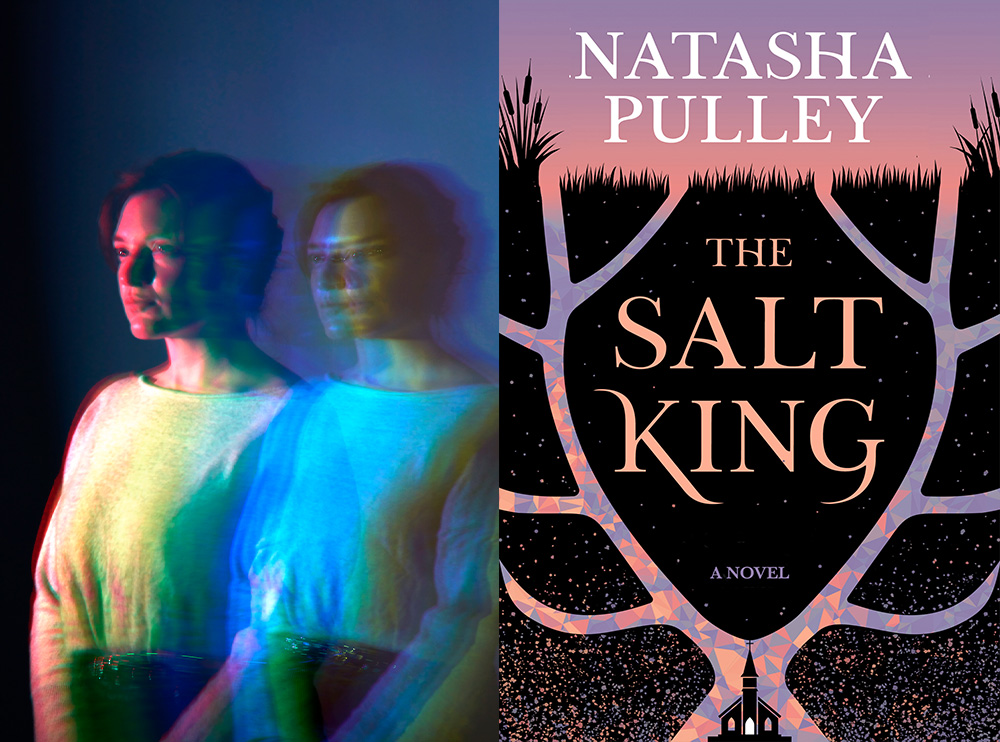
We chat with author Natasha Pulley about The Salt King, which is an apocalyptic novel about belief, religion, and the power of myth that blends the gripping, end-of-the-world storytelling of The Passage with the biting wit and epic queer romance that makes Natasha Pulley’s books “delightful” (The Washington Post).
Hi, Natasha! Can you tell our readers a bit about yourself?
Hello! I’m a British writer based in Bristol in the UK. I teach Creative Writing at Bath Spa University and Cambridge University, but sometimes I escape and have very ill-advised adventures where I get seasick or slightly annoy Chinese police officers.
When did you first discover your love for writing and stories?
I’ve written for as long as I can remember being able to write. I think I started writing Star Trek stories when I was about six!
Quick lightning round! Tell us:
- The first book you ever remember reading: It’s an awesome picture book called Yendor by Rodney Matthews. The art is brilliantly weird and the ideas in it, not to mention the general forest-grunge aesthetic, still influence me today. It’s just about a little boy who goes off and has an adventure unbeknownst to his parents, back by tea time, but honestly, I still find it captivating.
- The one that made you want to become an author: I actually didn’t know ‘author’ was a job for ages; I didn’t think it was possible to make a living doing it until I was in my twenties. When I did, it was really through talking to friends who also like to write, so it was a slow process. I think in Small Natasha’s brain, books just sort of appeared, like photons. I was always interested in stories, but never in the writers — I used to be annoyed if the author picture was featured too prominently on the back cover: it breaks the fourth wall! So of course, I didn’t have any time for hearing anyone’s ‘journey to publication’ story. Author and story were very firmly separate in my mind. Stories were interesting: authors were absolutely not.
- The one that you can’t stop thinking about: Fool’s Errand, by Robin Hobb. I read it as a teenager and it was the first time I realized that a story — especially a fantasy story – didn’t always have to be ‘Girl meets guy and they fall automatically in love because somehow all men are compatible with all women, and everything is awesome’, a structure which I’d always felt terribly alienated by. It’s a fantasy book, but a lot like Game of Thrones, it’s not so much about magic as it is about very messy, intense, complicated character relationships, set against the backdrop of a world like ours but eerily not, too.
Your latest novel, The Salt King, is out now! If you could only describe it in five words, what would they be?
Love and faith clash apocalyptically.
What can readers expect?
The story follows a young Jesuit priest called Avelyn. He’s sent to an isolated monastery in England by the Vatican to investigate what seems to be a miracle: a man in a wheelchair there was cured, but then turned to salt. The monastery is inside a salt mine, where the locals believe a god called the Salt King sleeps…and might now be waking up. Before very long, Avelyn is torn between his faith and the monastery’s lovely but mysterious doctor, Jericho, who seems to know a lot more than he’s saying.
Where did the inspiration for The Salt King come from?
I think it’s misleading to talk about ‘inspiration’ as if it’s one thing. If you bumble through life running after interesting things and collecting as many odd experiences as you can, you can usually shape them into something novel-ish eventually. The Salt King is made of thousands of different things. I know it did evolve out of a completely different story about a small church in Yorkshire I started writing during the pandemic, but I can’t trace how or why.
Were there any moments or characters you really enjoyed writing or exploring?
I really enjoyed writing Avelyn’s thoughts about his old, pagan beliefs, versus Catholic dogma; faith is something I think I could probably spend my whole life writing about. It’s so beautiful and so punishing!

Did you face any challenges whilst writing? How did you overcome them?
The huge challenge for me was that I’m completely god-blind. I don’t have any faith of any kind, and I’ve never experienced anything that I could honestly attribute to anything supernatural or divine. I had to interview quite a few people before I could get my fingernails over what they were describing. The big difficulty is that when someone does experience faith, they often struggle to explain what it’s like, just like native English speakers are usually awful at explaining or even noticing English grammar (why is ‘the blue big ball’ wrong? Why can you have ‘hot pink’ and ‘red hot’ but not ‘hot red’?). The most common reaction of people with some kind of faith was disbelief in my disbelief: it was hard to communicate that I honestly can’t feel what they perceive to be God and likewise, it took me a long time to understand that they are genuinely feeling something I’m not. It usually takes a good twenty minutes to convince someone I’m not pretending or stupid. But you overcome that with more talking. It’s so much fun, and so satisfying, to have a proper conversation with someone who thinks in such a fundamentally different way to you, where you both come away going, ‘OH, so that’s what that means!’
What’s next for you?
I’m not quite sure yet — I have some fun ideas brewing, but I don’t want to hex it!
Lastly, what books are you looking forward to picking up? Any you’ve read so far this year that you’ve enjoyed?
I just finished a brilliant novel called Father Alberto and the Flying Girl by Timothy X Atack – it’s set in a medieval convent dedicated to the housing of lunatics, including an evil horse called Zanzibar, and I loved it. I’m really looking forward to From The Library of Jurgen Leitner by Premee Mohamed and Jonathan Sims; I love the Magnus Archives and the novel is set in that world, so I can’t wait.