


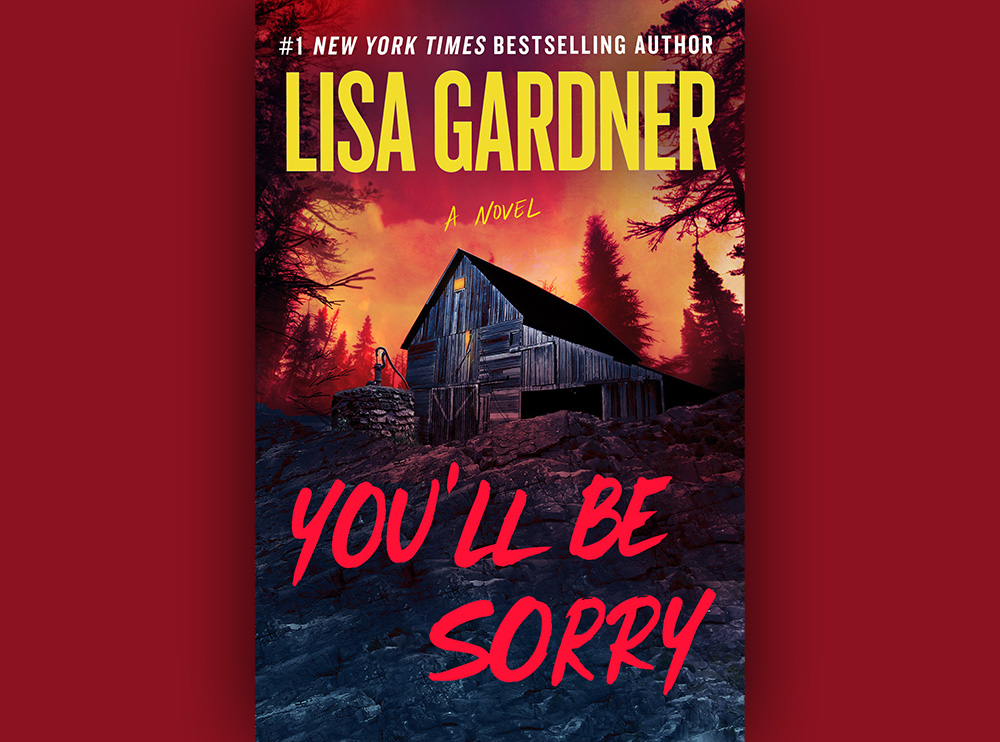
A newlywed couple each with their own secrets. An abandoned lodge with a horrific decades-old mystery. And a small mountain town where everyone believes they know their neighbors, in this thriller from a master storyteller.
Intrigued? Read on to discover the synopsis and an excerpt from You’ll Be Sorry by Lisa Gardner, which releases on August 4th 2026.
For Raquel and Theo Collins, it appeared to be love at first sight. Raquel, a renowned interior designer, and Theo, a brash financial wizard met and married in a matter of months, only to confront a terrible tragedy. Now, unbearably aware of the distance between them, they’ve come to a remote town in New Hampshire to begin anew.
Perched on a ledge with stunning views, the Dixon’s family lodge was once a crown jewel of the mountains. Until late one August night, when both parents and their four children vanished, leaving behind a trail of bloody footprints, and a mystery that has endured for thirty years. Now, its latest occupants, the Collinses, are arriving, and the former grand lodge is once more stirring to life.
For Amanda Grady, following in her father’s footsteps as the recently appointed Shereford police chief, it’s good to see a fresh start for the derelict Dixon place. However, not everyone is happy about a new family in the old home and its hidden past may have returned with a vengeance.
When a stray dog leads to the discovery of a skeleton on the property, Raquel and Theo face a daunting choice of what to believe, who to trust, and how to survive. Because in the tiny village of Shereford the time has come. The local residents, the new neighbors, and the fledgling police chief must work together to unravel the terrifying events that happened one night thirty years ago, or …
You’ll be sorry.
EXCERPT
“I made you a sandwich,” Betty greeted her at the door.
“I’m fine,” Mandy replied out of habit.
“Don’t be stupid.”
That was harder to refute. Mandy stepped inside, accepted the
sandwich. Which involved slow- roasted turkey, homemade stuffing, and cranberry sauce, though Betty had been out all day, same as Mandy. Sometimes she couldn’t decide if such offerings were a gift or a rebuke. Because God knows the best Mandy could do for sustenance after such a grueling experience was corn flakes. Fine, Cap’n Crunch.
Sandwiches, at least, didn’t rate full dining room regalia. Mandy
was allowed to carry the late- night offering to the sofa, where Betty had both a cup of steaming tea and two fingers of whiskey sitting on a side table. Tough day for both of them.
“You’re spiraling,” Betty stated.
“You are too.” Mandy nodded toward the older woman’s beverages.
“My word,” Betty sighed. “I never thought, never anticipated… This was a day for the ages.”
“On that we agree.”
“You have questions.”
“More than I assume you have answers.”
“On that we agree.”
Mandy took a bite of sandwich. Damn, it was good. And, man, was she starving. Funny the things you could overlook until they all but slapped you in the face. Is this what her mother had done for her father? Greeted him with food and sympathy, knowing she’d married a cop and this came with the job? Mandy had grown up with a lawman father, and sometimes the sheer resentment over missed meals, events, promises had gnawed on her like a rat. Her parents, best she could tell, had had a solid marriage. The resentment had belonged to Mandy and Mandy alone, which had only alienated her more as she grew up.
With age came regret, which was mostly useless, so Mandy tried to focus on understanding instead.
“My father would disappear into his study after hard days. Kiss my mother on the cheek, pat me on top of the head, then grab his food and retreat behind closed doors. I always assumed he was going back to work, maybe writing down his thoughts while they were still fresh in his head. Now I wonder if it wasn’t so he could collapse out of sight of prying eyes.”
“Probably a bit of both.”
“What do we know?” Mandy mused. “I’ve been trying to break it down in my head. We can be pretty certain a young female was sealed into that well, alive long enough to try to force her way out. I’m leaning toward historic crime. Like early eighteenth century.”
“The register would support that. No entries after 1791.”
Mandy kept staring at her. That wasn’t the main reason behind her reasoning, and they both knew it.
At long last, Betty exhaled. She raised her glass of whiskey. “You’re wondering about the local legend. How much of it did we just uncover, turning folklore into fact?”
“So are you. And Mason. I heard you both whispering.”
“She appeared midwinter,” Betty recited softly. “Walking straight out of a blizzard without any coat or shoes, appearing before the townsfolk like a product of the storm itself. Jet-black hair, bloodred lips. A maid barely out of the classroom. She told them she’d lost her way in the woods. She begged for a cup of tea, a chunk of bread. The villagers felt sorry for her, a mere girl all alone in the world. They offered her a hot meal and warm shelter. Afterward, with no means to pay for her food and board, she announced she’d best move on.”
“The villagers begged her to stay,” Mandy provided. “The men staggered by her beauty, the women drawn to her tender years.”
“She agreed to work for her keep, tending the young, nursing the old. House by house.”
“But then the children started dying,” Mandy intoned. “House by house. First the older ones, then the younger ones, then the babies. House by house by house.”

“And the townspeople began to whisper.” Betty’s voice picked up. “Surely there must be a reason. Some great sin or terrible evil driving their punishment. A witch, stealing away the souls of their children.”
“A witch with jet-black hair and bloodred lips.”
“They rounded up the girl they’d allowed to live in their midst. They demanded she repent her evil ways. And when she refused—”
“Protested her innocence, more likely.”
“They dragged her to a frozen pond, where they hacked a hole in the ice and tied rocks around her waist. Let this be the test: A god- fearing woman would be saved.”
“Poor thing,” Mandy murmured.
“Staring into the icy abyss, the young woman swore one last time she was not a witch. And then she uttered a great and terrible curse. As they had accused her of, so it would be. They would lose a child every winter, to remind them of their treacherous ways.”
“A pretty safe curse, if you think about it,” Mandy interrupted. “In those days, I’m sure at least one child died every winter.”
“But according to the legend, she would appear with the snow and lure away an innocent into the woods never to be seen again. That’s fairly specific.”
“Nah. This whole place was woods. Is still mostly woods. And every winter, we still get a few locals and hikers who go missing. Nowadays, we’re just better at finding them.” Mandy set down her empty plate. “I always thought of it as little more than a local ghost story, something to titter about while sitting around a campfire. Or possibly be threatened with by an exasperated parent if you were a naughty kid. In fact, that might be how I first heard the tale. Of course, there’s also the childhood rhyme we recited on the playground. ‘Red witch, blue witch, black or white. One for love, one for fright. One will dance all night long. One will see you dead and gone. Night’s a- coming, she draws near. Wind’s a- howling, which one’s here!’ I never equated the rhyme with the story, though. It’s New England, after all. We have plenty of witch lore.”
Betty took another sip of her whiskey. “There’s another line to that song. From back in my day. The rhyme should begin: ‘Ding dong bell, the witch is in the well. Red witch, blue witch…’” She gave a little nod of her chin. “You know the rest.”
“The witch is in the well? Shit.” Despite herself, Mandy shivered. “I’d never heard that version, but given today’s developments…that seems rather prophetic.”
“Shoving a young girl into a frozen pond versus pushing her into an icy well,” Betty mused. “Those actions don’t feel so different.”
“Especially if you’re the girl.” Mandy had to sit back. “So what we found on the Dixon property— this proves there was a young woman accused of witchcraft, and what the town did to her?”
“Witch hysteria in the colonies peaked in the late seventeenth century,” Betty commented, “but allegations continued for hundreds more years. Especially against women perceived as threats. Possibly due to their beauty, but also power, say, a female business owner, or midwife who oversaw births and deaths.”
“Proving once and for all men have always been sore losers.”