


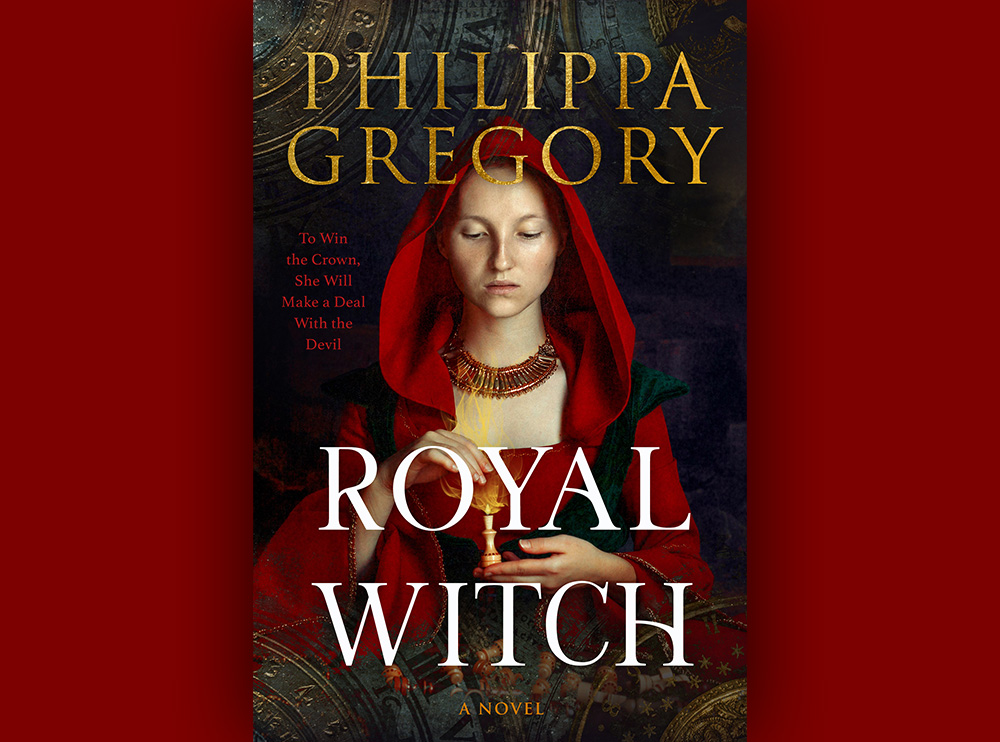
Royal Witch: the gripping new novel from the international bestselling author. Ambition. Sorcery. Treason. How far will one woman dare to go?
Intrigued? Read on to discover the synopsis and an excerpt from Royal Witch by Philippa Gregory, which releases on October 20th 2026.
1420. Eleanor Cobham arrives at the court of Henry V. Pretty but not highborn, she hopes for nothing more than to marry well.
It is a golden age for England, its royal family’s dynasty stretching across Europe. But chaos waits in the shadows. Betrayals and shifts of power change the flourishing world Eleanor has stepped into.
Working in the household of a Countess who commands her own army, Eleanor begins to see for the first time what a woman is capable of…what men’s promises are truly worth.
As the safe, comfortable future she’d envisioned begins to shift, Eleanor changes with it. Now she must use her wits to survive – and to rise. Her newfound ambition will to carry her further than any woman before has dared. But if she is to rule England itself, she will need to turn to darker arts..
EXCERPT
WINDSOR CASTLE, WINTER
1421
Queen Catherine goes into her confinement in November with a cartload of treasures and trappings and holy relics, including Our Lord’s circumcised foreskin, encased in a silver jewel. My lady visits her every day, so I have to go into the darkened rooms with her – though, as an unmarried woman and a mere baron’s daughter, I must wait at the door while the better-born married women sit in the shadowy room, whispering hopes and muttering blessings. The queen is not to be disturbed by any displeasing sights or sounds; she is to doze in a perfect womb herself, at peace, in silence, in darkened stillness. All she is allowed to do is eat, and the castle kitchens send up every sort of dainty feast to tempt her.
For weeks, she idles in stuff y darkness, until one morning I am startled awake by the pealing of the chapel bells, and I realise she has finally had her baby. The boom of twenty-one cannon tells me it is a boy, and my first thought is that at last, my lady can leave the queen’s rooms and muster support for her campaign, and I canemerge from this women’s world and be seen.
The baby is christened almost at once, in the royal chapel, but neither the king, nor his brother Humphrey, nor any men come home from France for the ceremony. The baby takes the name of Henry, and his two godfathers are the king’s uncle, Bishop Beaufort, and the king’s brother, Duke John. The only godmother is my lady, Jacqueline – a great honour.
My lady carries the baby to the font, holds him tenderly, and rocks him when he cries at the splash of holy water and holy oil on his tiny bared breast. They put salt in his mouth and blow in his ears; the priest dabs his spit on eyes, ears, nose, and mouth. I am quite disgusted by the little creature, naked like a pale-skinned rabbit. I cannot believe that this little figure, pale as a wax doll, could ever be a king – surely he will never grow to greatness. He looks as if he will not last the year.
Duke John takes him into his arms, holding him awkwardly, bachelor that he is. His big dark face is tender as he looks at his nephew; even though this child is displacing him as first heir to the throne, he looks at him with love. The baby howls, flushing scarlet in the face, and the rocker takes him and pats his back until, mercifully, the noise stops and he goes to sleep. We take him to the confinement room, and his mother holds out her arms, calling him her little angel – his soul saved by baptism.
He should be suckled by a wet nurse, rocked by a team of rockers, and governed by a head nurse with two assistants; but with the king far away in France and the queen’s mother in Paris, nobody has the authority to take the baby from his mother and bind up her breasts to stop the milk. Secretly, they defy the male traditions of separating mother and baby. The wet nurse leaves the queen to suckle her son and sleep with him in her great bed, as contented as a fat yellow cat in a basket with a solitary precious kitten, and Jacqueline writes to the king that mother and baby are doing well, and all is as it should be.
WINDSOR CASTLE, SPRING
1422
The spring is as dull as the autumn. There are no young noblemen in England – they are all setting siege to the city of Meaux with the king, and if they were here, they would hardly look at me as the queen rises up from childbed, doubly beautiful in her pride and happiness – a queen of proven fertility: dancing with her ladies and riding out in the frosty water-meadows by the river, or hunting in the park as the days get longer and the birds start to sing in the early dawns.
Jacqueline has been bombarding the Holy Father the pope with long learned letters, citing her unlawful affinity with her false husband, John of Brabant. Her mother – his own godmother – wrongly advised them to marry, and Jacqueline says that she separated from him as soon as she realised it was a false marriage between too close kin. She has confessed and done penance for the sin. She writes like a lawyer, fierce and clever, one logical step rising to another in a staircase of argument that reaches to the dizzy height of her conclusion: that she is not married now and never was.
It is a convincing argument, and I am not surprised that the pope replies from his palace in Avignon and agrees with her. Even though she is a runaway, a disobedient wife who has taken up arms against her husband, the pope declares her marriage was invalid, and she is free to make war against her false husband and even free to marry another man.
This would be a complete triumph but for the bad luck that there is a false pope in Rome, and he is supported by Jacqueline’s enemy, her cousin, Philip of Burgundy. Of course, he says nothing in her favour.
‘But the true pope says you can marry again?’
‘I just got rid of one bad husband,’ she says. ‘Why would I marry another?’
‘You got rid of a bad husband who took your lands,’ I remind her. ‘Now you should choose a good one to win them back for you.’
She laughs at me. ‘Ah, Nell,’ she says with affection. ‘Will you never see that I can win by myself, without a man?’

‘Ah, Jacqueline.’ I dare to use her given name, since she is smiling at me. ‘Will you never see that every woman has to have a husband to fight for her?’
‘A woman can hold her own lands and her own noble title,’ Jacqueline points out. ‘A woman can raise her own army and lead it into battle. A woman need not depend on a man. I’m not the only woman in the world who prefers to make my own future. I will never again put myself into the service of a husband.’
‘Everyone has to serve someone,’ I point out. ‘I serve you.’
‘I pay you, and you can leave me,’ she says. ‘Anything else is slavery.’
‘Marriage is not slavery!’ I exclaim. ‘It’s my only escape from my home at Sterborough.’
‘Why escape one servitude to go into another?’ she demands.
I do not need Jacqueline’s careless words to make me doubt my plan to win a noble husband with nothing more than my smile. I am disappointed in court life. It is nothing like the Romances. No one is going to catch sight of me, singing in a rose garden like Nicolette in the poem. There is more to getting a husband than simply being pretty. Someone must speak for me.
I ask for permission to visit my father.
‘Are you missing your home?’ Jacqueline asks me kindly. ‘I miss Le Quesnoy so much that even now, I dream of it, and I wake and don’t know where I am.’
‘Not really,’ I confess, ‘but I should visit my father, if you can spare me.’
‘I can survive a few days without you,’ she says cheerfully and takes me to her room and gives me a new gown with a new thick cape. She orders the royal guard to keep me safe from the injured soldiers on the highway and speeds me on my way with her blessing.