

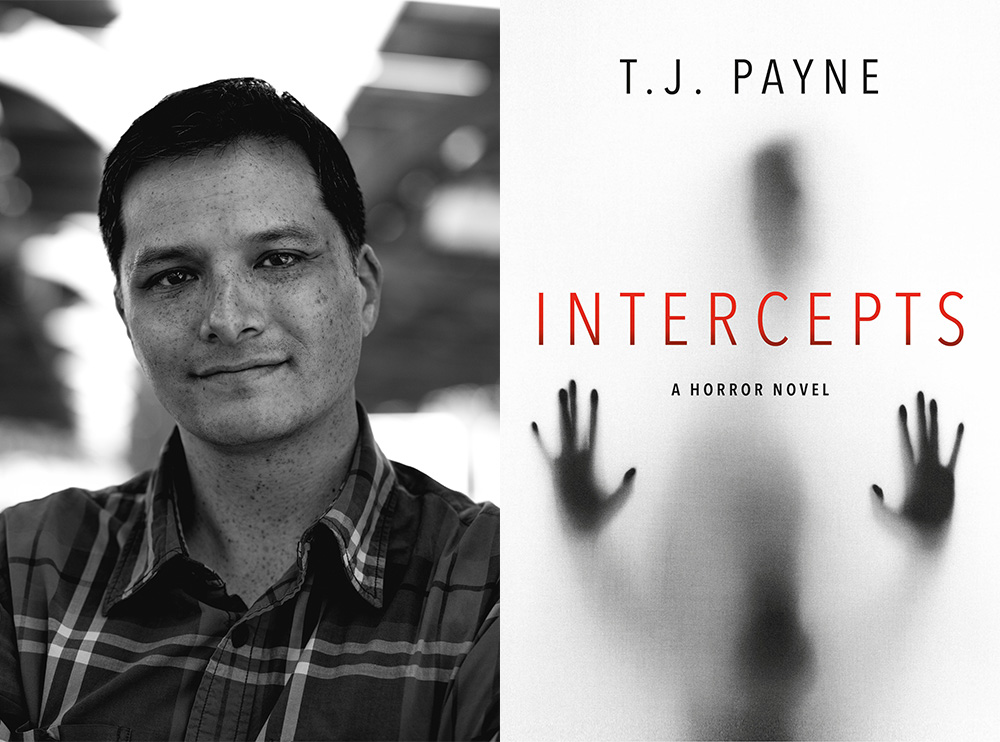
We chat with author T. J. Payne about Intercepts, which follows a supervisor at a top-secret government facility running experiments on human beings. He’s always been able to tell himself it’s for the greater good—until the day his work follows him home.
Your career began in screenwriting and in the romantic comedy world, what made you want to shift to writing darker stories in the horror and sci-fi space?
My interests were always in exploring the crueler sides of humanity, but horror as a genre made me too uncomfortable and so I started with lighter stories. But after I married my high-school sweetheart, the romcom formula just stopped resonating with me. Instead of “cute meets,” romance became about growing together and developing a shared history, but increased happiness in my life also brought about increased fears. That’s when I finally committed to writing horror—to express my anxieties about a nasty and depraved world.
How has your screenwriting background shaped your approach to fiction? Are there specific skills from film that proved especially useful when writing INTERCEPTS?
Romcoms taught me how to structure dynamic character relationships, and in that sense, learning to write within the wrong genre might have been the best mistake I ever made.
I base all my books around the exploration of relationships in one way or another, whether parent/child or old friends. I enjoyed writing romcoms because I do believe in love, and what I’ve discovered is that a foundation of love is the ingredient that makes good horror resonate with readers. In INTERCEPTS, that’s the relationship between Joe and his daughter.. If you strip away the genre elements from INTERCEPTS, what’s left is this emotional and relatable story of a man who chose work over family and is now having to learn to take responsibility as a father.
When you began self-publishing, you adopted a pen name, T.J. Payne, that your readers know you by. What was behind that choice, and how do you think writing under a different name has shaped your identity as an author?
It was a scary career turn, and so I wanted a fresh name to go with it, something that could live on its own and wouldn’t necessarily intersect with my screenwriting. My mom has always been my biggest supporter (she detests horror, but she still reads and gives feedback on everything I write), and I decided on her maiden name, Payne. What started as a somewhat impulsive choice has turned into a meaningful way to honor one side of my family and half of myself. As a multiethnic person, my personal identity has been a lifelong journey. I’m proud of my Japanese heritage and my legal last name “Hanada,” but I’m equally proud to be a Payne, which is the family through which I’m a Cherokee Nation citizen. Now I have two separate writing careers, one under each side of my family.
What was the self-publishing experience like for INTERCEPTS? At what point did you realize it was gaining traction in online communities, and did reader response shift your perspective on the book at all?
My first self-published book, IN MY FATHER’S BASEMENT, wasn’t a huge success by any means, but it did find an audience and the feedback it received, both positive and critical, helped shape INTERCEPTS. Its discovery has been completely grassroots, picking up fans along the way. I think that human element—the fact that it is based around a father and daughter relationship, despite all the sci-fi and horror components—is something that makes the gore and scares linger long past the final page.
Were there particular books, films, or shows that influenced the tone or themes within INTERCEPTS?
I grew up on the Christopher Pike and Lois Duncan YA horror/thrillers, and so that type of dark story, set among everyday people, grounded but sprinkled with bits of the fantastical or supernatural, influenced much of my worldview.
As far as films go, I’m someone who gets very uncomfortable during routine blood draws, and so I’ve always had visceral reactions to body horror. The movie THE FLY (1986) sticks in my mind as something I saw at way too young an age and it absolutely terrified me to the point where I wouldn’t even look at the VHS cover in Blockbuster. Those types of images—the human body disintegrating under man’s inability to wield the power of science—became deeply infused into the imagery of INTERCEPTS.
What sparked the idea for this novel and how did that initial concept evolve over the course of writing?
I knew I wanted to do something in the morally questionable world of government secrets, and so to push those concepts to their extremes, I came up with the idea of a facility where people are tortured until they can remote-view and “intercept” the senses of our enemies.

My first inclination was to base the story around one of those inmates using their powers to escape, and truthfully, that would have been the easiest direction because readers would automatically sympathize with such a character. But I didn’t respond to that idea much on a creative level. I wanted to explore deeper questions of morality and worried that the guards and doctors would come across as cartoonishly evil, and it would give readers an easy villain and therefore an easy escape from having to confront questions of morality. I believe that horrible acts aren’t committed by monsters but by humans, and that by humanizing our villains it allows us to see ourselves and our own flaws reflected.
INTERCEPTS is set in a powerful government surveillance facility, “The Company,” that is also bureaucratic and flawed, with characters “just following orders.” What were you most interested in exploring about institutional power through that lens?
“Just following orders” are three of the scariest words ever uttered in human history. Bureaucracy is an annoyance to anyone who has worked for a large institution or corporation because it removes autonomy from employees and diffuses it through complex structures, but bureaucracy also exists to insulate the individual from their choices and greater responsibilities, and in that respect, it is very much a character within the world of INTERCEPTS. Does simply being a cog in the machine absolve people of their moral responsibilities?
The story is primarily from Joe’s perspective, who runs the torture facility but doesn’t come across as intentionally malicious or evil in his treatment of the “Antennas.” What drew you to telling the story from Joe’s perspective?
I always knew I wanted to tell this story through the perspective of the Facility’s supervisor—there’s something I find fascinating about how mid-level management is both incredibly powerful yet helpless at the same time. What unspooled from there was a story about a man who had chosen work over his family for many years, always with the thought that it was temporary and one day he would get to be the father he wanted to be. It’s only after one of his inmates “intercepts” his daughter’s mind and begins haunting and tormenting her does Joe have to face the horrors of what he’s done and the choices he’s made.