


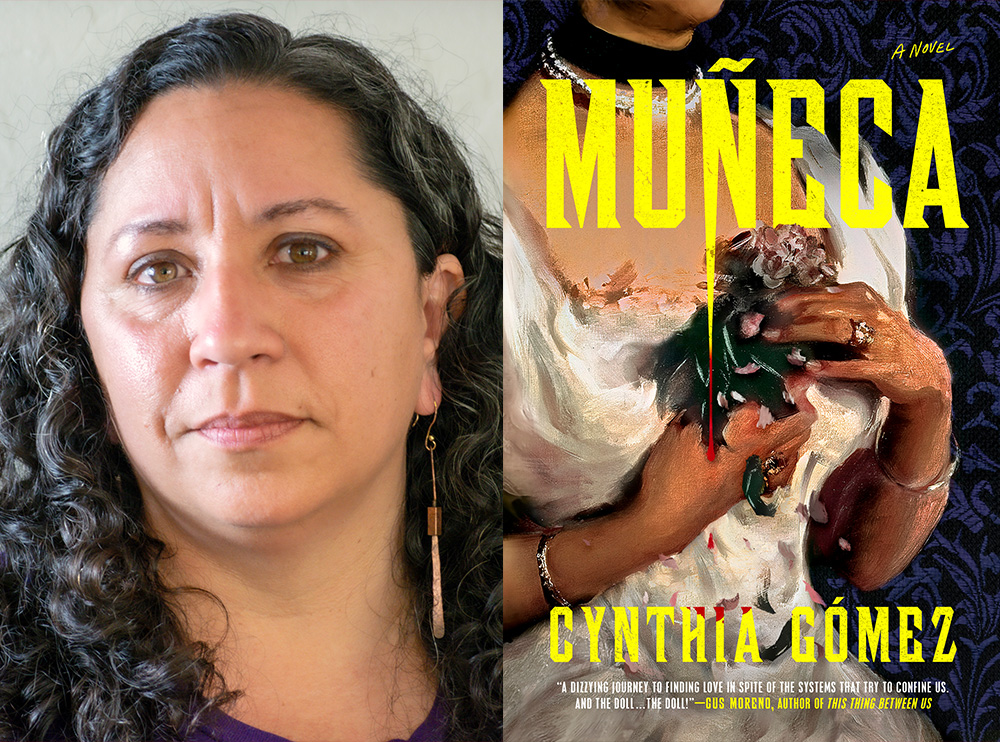
We chat with author Cynthia Gómez about Muñeca, which is a vivid, surreal Gothic about a queer, Latine, working class witch who sets out to rescue a bespelled heiress and loses control of her powers and her heart in the process.
In your own words, tell us what Muñeca is about!
It’s about a young woman—Natalia—who takes tremendous risks not only in hopes of rescuing the person she’s come to love, but also in reclaiming her own magical power and forging a new relationship with that power based on love and a clear moral vision.
Muñeca is set in late 1960s Oakland, CA, a time and place charged with social change. Why did you choose this specific moment in history as the backdrop for your story, and how did you go about researching it?
It’s precisely because it was a year of such change! I wanted a time when women still faced a lot of legal constraints—no-fault divorce was not a thing, and women’s rights to abortion or even a bank account totally varied by geography—and also a lot of social constraints, such as the stigma of divorce and the complete acceptance of sexual harassment. No matter her wealth and position, Violeta is contending with these extreme restrictions. In fact, it’s exactly that wealth and position, and her family’s obsession with keeping both, that have made Violeta so vulnerable to harm.
Then in comes Nati, representing the opposite pole to that, with her songs from the civil rights movement and her queer found family and her class-conscious politics. The Gothic often has a figure who’s kind of liminal with respect to class—the governess, usually—and that’s Nati, but those added elements make it even more delicious.
To research it, I talked to my relatives who lived through that time, and I spent lots of time looking up queer history in the late ‘60s, through books like Wide Open Town (a history of queer life in San Francisco before Stonewall) and online records, things like the minutes of groups like the Mattachine Society or the Daughters of Bilitis (two of the first queer liberation groups in the U.S., before either “queer” or “liberation” would have been the terms used).
Natalia, the protagonist, is a queer, Latine, working-class woman—a character rarely represented in the Gothic fiction canon. Why was it important for you to center someone like her within a genre that has traditionally been Eurocentric and patriarchal?
I’ve said before that Gothic literature largely takes place in the homes of the wealthy: people whose very existence, from the food they eat to the clothes they wear, depends on the labor of dozens, if not hundreds, of unseen human beings whose work is everywhere but who almost never actually show up on the page (or the screen.) It’s a deeply distorted depiction, and so I’m just putting back onto the page the people who’ve been kept off it. I mean, in the U.S., at least, who was washing all those nightgowns that those young ladies kept wearing while they ran from their mansions in the middle of the night?
Muñeca isn’t just the title of the book, it’s a recurring symbol throughout the story. Natalia calls Violeta “Muñeca” as a term of endearment and later channels her spirit into a doll. What does the doll symbolize for you within the novel, and more broadly, within the realm of magic and witchcraft?
I first brought a doll into the story because Nati initially fails at breaking the spell, and she’s trying to find a way for Violeta to have some kind of vessel for her spirit to occupy, so that she can have some agency of her own and some way to move about the house. The doll starts out as just an object, sitting on Violeta’s shelf, “made to be moved and carried around,” just like Violeta is. Violeta herself is treated like an object by her own family, including her husband, to be moved and manipulated wherever is most convenient for them. And, by the end, that same doll ends up playing two extremely pivotal roles, working in tandem with Nati, the very person who put Violeta’s spirit into the doll in the first place. It’s, to use that word again, delicious, to see that arc unfold.
Dolls are also fun in horror because they occupy that liminal space (there’s that word again too,) that uncanny valley, where they look like us but without any of our humanity, and that makes them very creepy. Especially when they pick up sharp objects. I love the “scary doll/figurine” angle; Muñeca marks the third time I’ve written that into a story, and it won’t be the last.
You’ve mentioned that much of your writing focuses on the oppression faced by working-class, Latine, and queer communities. What draws you to explore these issues through a horror lens?
The shortest answer is that horror is so much fun, and I love looking at everything through that lens! It’s such a richly metaphorical genre, and it taps into fear, which is a human being’s most primal emotion. What I love asking is: whose fears? Of what? I explored this a lot in The Nightmare Box and Other Stories: I had to give my vampire character supernatural powers so that she’d be safe alone in a room of drunk men. Or magical clothing to another character so he’d have a chance of surviving a queer-bashing. Using horror allows for my characters to sometimes flip the tables, using magic and other supernatural powers, and that can feel so damned satisfying, especially as in real life we’re watching our rights being taken away faster than we can say “f*ck ICE.”
Literature and music play a significant role in Muñeca, often as tools of quiet resistance. Natalia reads The Autobiography of Malcom X to Violeta to give her a sense of freedom and listens to blues musicians like Nina Simone and Otis Redding. How did you choose these specific works, and what inspired their inclusion in the novel?
I’ve loved Nina Simone, Aretha Franklin and Otis Redding since I was a teenager, playing and replaying my parents’ old records. For Muñeca, once I figured out that music is a good way to spark a spell, I had a lot of fun picking songs, mostly for their titles. “I Put a Spell on You” was an obvious choice, and so were “That Old Black Magic” and “I Shall Be Released.” My favorite song choice, though, was Mahalia Jackson’s version of “Amazing Grace.” Not just because Mahalia Jackson was such a celebrated and gifted singer, or because she supported the same civil rights causes that were anathema to the Miramontes family, but because Nati uses exactly the same Mahalia Jackson record that once belonged to the Black housekeeper that Mrs. Miramontes treated with such racial prejudice. In a way. it’s Mrs. Miramontes’ own wrongdoing that comes back to get her.
In terms of The Autobiography of Malcolm X: I loved that book and it was very influential for me, and so when I wanted Nati to be sneaking radical Black thinkers into the house and reading them to Violeta, right under her racist family’s nose, that was a pretty obvious choice.
Who are some of your favorite Latina horror authors and did you draw inspiration from their books for Muñeca?
Mexican Gothic was probably the strongest inspiration, because it so richly lays bare the moral rot at the heart of its wealthy, colonial landowning family, and it also has a strong, independent heroine who represents a threat to that family and its order. I also enjoyed the simmering sexual tension of The Hacienda, which also plays with the liminality (last time, I promise!) that’s such a feature of Gothic literature.
The book ends on a hopeful note. Did you always envision this ending from the start, or did it evolve naturally as you wrote Natalia and Violeta’s story?
I had the ending in mind even before I started writing, and it never changed (although I did originally envision more sacrifice on at least one character’s part.)
Your last book, The Nightmare Box and Other Stories, was a short story collection, while Muñeca is your first full-length novel. What inspired you to take the leap into a novel? Did the writing process differ from your experience with short fiction?
I basically learned how to write via short stories (and going to plenty of workshops,) gaining not just writing skills but also stamina and the ability to set short- and long-term writing goals. Once I started sending around the collection, I decided I was finally ready to expand into the land of short novels. That’s always been my goal: to have the ability to work in whatever story/book length I wanted.

I don’t know if the process was harder or easier, but I will say that the “revision to word count” ratio is way higher the longer my projects get, because if I change something in Chapter Two, that also might mean going and finding that same reference in a whole bunch of other chapters as well. Ultimately, I think I’m really happy in short and long fiction, and I hope to keep working in both.
What are you working on next?
An even longer novel! This one is about a dress that’s haunted by the spirit of a garment worker from the early 20th century, and the woman who buys it a hundred years later and finds herself able to see into that woman’s past, and to absorb some of her spirit, even at great danger to herself.