


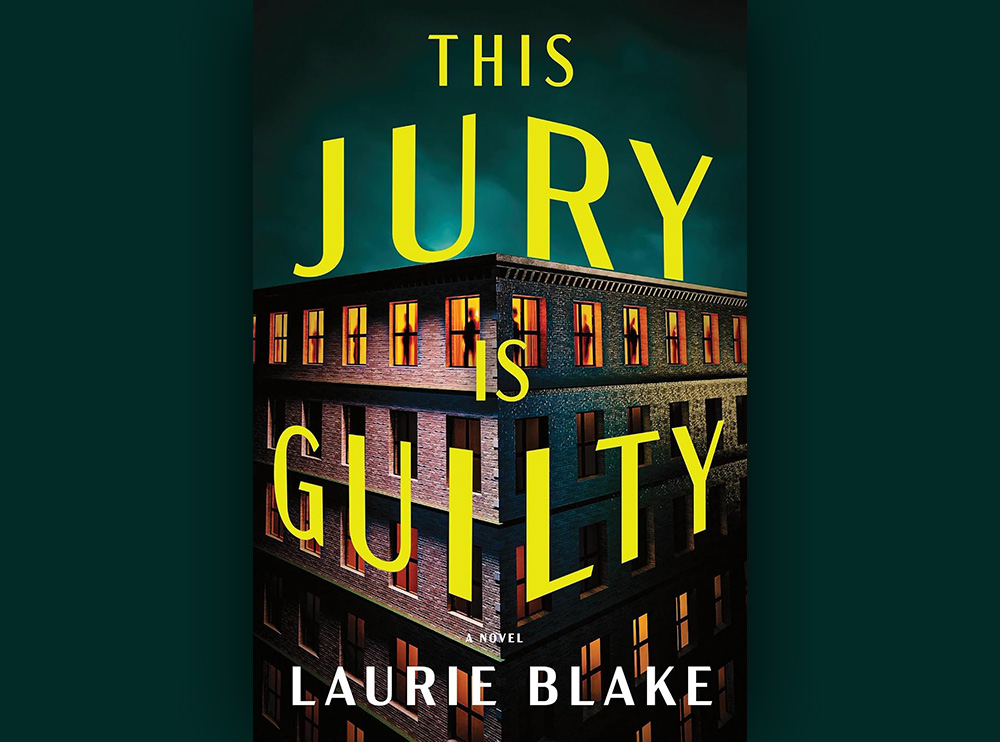
Everyone is Watching meets Twelve Angry Men in a tense and twisty locked-room thriller where, sequestered together until the Hollywood trial is closed, a jury must decide the fate of an actor accused of attempted murder, but this jury has explosive secrets, and one of them is about to get away with a murder of their own.
Intrigued? Read on to discover the synopsis and an excerpt from This Jury Is Guilty by Laurie Blake, which releases on November 3rd 2026.
No one here is innocent.
Hollywood’s biggest movie star, Danny Scott, stands accused of trying to murder his wife, starlet Hope Harrison, in a case that has taken the world by storm. Everyone is asking: What led to the events of that night, and what darker truths simmer beneath the surface of Danny and Hope’s marriage? As the world watches, twelve sequestered jurors must decide Danny’s fate. But even a jury has its secrets…
Juror 6 is risking everything for this trial. Even her life.
Juror 2 is playing games. But can he keep one step ahead of his own lies?
Juror 13, the alternate, will do anything to be on that jury. Anything.
Juror 7 is hardly noticed by anyone. Just as she planned.
As each juror vies for the verdict they want, secrets, obsessions, and plots for revenge will come to light in the stands. Because everyone is lying. Everyone is guilty. And one of them might be planning a murder of their own.
With shocking twists and propulsive pacing, This Jury Is Guilty is a thought-provoking, locked-room thriller exploring our obsessions with true crime, the blurry lines between fact and fiction, and the lengths we’re willing to go to seek justice. For fans of Amy Tintera, Steve Cavanagh, and Ellery Lloyd.
EXCERPT
Two hundred million people watched the live stream from the Superior Court of Los Angeles that summer.
The People of the State of California v. Danny Scott.
Everything that happened in that courtroom was dissected, torn apart, and argued on TV, in coffee shops, checkout lines, offices, at dinner tables, and on social media.
Everyone had an opinion.
But only twelve people got to decide whether Danny was innocent or guilty.
The Prosecution
One
Juror Six
Dee McCallister
Dee’s suitcase bumps against her heels as she rushes along the courthouse corridor, a step behind the court deputy.
She made it!
Beads of sweat prickle the skin beneath her top. Thank God she chose black.
She keeps her gaze fixed on the shiny floor, weaving around huddled lawyers. If they’re staring, they’ll see a woman in her late thirties carrying a little extra weight, with a nose too long for her face and badly dyed blond hair. Nothing to see here. She’s made sure of it.
The deputy throws a glance over her shoulder. “You’re the last juror to arrive and you’re late.”
Dee flashes an apologetic smile. “Sorry. The traffic was gridlocked.” It’s not a lie, but it’s not the reason she’s late either.
“Always is,” the deputy replies, shifting the leather belt on her khaki uniform as she stops by a door, one hand resting on the handle. She has neat jet-black hair and a petite frame. She sets her gaze on Dee as though wondering whether juror six is going to be a troublemaker.
You have no idea!
The thought lands in Dee’s head, but she offers another sweet smile. It seems to work, because something softens in the deputy’s face.
“I’m Gloria Honey.” She opens the door and waves Dee into a large room already containing her fellow jurors. “I’m the court deputy assigned to take care of you for the duration of this trial. So anything you need, come to me. Pop your suitcase with the others. We’ll be conducting a search later and then transporting them to the hotel for you.”
Dee’s heart lurches in her chest. She knew it was coming but can’t stop the question from forming. “A search?” She pushes the frizzy waves of her hair away from her face, hoping her makeup isn’t already ruined. Less than five minutes in and she’s already a mess.
Gloria rattles off the reply as though she’s said it a dozen times this morning. “A search of baggage for contraband items such as phones, tablets, laptops, and newspapers and magazines is standard procedure for jury sequestration.”
Jury sequestration. Dee still can’t believe it. They’re not going home at the end of each day, but to a hotel. They’ll be completely shut off from the world. Watched by court deputies twenty-four seven. The thought causes sharp claws of fear to dig into her.
Gloria points to the table. “Notebooks and pens are there. You can use them to take notes during the trial to refer back to during deliberations. And please check your lunch order before you go into court each morning. We order from Lou’s Deli Monday through Wednesday. And Georgio’s on Thursday and Friday.” With that, she’s gone, shutting the door behind her.
Dee turns to face the room, feeling every pair of eyes on her. So much for wanting to slip in unnoticed. The claws tighten their grasp. She shouldn’t have spent so long standing on the corner, watching the crowds gather outside the courthouse while trying to convince herself she was doing the right thing. As if there’s even a choice not to carry on.
No more running, she reminds herself as she takes in her surroundings. The jury room is dominated by a long table and chairs in the center. The air smells of coffee and a woody aftershave.
To one side, there’s a smaller table set with a silver coffee carafe. Dee’s mouth is dry. She’s desperate for a drink and a hit of caffeine, but she forces herself to smile at the group.
Jury selection may have been weeks ago, but she remembers every face. She remembers their names and the answers they gave when questioned by the prosecution and defense teams, searching for the perfect jurors to secure the desired verdict, with both sides choosing six people each.
She remembers the numbers they were given when one hundred people were whittled down to four women and eight men. Plus two alternates—a woman and a man—who’ll watch the trial alongside them but won’t take part in deliberations or vote on Danny Scott’s fate unless someone leaves the jury.
She knows who has secrets, who has lied, and who might be useful when the time comes.
“Traffic was crazy, huh?” she says, trying not to worry about what these people are thinking of her and her Dollar Tree leggings, already sagging at the knees, and the top she picked up from a thrift store on North Avenue, bobbled and stretched from someone else’s body. How the hell are they a jury of peers to the likes of Danny Scott and Hope Harrison?
Allie Parks, juror five, gives a welcoming grin—freckles, heart-shaped face, dark-red ponytail. She’s a stay-at-home mom who spends over thirty dollars a week on gossip magazines, reading them cover to cover in coffee shops while her older kids are at school.
Beside her is juror two, Rick Peterson—a forty-three-year-old self-proclaimed artist from Pasadena. He adjusts his glasses before raising his hand in a mock-solemn wave. “Guess we’re in this for the long haul,” he says, grinning. “At least the coffee’s free, right? Even if it tastes like it was filtered through a gym sock.”
A ripple of laughter moves around the table where the other jurors sit. Rick soaks it up with a friendly smile that makes him look instantly at home. Dee forces herself to copy the expression, even as she feels the distance between his easy charm and her own awkwardness.
Dee runs through the other names in her head as she steps up to the coffee table. She spots Franny Davis at the far end of the table. Juror seven is a retired schoolteacher with white hair and large blue-framed glasses, and the oldest of the group.
Beside the coffee table is another couch and a half-filled bookshelf with tatty paperbacks and a collection of board games. The judge warned them to expect long periods of waiting in this room for the attorneys and witnesses to be ready. Panic whips through her. How will she cope when she already feels trapped? There are no windows. The only escape is through the door she’s just walked through, guarded by a deputy standing outside. The only other two doors on the opposite wall lead to their own private restrooms.
Coffee will help, she decides. Even bad coffee. She pours a cup and takes a sip. It’s bitter and already tepid. Rick wasn’t wrong about the taste.
Allie steps beside her and takes a cup. “I’m not sure if you remember me. I’m Allie. We chatted at selection.”
Dee takes a breath, forcing herself to relax—or seem it, at least. “Dee McCallister, juror six. And I remember. You have three daughters, right? Two teen girls and a baby.”
Allie’s eyes light up. “Peyton turned one last week. You said you sell makeup in a mall, right?”
Dee nods but doesn’t offer any more details about herself.
From her pocket, Allie pulls out a photo of her family, all wide smiles and the same red hair. “I got this printed since I can’t scroll through my phone.” There’s a wobble to her voice, and Dee pats her arm like any normal person would. She hopes the gesture doesn’t feel as weird to Allie as it does to her.
“You have kids, too, don’t you?” Allie asks. “Is your husband going to cope? My husband, Robert, is a good man, but I don’t think he’s ready for life on his own with three girls.”
Dee pictures ten-year-old Charlie and eight-year-old Mason and thinks she should’ve printed a photo. “Two boys,” she says. “Their dad is long gone, but my mom is looking after them. I hope this doesn’t drag on.” Dee has her own reasons for wanting a quick trial, but Allie doesn’t need to know that.
“Me too.” Allie leans in and lowers her voice. “But how are we supposed to decide if Danny Scott is guilty? I have enough trouble deciding what to make for dinner every night.”
They laugh and Dee feels her heartbeat slow a fraction. Allie will be her first ally, she decides.
But then a gravelly voice cuts in: “We’re not allowed to discuss the trial.”
Dee turns to find juror one—John Timpson—planting himself in front of them like a sentry in a plaid shirt. He’s a tall, thin man in his late fifties with a gray handlebar mustache and a red face. He’s a retired veteran who works as a security guard in an office block of the business district.
“It’s in the jury handbook,” he continues, voice hardening. “Rules are rules. Break them, you compromise the whole jury.” He steps closer, and Dee notices a gleam of sweat on his face. She’s also found the source of the aftershave.
She gives him the same apologetic smile that worked on Gloria. “Sorry. Although the trial hasn’t actually started yet, has it? We’re both just nervous.”
Before John can reply, the door opens and Gloria appears with a clipboard and a stern expression. This is it. They’re going into court. Dee’s heart starts to beat so fast it feels like it will split her chest in two. If anyone recognizes her… She cuts the thought dead. They won’t. They can’t.
Two
Juror Seven
Franny Davis
Franny remains perfectly still as the other jurors scramble to collect notebooks and pens from the pile on the table before checking off their lunch orders from a printed sheet of sandwich fillings and salads. She glances down a final time to clue three in her large-print crossword book.
“Tropical bird (5)
Last letter, w.”
She likes to have a clue ruminating, something for her mind to chew on as she goes about her tasks. It’s an old habit—but then, everything about Franny is old. Her body, her bones, her eyes. They’re all failing. But her mind is still sharp. Sharp enough to know that if she’s going to act, it must be soon.
Last year she watched a dear friend sink into the depths of dementia until she didn’t know her own name, didn’t know she should have a name. It’s a terrible way to go. And yet sometimes, in the dead of night when Franny can’t sleep and everything hurts, she wonders whether knowing her body is failing is worse than the oblivion of a mind that goes first. Either way, she hopes her body won’t quit on her before she’s done what she’s come here to do.
“Morbid thoughts again, Francine.”
Franny exhales a small huff of amusement. It no longer surprises her to hear her husband’s teasing voice in her thoughts. It’s as though he’s leaning close to whisper in her ear like he did for the thirty-one years of their marriage. She’s learned not to reply aloud like she did at his funeral.
“Waste of money, those flowers.”
Out of habit, she shushed him, turning to catch the twinkle of mischief in his eyes as the reverend gave her a quizzical look.
It’s been two years since Bill’s death. She still misses him. Bill owned his own building company and was the kind of man who undercharged to help families in need. Even if it meant he and Franny barely scraped by some months.
They’d met when Franny was forty-one, in what she thinks of as the second half of her life. The first half ended with a single mistake that cost her everything. She and Bill married a year later. He was the only silver lining after what happened.
He’d been one week into his retirement when a stroke killed him. Then it was just Franny and the cat. She’s always thought of the tabby as Bill’s. She hopes her neighbor remembers Mittens likes the fish-flavored treats but not the cheese ones.
Gloria Honey waves her clipboard in the air, and everyone stops like it’s a game of freeze dance. The deputy wears that same frazzled expression Franny recognizes from class trips when she taught high school English. There’s a lot she misses about teaching, but trying to herd thirty bored kids around a museum isn’t one of them.
“OK, folks. It’s time for court,” Gloria says, tucking her black hair behind one ear. “When you enter the courtroom, the judge, defendant, and attorneys will already be waiting, so take your seats quickly and be ready for the proceedings to start.”
Franny plants both hands on the table before pushing herself up to standing. She moves carefully with her cane, pretending it’s only caution and not necessity. She doesn’t want Gloria to realize how heavily she relies on it.
Her legs tremble all the same, the ache spreading from hip to knee until it’s almost a throb. Let the young ones rush for their notebooks. She’ll take her time, thank you very much.
“You’re too damn old for this,” Bill tells her.
He may be right. What business does a seventy-five-year-old woman have on a case like this? Even Judge Thornton J. Malone told her she could go home. “Anyone who’s received a summons and is over seventy years old is excused from jury service,” he said at the start of jury selection two months ago. “I thank you for your time today. You may leave.”
Franny watched several members of the jury pool rise from the courtroom benches and hurry to the doors as though a great freedom awaited them. But she had nowhere to go. Nothing to do except feed Mittens and water Bill’s rosebushes.
“Mrs. Davis,” the judge said when she took her place in the witness box to answer questions from the lawyers. “You’re aware you can leave if you wish?”
She nodded. “If it’s all right with you, Your Honor, I’d like to stay.”
When the district attorney, Mark Vale, asked her why, she told him a half-truth. “I’ve spent my life serving this community as a teacher. I’m retired now, but I’d like to serve one more time.”

She didn’t tell him this was her last chance to right a wrong. To lift the guilt that’s eaten away at her for the last thirty-five years.
Gloria’s voice continues from the doorway: “I will remind you that some discussions between the attorneys and the judge will happen in court without you being present.”
“What kinds of discussions?” It’s juror two who asks the question. The man with the glasses and the brown hair who introduced himself as Rick, shaking her hand earlier like she was made of glass.
“Mostly whether certain evidence or witnesses can be included in the trial. If Judge Malone says no, then you won’t hear it.”
A man standing by the bookshelf raises his hand. “Hi, Gloria. Simon Wu, juror nine. I have a question, too, if that’s OK?” Simon is wearing a white shirt and a sports jacket. He’s a Korean American in his early sixties and has a receding hairline and a slow Californian accent.
Gloria frowns. “As long as it’s quick.”
“I…” Simon’s voice trails away and he blinks nervously. “I want to know if it matters where we sit? I’d prefer—”
“Yes, it does,” Gloria replies before Simon can tell the room his preference. “You need to sit in the order of your juror numbers. Your seat and your juror number today will be the same for the duration of the trial. It does not change. When we reach the door to the jury box, I will call you to your seat one at a time. The back row will fill in first and then the front row.”
“And us?” a voice says.
Franny watches one of the alternates step forward. She’s a beautiful Black woman in her early thirties, with Afro curls and red lipstick. Her clothes are smart, fitted, and expensive. She looks as though she’s heading to Wall Street or a fancy meeting Franny can only imagine exists outside of classrooms and cafeterias, and now the weekly trips to the senior center in Potrero Heights when she can bear it.
“Alternates have their own seats to one side,” Gloria replies. “You must watch the trial as though you’re a member of this jury. The same rules apply to you as to the others, but you won’t take part in the deliberations or vote at the end of the trial to decide the defendant’s innocence or guilt.”
A man in his late forties steps forward. He has a large belly and a friendly face. “Hi, Gloria. I’m juror eleven, William Slack.”
“I know who you all are,” she replies, tapping her clipboard.
“I want to ask why we need alternates if they don’t get to vote? Seems like a waste of their time.”
There’s a mumbled agreement from the second alternate—a young man in his twenties with glasses and neat hands.
“It’s very rare a juror is unable to complete jury service, but if it happens, the alternates will need to take that juror’s number and place to ensure the trial can continue,” Gloria says, before waving her clipboard in the air again. “Now, let’s go, please.”
Franny closes the crossword book, making sure to tuck her gold pen inside to keep her page. The pen was a gift from a student some years back, and it’s special to her. She leaves the book on the table, saving her place. From here, she can see the entire room and everyone in it, including the young man who introduced himself as Freddie Malik—juror four. Freddie is in his twenties, with dark circles under his eyes. She notices the way he keeps looking at the door like he’s expecting someone to burst through it and drag him away.
Like the rest of the courthouse, the jury room isn’t much to look at. Franny remembers it being built. Her father loved architecture and brought her to see it during the construction. She remembers how modern it looked through her child eyes. That white-brick facade rising six stories high. Named at the time after Stanley Mosk, the longest-serving judge on the California Supreme Court. The building no longer seems grand or imposing, but bland and functional.
None of the jurors look Franny’s way as she shuffles slowly to the door, cane in hand. She can’t remember what age people stopped seeing her. It started with men no longer giving that second glance, eyes no longer lingering on her breasts or her legs.
Eventually, the rest followed. Even store assistants stopped asking about her day, wary of being trapped in a litany of ailments like the seniors at her community center like to talk about.
Franny understands. Doesn’t even mind. In fact, it’s better she’s invisible. If no one is watching her, then no one will suspect her of the murder she’s planning to commit.
WKT NEWS
LIVE with Hannah Smith from Stanley Mosk Courthouse, Los Angeles County Superior Court
I’m standing just meters away from the entrance of the Stanley Mosk Courthouse in downtown LA on the first day of the Danny Scott trial. The crowds you can see on my left have been gathering since yesterday as they wait to catch a glimpse of the famous actors who’ll be arriving at any moment.
We’ve not seen crowds this big outside a courthouse since OJ Simpson was famously found not guilty of murder inside this very building in 1995. This really is the trial of the century, at the center of which are the events that took place in May of last year, when Artie Peets broke into Hope Harrison’s home with the intention of killing her. But, in a struggle with her attacker, Hope overpowered Artie and he fell to his death from the second-floor balcony in what was later ruled justifiable homicide. Over the coming weeks, evidence will be heard from both sides to determine if Danny Scott paid his longtime friend Artie Peets to kill his then-wife, Hope Harrison.
We know Danny Scott has been charged with solicitation to commit murder—the act of getting someone to commit a murder for them. It’s a felony crime carrying a sentence of up to nine years in a California state prison and fines of up to $10,000, which won’t be an issue for the fifty-one-year-old actor. Danny’s net worth is estimated to be a whopping $400 million.
The judge presiding over the trial is Judge Thornton J. Malone, a man with a stern reputation among the clerks at LA court. He’s already warned both the prosecution and defense teams he’ll not suffer time-wasting. Due to just how high profile this case is, the jury has been sequestered and will not be allowed any contact with the outside world for the duration of the trial.
Last week Judge Malone granted permission for this trial to be live streamed, citing both public interest and a desire to keep order in the courtroom in his reasons behind the ruling. Live streaming in the criminal court is rare but not unheard of.
And here comes the first car. It’s Hope Harrison, alongside LA County District Attorney Mark Vale, who’s trying the case against Danny Scott. Hope is looking demure in a high-collared white blouse with her famous blond locks tied back. Will she say something to us?
Hope, how are you feeling about the trial?
Mark, are you ready?
“We’re ready to get justice for this heinous crime.”
That was Mark Vale, the district attorney of LA County, cutting a dashing figure as he guides Hope into court. The thirty-eight-year-old British-born Oscar-winning actress won’t be allowed in the courtroom until after she’s appeared as a witness, which isn’t expected to happen for several days.
Here comes Danny, arriving with his attorney, Jessica Brady, famously nicknamed among fellow lawyers as “the woman of steel” for both her ice-blond hair and her composure in the courtroom.
Danny, how are you feeling about the trial?
“Hi, Hannah, good to see you. The truth is, I’m glad this day has finally arrived. Now I can prove to all my fans that I’m innocent and get my life back.”
There you have it. The two people at the center of this trial—Danny Scott and Hope Harrison, who were once considered to be Hollywood’s golden couple—have entered the courthouse. As we can see from the images now playing in the corner of the screen, the live stream has begun as the lawyers take their places in courtroom one.
Very soon, the jurors will be taking their seats and Danny’s trial will finally begin. There have been weeks of delays since the jury were selected. This has been caused by legal challenges from both sides, key witnesses abroad, and a significant security operation put in place as media attention continues to intensify. Jurors were able to remain at home while waiting for a trial date, with Judge Malone instructing them to avoid media coverage surrounding Danny and Hope. They’ve since been sequestered for their own safety.
What I wouldn’t give to be a fly on the wall in the jury room for this trial. That’s the latest live from WKT News. I’m Hannah Smith. Back to the studio.


