


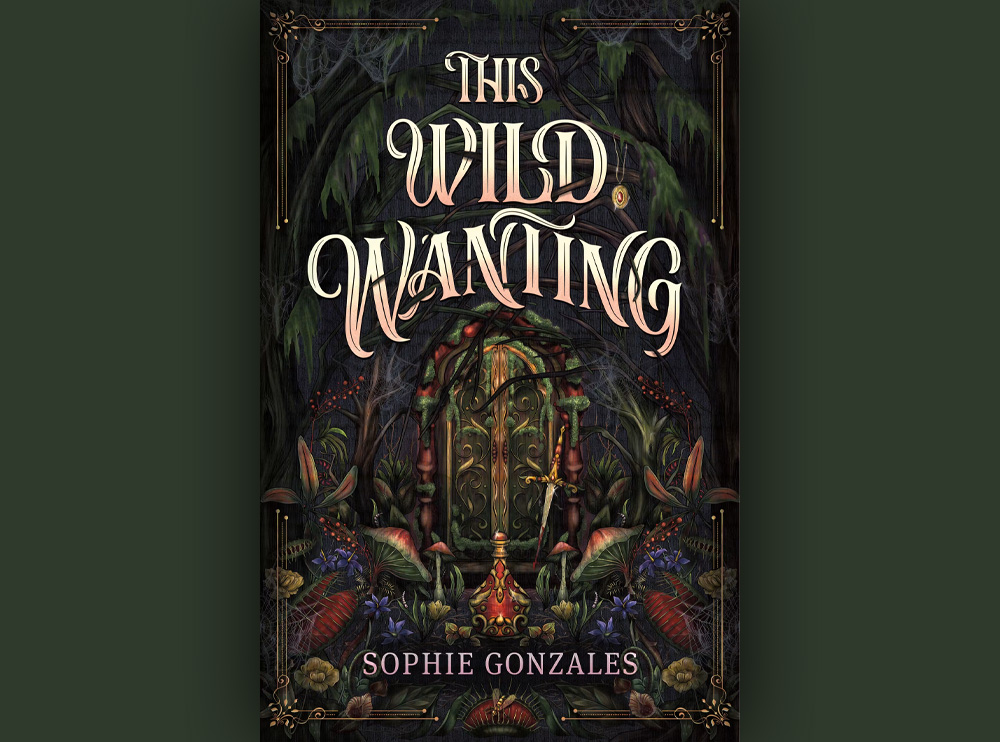
Introducing Sophie Gonzales’ sensational fantasy debut, where a magical potion comes at a terrible price to a noble’s son —and the potion maker’s daughter who is determined to rescue him.
Intrigued? Read on to discover the synopsis and an excerpt from This Wild Wanting by Sophie Gonzales, which is out now.
A dangerous bargain. A forbidden alliance. An impossible love.
Everybody knows about the faerie market that borders the crumbling edges of the mortal world. It is a place where almost anything can be bought . . . by those willing to pay terrible prices. Skills, memories, years of your life—even the freedom of one’s own mind are the currency of choice.
Declan Bonfeld, the only son of a noble house, has never encountered a price he cannot afford to pay. Until the day he attempts to bargain with a ruthless potion merchant for the impossible: a way to bring back someone he loves. When Declan dares to steal from the tyrant’s shelves with the help of the merchant’s captive daughter, Calla, the two discover a horrifying truth. Once a stolen potion is consumed, the thief pays the price, no matter who drinks it.
With Declan’s mind and body unravelling piece by piece, Calla must help him outwit her father, the man she has spent a lifetime fearing, before Declan is stripped of everything he is, and she loses the only person who has ever truly seen her.
EXCERPT
Prologue
Calla Fenn was only nine months old when her birth father stole her away in the dead of night.
The family’s town house was finally still, blanketed in the sort of silence only sheer exhaustion brings. Calla was experiencing what the ladies in her mother’s knitting circle called “the eight-month backslide” and what her adoptive father called “gods, she’s awake again?” and what her mother called “undeniable proof that all ten hells exist.” That night, like every night for the past two weeks, she had tested the limits of her parents’ patience, wailing and kicking her tiny feet every two hours like clockwork. This turn of events had— quite inconveniently—shattered any illusions her parents had that, now that the newborn months were long passed, she would sleep through the night forever.
It had only been an hour since Calla’s parents had collapsed into a heavy, desperate sleep, which meant they were due at least one more hour before Calla’s screams broke through their consciousness. So they did not stir when the front door gave a soft creak. Didn’t flinch at the shift in the air, or the brush of footsteps gliding over the floorboards. Did not notice the shallow breathing of the figure stealing down the hallway holding a wriggling bundle in his arms.
How could they have? A creak is just a creak. A breath is quieter than the wind. And dread? Well, dread is hardpressed to rouse the truly sleep-deprived. It settles in the belly, silent and slow, seeping into dreams and wrangling them into nightmares.
Calla, though—Calla woke. She grasped pudgy fists around the bars of her crib and pulled herself to her feet, wobbling slightly. She’d learned to stand only days ago, and she wasn’t yet graceful about it, but she was curious. Expecting her mother or father, she blinked into the shadows, only to find a stranger blinking back. A beautiful man with flowing black locks, and skin like starlight, and flashing black eyes.
Calla didn’t cry. If only she’d cried.
Only, there were many things Calla didn’t like lately. She decidedly did not like turnip. Or the color blue. Or wearing socks. But what she did like—what she absolutely loved, in fact—was attention. Company. Newness. And this man was new.
“Hello, Calla,” the man whispered, dropping to the crib’s level. “I believe you belong to me.”
Then he brushed a hand, cool and unfamiliar, across Calla’s face before turning to the bundle in his arms. A second infant, a little smaller, smooth-skinned and sleeping. Again, the man passed his hand over the baby’s face, and Calla watched in fascinated silence as the baby’s features shimmered and shifted until they mirrored her own.

Calla stared down at the other baby, not knowing enough about her own face to recognize it on another. All she saw was a companion. She observed with wide eyes as the man lowered the other child into the crib beside her. And though she was sad to be parted from her new friend so quickly, she didn’t whimper when the man lifted her from the crib and whisked her through the darkness of the house.
In fact, she made no noise at all until the two of them were well past the garden path, and the cobbled fence, and the thicket of brambles that bordered the gate. Not until the man pulled a small gold band from his coat—barely larger than a bangle—and slipped it over Calla’s hand, about halfway to the elbow.
“I apologize for this,” the man said, now in a normal speaking tone. “But I can’t have you getting lost on me again.”
With that, he laid his hand over the bracelet until it sank deep into Calla’s skin. Then, Calla screamed. The scream of a child experiencing agony for the first time. The scream of a child who has learned, far too young, that not all people are good. The shrill, terrified scream of a child begging for her mother.
But her mother, tucked safe in bed behind thick stone walls and beneath a blanket of sleep, did not stir.
Her mother wouldn’t wake again, in fact, until the sun streamed through the curtains hours later, and the baby down the hall started fussing in her crib.
“She didn’t make a peep after midnight,” Calla’s mother said to her husband, bouncing the baby on her hip as they shared a relieved look. “Perhaps the worst is over.”


