


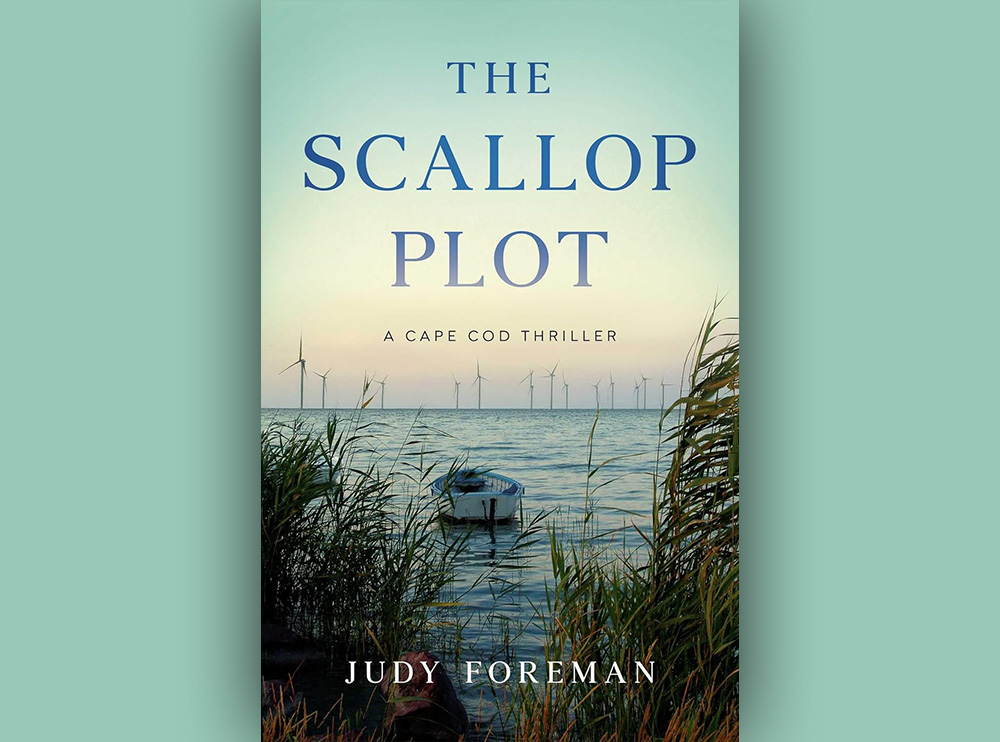
In this thriller, star investigative reporter Samantha Fuller joins a feisty Cape Cod fisherwoman to foil a wind farm developer’s evil plot to poison precious ocean scallop beds—and finds herself facing off against right-wing climate deniers.
Intrigued? Read on to discover the synopsis and an excerpt from The Scallop Plot by Judy Foreman, which releases on August 11th 2026.
In Provincetown, MA, feisty scallop fisherwoman Isabella Ferreira goes up against a sleazy wind farm developer, Olaf Svensson, who wants to install wind turbines in the ocean right off the coast of Cape Cod.
At a nearby scallop hatchery, marine biologists Leif and Astrid Borgen are already using the new gene editing technique CRISPR to insert a growth hormone gene into scallop embryos to make them bigger and thus more profitable—all of which is legal. But unbeknownst to the hatchery owner, Svensson is also paying the pair to insert another gene—one that causes PSP, paralytic shellfish poisoning. If this works, no one will ever eat scallops from this site again, thus freeing it up for Svensson’s turbines.
Enter Pulitzer Prize–winning Boston Times reporter Samantha Fuller. Together with Isabella, she slowly uncovers Svensson’s deadly plot—but not before hundreds of people die. Along the way, love blossoms, tragedies occur, and the subtleties of the pro- and anti-wind power groups are exposed.
Prologue
It was magic hour in Provincetown Harbor. The wind had died down to a soft breeze. The scattered clouds were turning a gorgeous lavender. The whale watch boats bobbed gently at the pier, disgorging their last contented sightseers. The bars were getting noisy, happy hour in full swing.
But the tense, middle-aged man slouched in the stern of theVacker—which meant “beautiful” in his native Swedish—was distinctly not happy. He popped open a beer—his third—and stuffed the last, now-cold, bit of calamari into his mouth.
Olaf Svensson had spent the day alone, as always. But fuck it, he was not exactly a people person, and sour as his own company was, even to him, it was better than trying to talk to people who knew less about the world than he did.
He had taken the day to sail around the waters off Provincetown.
The area, teeming with bluefish and sea bass, was the perfect site for an offshore wind farm.
Now in his sixties, graying though still with the body of the swimmer he once was, Svensson was mostly unknown in America but had become famous in Europe for trying to develop Sweden’s offshore wind farms.
That work had once been part of Sweden’s famous green plan.
But then the anti-wind protests had come, at first with critics crying that Sweden’s beautiful coast would be marred by the huge turbines and all the helicopters flying overhead to de-ice them.
Others called his projects “fashion,” mere virtue signaling for wind energy fans. And then had come the big fear: that all those turbines in the water off Sweden’s Baltic coast, the coast facing Russia, might make it harder to detect any incoming Russian cruise missiles.
Agonized, he watched his dream collapse, his investors back out.
After years of fighting, he reluctantly terminated the leases he had so painstakingly won.
His projects doomed, Svensson had slid into a deep depression, drinking heavily, buying sex, living on ice cream and pizza. If he had had any friends, they might have gently noted that this depression was actually not new, that he should seek help. But there were no friends, and his despair festered.
He had grown up poor, or as poor as anybody could be in Sweden’s egalitarian society. His parents had run a small chain of mom-and-pop grocery stores, and he had learned as a teenager how to order goods, stock shelves, and sweet-talk customers into buying more than they’d come in for.
The mere thought of his father made him shudder. He still had the scars on his back from the endless, terrible beatings. He had only one eye, not a great thing for a sailor, or anyone else, for that matter.
The so-called accident had happened when he was three. His father had given him a pocketknife. Why on earth his father had done that, no one knew. Olaf, of course, played with it right away and within minutes had flailed around and jammed the sharp blade into his left eye. He’d lost the eye and had had a glass eye, and an attitude, ever since.
Once out of the house, no longer having to look at his mother’s sad and perpetually bruised face, he had been a quick study, cruising with a vengeance through college, taking easy courses, then going on to business school. Along the way, he’d tried marriage. But the bitch had abandoned him for another guy, leaving him lonely, childless, and angrier than ever.

But so what, he figured. He was smart. And determined. And before long he was among the first to catch on to the world’s burgeoning energy crisis.
He’d paid close attention in the 1970s as the oil embargo, long gas lines, and the world’s insatiable appetite for oil crippled countries around the world. But where others saw crisis, he saw opportunity.
He prided himself on being that rare breed: an environmentalist-businessman, driven—or so he liked to think—in equal parts by a genuine desire to save the planet and make money in the process.
Lots and lots of money. Doing well by doing good.
Now, as evening fell, the bitter man in the stern of the Vacker shook his head to emerge from his reverie. He put on his sweatshirt and opened his fourth beer.
For several years, his memories of the torpedoed Swedish projects had made him sad. But now they only made him mad. And more stubborn than ever. Now, as his depression morphed into fierce determination, he contemplated his new project, Provincetown Wind.
The waters off Provincetown offered perfect conditions for wind power: consistent strong winds and a shallow ocean floor. This time, he swore silently, he really would impress the young woman he had secretly fallen for—the one who haunted his dreams, the one he admired more than anyone else on earth, the one young enough to be his granddaughter yet worshipped enough to be his wife: Greta Thunberg.
He would make his millions. Nothing would stop him this time.
Not the law. Not ethics. Nothing. He had a secret plan to make sure his idea would become reality.
It had to.