


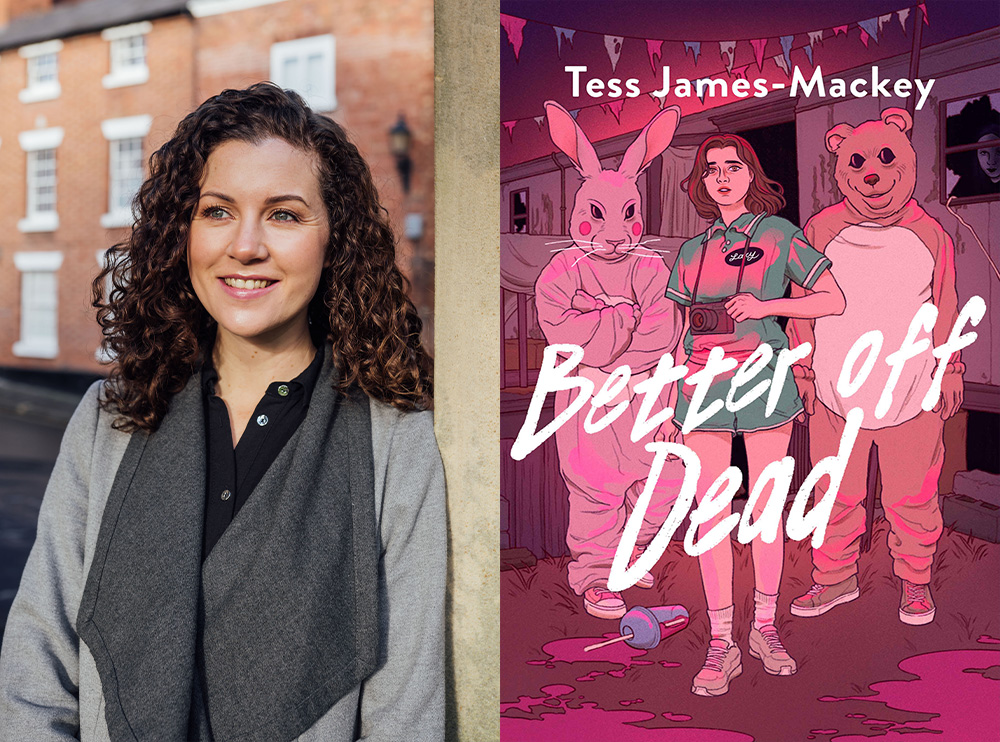
Guest post written by Better Off Dead author Tess James–Mackey
After growing up in rural Shropshire, Tess set out to explore the world and find her place in it. She quickly rushed straight back to Shrewsbury when she realised she’d been where she belonged from the start. She now lives in a quiet suburb with a noisy partner and daughter, two extremely noisy cats, and a less noisy tortoise.
She spent years mucking out and getting trampled on by horses, before finally deciding she might prefer a less precarious office job. Between analysing insurance risk, she writes teens into terrifying situations inspired by her lived experiences.
When she’s not allowing her mind to wander to dark and twisty places, she pursues more wholesome activities, like growing mediocre vegetables in her garden, camping with her daughter, and even riding the odd horse.
About Better Off Dead: An edge-of-your-seat supernatural YA thriller for fans of Don’t Let the Forest In and How To Survive a Horror Movie. All Lacy wants is to escape to Paris and be with her older sister. But she needs to make some money first, so she takes a summer job at a caravan park in North Wales. When one of the guests is brutally murdered, rumours start to swirl about the park being haunted. There are sightings of a mysterious figure walking along the clifftops at night and Lacy can’t shake off the feeling that she’s being watched. Could there be some truth to the stories? And can she discover who – or what – the killer is before she becomes the next victim?
Many writers start their plotting process with two simple words – what if?
What if this happened?
What if a character did this?
What if I tried this technique – how would that affect the story?
My process is full of what ifs, but it always starts with a place. So far, those places have been real locations I know well, and it all started with Shrewsbury Prison.
In 2017, my daughter was two years old, and I filled my weekends with finding suitable places to take her. Just down the road from me was the recently abandoned Shrewsbury Prison, and since the inmates were relocated in 2013, the sports hall had been repurposed into a soft play centre, complete with a bouncy castle and ball pit. Though the signage pointing towards cell blocks and visitation rooms remained.

I’d sit there in a sleep-deprived daze, my mind off wandering the ancient passageways that dated back to 1783. I booked myself a tour and allowed my imagination to explore even further – what if a teenage girl was dared to delve deeper into the prison and got trapped?
Someone Is Watching You went from there, and I picked my way through the prison, asking more what ifs as my character rounded each corner and stumbled upon another section of the vast building.
My second book – You Wouldn’t Catch Me Dead – was based in Llanthony, a tiny hamlet in the Welsh Black mountains – home to a 12th-century priory where I learnt how to ride horses and later worked for a summer. We used to ride up the mountains and pass exhausted Duke of Edinburgh students, who were expected to find their way in the unforgiving wilderness without an adult. What if a school trip went horribly wrong somewhere so wild and isolated?

Better Off Dead was inspired by a well-known caravan park in North Wales – the site of family holidays and where my husband worked as a teenager. His stories of the staff parties and the clash of the rugged coastline with the occasional chaos of the park set my imagination off. And when I stumbled across an abandoned section of the park, I pressed my face against the grimy glass of an old apartment block and pictured someone staring right back at me. What if a summer job here could lead to someone fighting for their life?
Wales has been a particular source of inspiration for me. I live right on the border and spent a huge amount of my childhood exploring the country, before going to Aberystwyth university. It was there I met my husband, who grew my fascination even further by teaching me more about the language, culture and history. Wales is packed full of what if locations to explore, and I can’t wait to find the next place that will inspire me to put pen to paper.
It’s especially fun to use this technique for thrillers, as you’re essentially picturing what could happen in your location that would really ruin your main character’s day. How can the setting be used to escalate the tension? My plotting process usually starts with a specific place within the wider location, which is where something terrifying will unfold. And being able to actually go there and see the exact place it will happen can really help bring the scene to life (and yes, I do manage to scare myself in the process!)
Though I’ve found that, often, the real places and history are the hardest to believe. Have you ever been somewhere that’s made you pause and wonder how somewhere such as this exists, and what might have happened there? Sometimes, even my wildest imaginings don’t rival the true stories.