
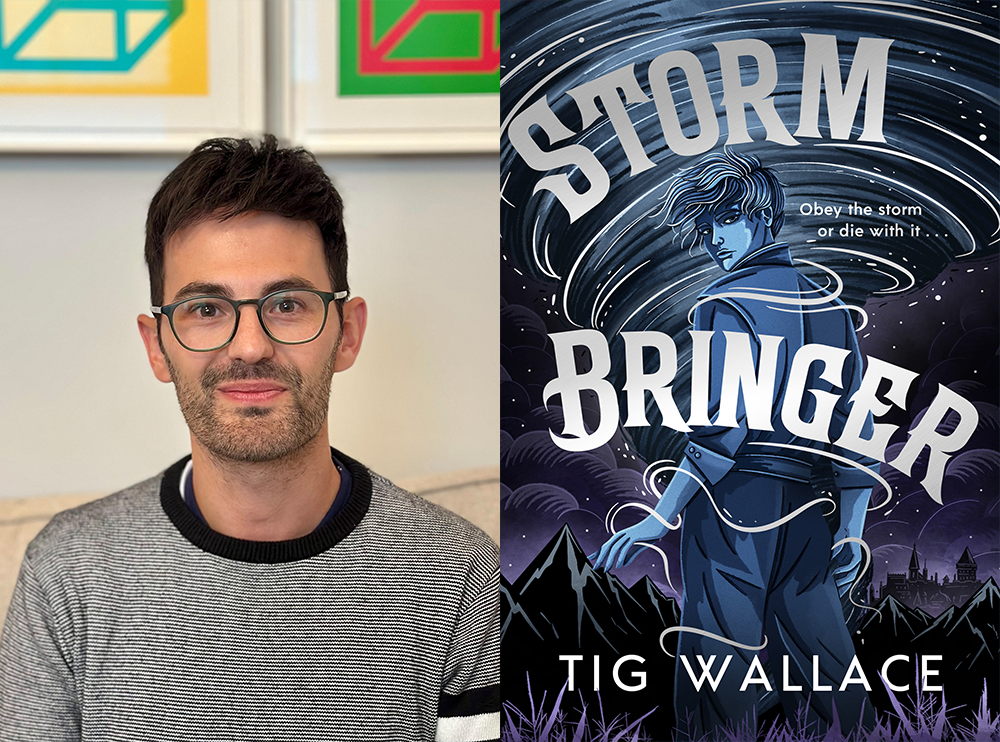
Guest post written by Storm Bringer author Tig Wallace
Tig Wallace grew up in a town between London and Oxford, reading as much fantasy as possible. After work as a runner on movies, and a brief, eye-opening experience working in magazines, Tig started a career in book publishing as an editor. Tig is a keen tennis fan, as both spectator and player, a cat enthusiast, and has never been known to say no to karaoke. He lives in London, Storm Bringer is his first book.
About Storm Bringer: In a world ravaged by supernatural storms where people are divided between magic and science, Amelio is thrown into a spiralling crisis. Discovering a dormant power within himself, he joins companions Paige and Vintane on a quest to unite divided provinces against the most destructive storm the world has ever seen. Bravery, loyalty and love clash in an exhilarating mission to save humanity from nature’s wrath … Released May 9th 2026.
As an author, you spend a lot of time imagining your reader. Everyone else is thinking about it too, early on, from the literary agent to the publisher to the retailer. Working out who you’re writing for informs many decisions, both creative and commercial. Great, you think, as you and the team determine that your manuscript is this similar book meets this popular TV show with a dash of this other aspirational novel. But then the publication date approaches and your prospective readers are about to become real readers. Will they like the book? What else are they reading right now? Who is my book really for?
I’ve always loved YA fantasy, the category of my debut Storm Bringer. I was lucky to grow up at a time when YA was really establishing itself, with tons of incredible authors publishing big fantasy novels, like Garth Nix, Cliff McNish, Cornelia Funke, Holly Black, Jonathan Stroud, Philip Pullman, Darren Shan and more. I was also devouring more classic fantasy, like Ursula Le Guin and Susan Cooper. The access to extraordinary other worlds is what made me want to work in books.
I spent ten years as a children’s and YA book editor, which was a total dream come true. It was also a point where YA was having a tougher time, the market moving away from fantasy in favour of contemporary novels, and then more broadly towards middle-grade. Fast forward to now and things couldn’t look more different. As both a reader and editor, it’s unbelievably exciting to see the thriving YA fantasy market. It’s made me reflect a lot more on readers, and as I looked again at the first draft of my book, it was time to answer two big questions: where does it fit in and who is it for?
It’s a drilling down exercise, trying to work out who that core reader is (I say core because yes, we all secretly hope our book is for every single person who reads books). For me, the first thing I could latch on to was a preoccupation that I knew had worked its way into my writing: the drop-off in reading after age 12. NLT stats show that daily reading declines heavily for children at age 11/12, continuing through to older teens.


Reading enjoyment declines along with it. According to NLT, by the age of 14, just 18.8% of boys say they enjoy reading, and 37.7% of girls. The stats above are from 2025, but the pattern has been present for a long time. There are many complicated factors at play, which I wouldn’t be qualified to do more than speculate on, but this was in the back of my mind when I was writing. I wanted to write something that felt epic and magical, with a compelling romance thread that older teenagers would enjoy, but that was also accessible to readers 12+ who are moving on from middle-grade and into YA. In the thriving current YA market, with its strong romantasy offerings and crossover leaning, I liked the idea of trying to reach readers who might not want all of what upper YA content offers just yet.
I wanted to write something pacy, action-packed and engaging, in the hope that the book would appeal to readers who’ve enjoyed upper middle-grade series like Percy Jackson and Alex Rider and are looking to take a next step. As a boy who read a lot, who went on to become an author and editor, I’m also conscious of the extra drop-off for male readers after 12. It wasn’t a conscious decision to make my protagonist male, but I loved putting Amelio at the heart of both the action and the romance storyline.

I guess this all made me realise that the reader I was writing for is…me, or rather my younger self; I think I’ve subconsciously written the book I wanted to read at 12 or 14 or 16. And not just the same as the books I loved then – though their influences are certainly in Storm Bringer – but something that filled the gaps of what I wasn’t reading perhaps. I hope it’s fair to say YA fantasy was for quite some time the purview of somewhat literary, serious male writers. Male point of view protagonists in fantasy that I read as a kid – few in number as they were – were often separated out from romantic storylines…and those characters and stories weren’t particularly diverse or representative. Today, YA fantasy readers have such a brilliant and diverse range of books to choose from. So much of it is driven by the increasing number of ways readers get to express their thoughts and views and demonstrate what they want to be reading. It’s an incredible thing to watch.
I hope my book reaches readers who will see themselves reflected in Amelio and I hope that future writers will subconsciously log the gaps they want to fill with their own writing some day.