

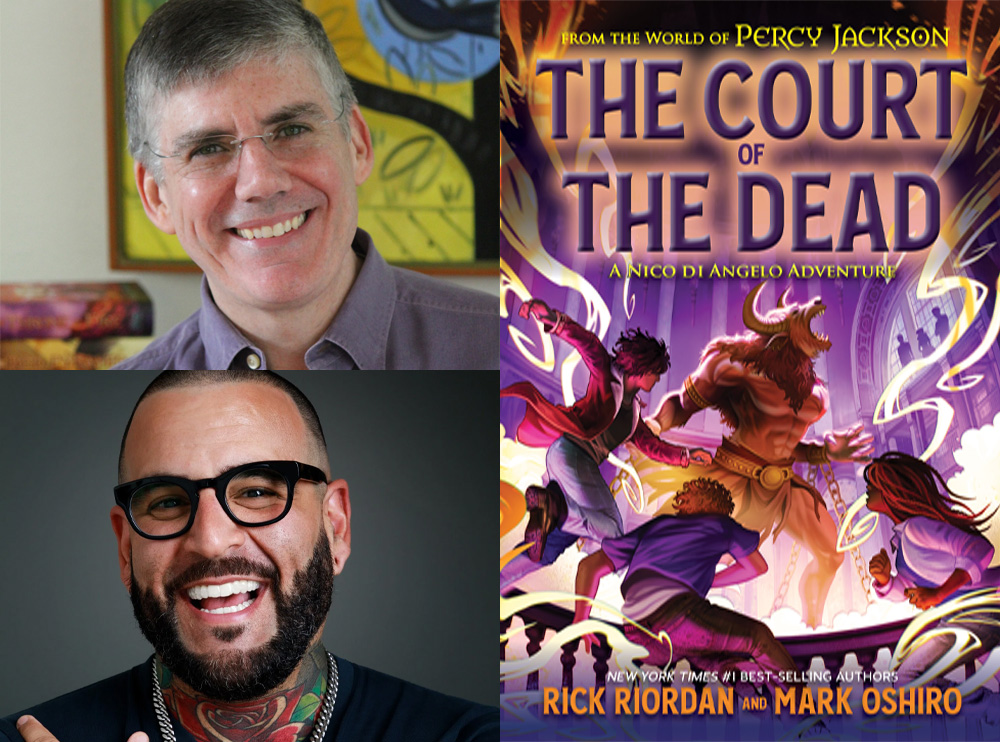
We chat with authors Rick Riordan and Mark Oshiro about their upcoming book release, The Court of the Dead, which sees favourite characters Nico di Angelo, Will Solace, and Hazel Levesque on an adventure with monsters, mythics, and every minor god in between. Exploring themes of good vs. evil and the impetus of choice within the threads of fate, this story dives back into the Percy Jackson universe, unravelling complex emotions, mental health struggles, and intricate relationship dynamics between unexpected characters.
Can you describe The Court of the Dead in five words?
Riordan: Percy Jackson’s world turned upside-down.
Oshiro: This is really, really unhinged.
Quick lightning round! Tell us:
- What books made you want to become authors?
Riordan: The Lord of the Rings, and, probably, A Wizard of Earthsea. Those were probably my two major touchstones.
Oshiro: My answer is Stephen King’s It, which I was way too young for, but was so magical in terms of being able to make me feel a wide range of emotions. - Can you tell us what book you are currently reading?
Oshiro: I’m reading The River Has Roots by Amal El-Motar. It’s a new novella from one of my close friends, whom I adore, and it’s very good. Very fairytale-like and strange.
Riordan: I’m in the middle of reading a thriller in Italian, actually, by Donata Carisi. It’s called Io Sono L’abisso, I Am The Abyss, and it is really, really dark.
What kind of reader do you encourage to pick up this new release?
Oshiro: I would say an adventurous one.
Riordan: I mean, anyone who is familiar with the Percy Jackson world and wants to get back into that world, but also anybody who needs a fun adventure. I think we could all use a break these days, and a chance to get away from reality. I think this book is a good way to do that.
What was the co-writing experience like, and was there any conflict or compromise?
Oshiro: Rick and I both feel very lucky that our writing processes are similar. We wrote a detailed outline of what we wanted in the book, and then wrote the manuscript. Because this was our second outing, the process felt even more in sync. I come from journalism. I don’t have a huge ego around my writing. I’m used to it being edited and being changed, so I don’t know that we’ve ever had a disagreement. It becomes so convoluted in terms of who wrote what that we often can’t determine who wrote a specific sentence. We both approached this with humility, curiosity, and wanting to write a fun adventure, which meant we were always kind of one-upping each other.
Riordan: I was thinking the closest thing I can compare it to is, like, improvisational jazz. When you just sort of have the general key, and you have the chord patterns, but everything else is kind of up for grabs, you know? It’s like, yeah, that’s awesome, do that again. Okay, all right. I can riff off of that.
What inspired the decision to write this series together?
Riordan: Well, I mean, Nico di Angelo is probably one of the most popular characters among the readership for Percy Jackson. He’s a real touchstone for a lot of readers, and he’s very near and dear to my heart, and of course yes, I’ve written about him before, and I’ve even written from his point of view, but I think the idea of writing an entire novel from his point of view, and based on his relationship with his boyfriend Will Solas, felt like something that I needed help with. I don’t have the context for his life experience; I needed someone with the toolset of emotionality, life experience, and the authenticity that would make readers say, I understand this, I empathize with this, I get this; this feels real to me. I loved Mark’s previous work, and so I was very fortunate that they were open to doing this.
How did you approach interweaving mental health into the story?
Oshiro: I mean, a part of this came from The Sun and the Star, and a lot of Rick’s ideas came from how he wanted to explore Nico’s trauma in that book. So when we were having conversations about The Court of the Dead, a lot of it was, how is this going to look? Especially if you’re now a person whose emotions are hanging around and can affect other people. What does that mean for this character, who has historically hidden their emotions, and now doesn’t have a choice in the matter? So, I think it was twofold, which is, if we’re gonna do this, we need to have it be a big part of the story. Then also, Mr. D, the camp counselor, has been around for a while and has seen a lot of demigods come through, and he has this very unique relationship with Nico and Will. What if we expand that just a little bit more and show this side of the counselor as well? How might things be changing in Camp Half-Blood for other campers? So, yeah, these are all intentional conversations that we had.
Some readers have mentioned that Nico’s voice in The Sun and the Star feels a little bit different compared to when he’s written in The Trials of Apollo, for example. So, I think they’re curious to know, did you revisit that series when you were writing, or did you intentionally approach this perspective differently?
Oshiro: So yes, I did. I read the series twice before I got the call from Rick and from Disney. Then, in the few days before we started the process of auditioning to write for the series, I re-read them all again and took extensive notes, with post-it notes. It’s different when you read the books and you’re reading them as a fan, and then reading them as now making an entry into this canon. We talked about how I would write the first draft, rather than us writing a chapter at a time and sending it back and forth. But, being given the creative freedom to just write the book, I didn’t worry about trying to imitate, necessarily, what a person sounds like in the past. We were like, this is going to be Nico’s own book, which means we’re going to spend more time in his head. Also, time has passed since the trials of Apollo. How has he changed because of that experience? How can the way he talks when we’re in his head also change? Even if I tried to imitate Rick, I think it was always gonna be different. There was no way to make it exactly the same, because I’m a whole different human. I’m curious, Rick, how you felt about that? That’s gotta feel strange, someone’s writing your character?
Riordan: Oh, no, I love it. I think it’s great. I think there’s a huge range for latitude on what a character sounds like. Have you ever listened to your own voice recorded? I mean, you sound different to yourself, you know, so think about all the range that we have to sound different at different times in our lives, under different circumstances. And a lot of what a person sounds like also has to do with who’s receiving that voice, who’s listening, and when, and how they’re listening. So, I think Nico is very true to Nico. But I agree, I think that the tenor and the tone have sort of evolved, and I think that’s all good.
Did you use AI tools in any part of the writing process for this book? Or have you ever worked with ghostwriters?
Riordan: I’m so old, I wouldn’t even know how to start it. The only thing I know about AI is how to turn it off immediately. Anytime I update a device, that’s the first thing I do. Is there a way to turn this feature off? I mean, I’m sure it will have a place in the world. But I think creativity is exactly the wrong place to be trying to use that. If you can’t be bothered to write the book, why would anybody be bothered to read it?

Oshiro: Yeah. I also don’t know how to use it, and I don’t understand it. Part of what made my writing grow over the years is writing badly. You have to do things that don’t work, and you have to write sentences that don’t make sense, or don’t communicate what you’re trying to, so that your brain can figure out what works. If you want to develop your own voice and this distinct voice we were just talking about, you have to be willing to write the stuff that doesn’t work. I’ve seen people with Percy Jackson tattoos that are quotes from the book, and I’m like, that is magical that a sentence and this stringing of words that you put together has affected someone so deeply.
What do you hope readers take away from the book?
Oshiro: I hope that the book’s questions about the nature of right and wrong, good and evil, hero and monster, have a lasting impact. I think there are a lot of sometimes uncomfortable scenes where Rick and I were also uncomfortable writing them, thinking about how this even challenges the world of Percy Jackson itself. I love a book that keeps you thinking after you finish it, and so I hope it inspires a lot of thought in our readers.
Riordan: Yeah, I would echo that. I think that’s a beautiful sentiment.
What is next for the two of you? Any plans to continue Nico’s Adventures?
Oshiro: Yeah, we’re both not planners. I get why some creatives are, but we are not generally ones who plan 10 years in advance. A couple of weeks ago, I turned in my next young adult book, which is a horror novel, and I’m very excited, but that’s a year and a half out. Right now, I’m excited about The Court of the Dead finally coming out.
Riordan: There’s no grand plan. We’re making this up as we go along. We wrote the first book because it was just something we were very excited about. The second book came from talking about ideas we thought were so fun that we couldn’t wait to put them down. So, if something like that comes along again. I’m sure we’ll jump on the phone and have that conversation, but it’ll be organic, and it’ll be natural, I hope.