

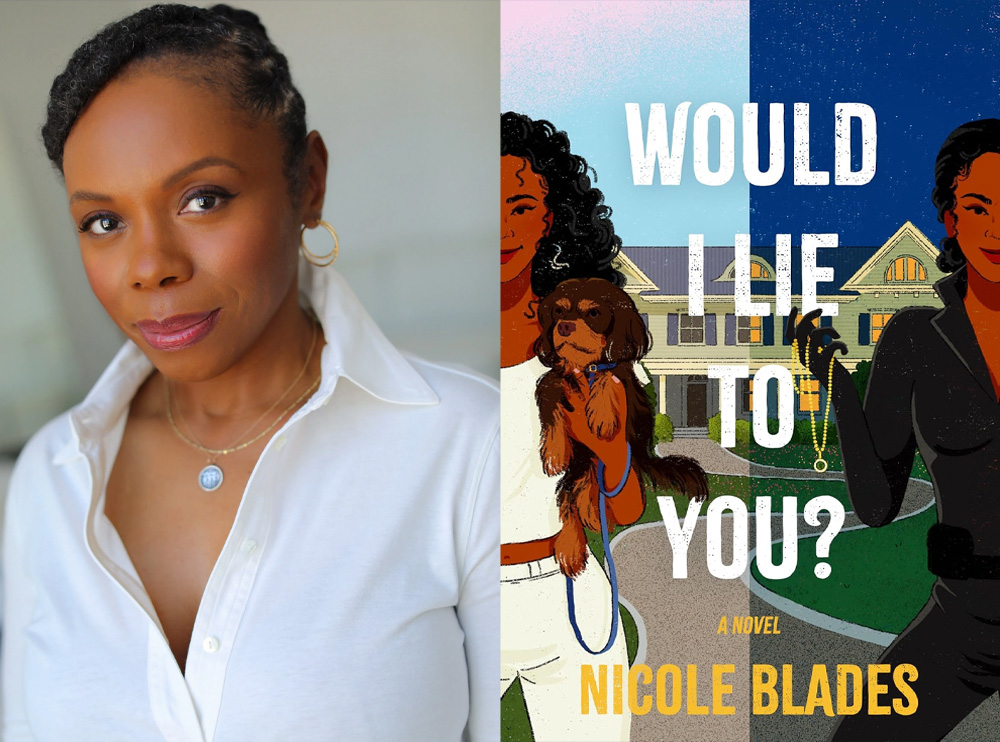
Guest post written by Would I Lie To You? author Nicole Blades
Nicole Blades is a novelist and journalist with nearly two decades of experience in the media industry. Her cover stories and features have been published in The New York Times, The Wall Street Journal, Runner’s World, Women’s Health, and more. Her novels often focus on the façade and filters people put on to face the world. Her new book, WOULD I LIE TO YOU?, will be out in Spring 2026! The domestic thriller joins Nicole’s previous novels, HAVE YOU MET NORA?, THE THUNDER BENEATH US, and EARTH’S WATERS. She’s also a member of the International Thriller Writers, Crime Writers of Canada, and the Crime Writers of Color organizations.
About Would I Lie To You?: Would I Lie to You? is a thrilling spy-next-door story that may have you cheering for all the wrong people, perfect for fans of Finlay Donovan and Killers of a Certain Age. Releases April 21st 2026.
It’s one of the many famous lines from The Godfather film trilogy: “Just when I thought I was out, they pull me back in.” The quote comes from Michael Corleone (played by Al Pacino) in The Godfather III, but Pacino’s classic delivery truly sets the words on fire. He’s heavy on the throaty theatrics while dispensing the last four words through gritted teeth. You truly feel the man’s deep resentment and agonizing realization that as much as he wants to leave the crime life behind, that dark world has other plans for him.
The thing is, his frustration fuels your fascination. The uh, not so fast, buddy, boom barrier dropping down on your hero just as he’s plans to drive off into the sunset pulls you further into to his predicament while also raising the emotional stakes. Add the element of “one last job” to the havoc, the dramatic tension gets even tighter, and you’re leaning in.
From Stephen King’s Billy Summers and S.A. Cosby’s Blacktop Wasteland to Hollywood blockbusters like Ocean’s 11 and Heat, you’re invested, rooting for the main character who’s now thisclose to getting out, but for this one final lap around the worn track.
In my upcoming novel, WOULD I LIE TO YOU?, Lu Barlow is living a dangerous double life. In one world, she’s a loving wife, mom, Pilates studio owner, and kind neighbor. In the other, she’s a deeply covert high-stakes cat burglar who is given one last job before she can retire. However, this particular carrot is tied to a short, tangled string as it asks her to steal from her unsuspecting husband and destroy everything she loves most in the process.
Be it the final heist, mission, rescue or duplicitous turn, here are three reasons we can’t quit “one last job” stories:
1. Craving Closure
Although it’s not officially on the hierarchy of human needs, the idea of closure is still incredibly important. When things go south, you’re thrown into emotional tumult or you find yourself trapped beneath horrible circumstances, the need to find answers can become the only thing that matters. You need to feel better; you need resolution, you need to know that somehow this—the whole mess—makes sense. The one last job can offer your hero (and by extension, the reader) this crucial sense of closure.

2. All Aboard the Redemption Arc
Whether it’s through repentance or atonement, the redemption arc of an unsavory or morally complex character can be the thing that sinks or saves the entire story. The final job is the flawed hero’s last chance to escape their haunted past and finally close the loop on all of their unwise choices and unruly behavior and end on the right side of history. Of course you want this rebirth for the character you’ve been rooting for through all their missteps and wrong turns. It earns out on the benefit of the doubt you gave them. Redemption arcs are hopeful reminders that people, especially in real life, have the capacity to change.
3. The Heavy Weight
Watching an exceptional, strong—albeit ethically murky—character show vulnerability, exposing their neck to protect someone or something else, makes them more relatable. They feel grounded in the real world. When have a professional thief, hitman, mobster, etc., facing an impossible choice: get out clean or go back one last time, ultimately risking it all, and they opt to go with the latter, it shows human depth and extends your empathy for their plight.