

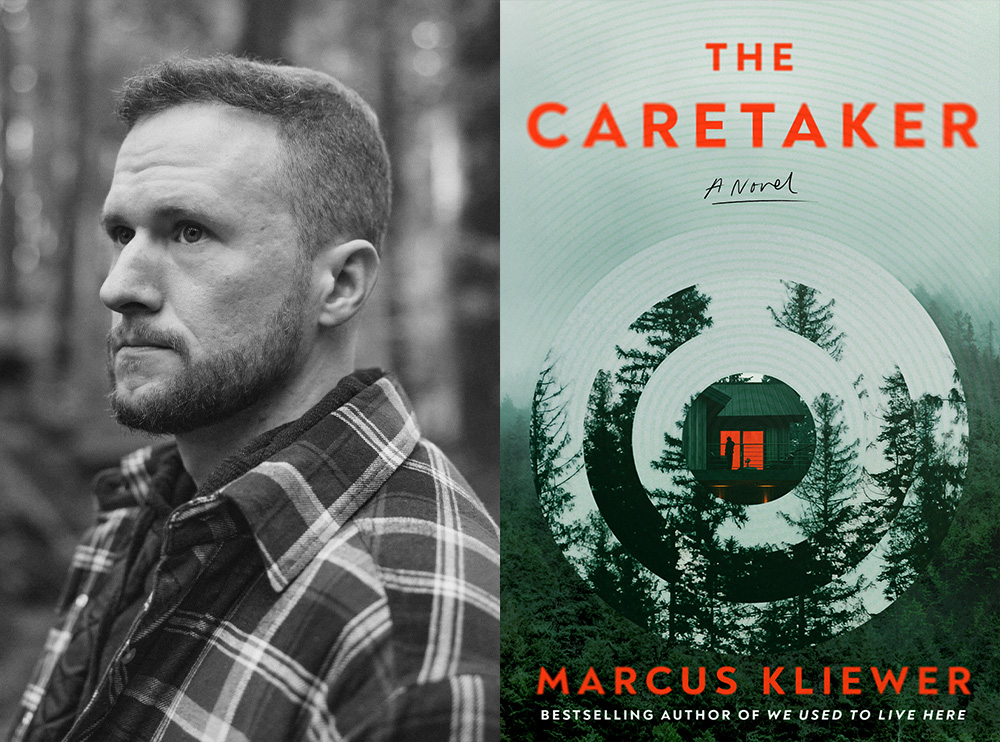
We chat with author Marcus Kliewer about The Caretaker, which releases on April 21st 2026 and is a supernatural horror about a young woman who accepts a caretaking job from Craigslist, only to discover the position has consequences far greater—and more dangerous—than she ever could have imagined.
How was your experience writing your sophomore novel, after your debut experience in 2024. What did you learn from your previous experience? Did anything come up that you weren’t expecting?
I’ve learned to incorporate feedback from people I trust as early as possible. Having other voices and perspectives guide a story is truly invaluable. External points of view can catch and highlight so many things that are simply impossible to see when you’re in the weeds of a story. Having friends and family read early drafts or even outlines really helped the overall process and the final product. I’m self-conscious about sharing work with people, so I need to find folks that I trust to be honest, and kind. People who can point out a plot hole by simply asking a thoughtful question.
As far as surprises, I think the book ended up being much more personal and darker than I had planned.
Writing a book is no small task, and taking a story from a Reddit short to full length novel must come with its own set of rules and challenges. Were there any surprises or changes that you faced while adapting THE CARETAKER for publication?
This book was way more difficult to adapt/write than WE USED TO LIVE HERE. My original “Caretaker” short was rigidly structured around three “Rites,” and things happen so fast in the short, our main character doesn’t really have time to think about leaving the house.
To me the central support beam of a “haunted” house story is: the characters reason for staying in the house. Are they trapped? Are they financially tied down? Without this, readers will be internally screaming “WHY DON’T THEY JUST LEAVE?” If there isn’t a logical answer to that question, the entire story risks falling apart. It can still be entertaining, sure, but usually in an unintentional way. That doesn’t mean the reader needs to agree with all the character’s choices, but they at least need to understand where those decisions might be coming from.
You provided readers of WE USED TO LIVE HERE with a fully immersive experience including found documents and a morse code cypher, making it a book fans are still dissecting almost two years later. Can readers expect to find similar puzzles in THE CARETAKER? And can you provide any hints or sneak peaks?
Don’t expect the same amount of puzzles and mixed media, this is a much more “traditional” narrative than WE USED TO LIVE HERE. However, there might be two or three easter eggs and/or secrets for the extra observant reader …
From a house flipping project that flipped a woman’s life upside down, to a Craigslist job nightmare straight from the online stranger danger panic, you have a talent for unsettling readers with how horrifying the everyday can be. Where do you find the inspiration for your unique take on the horror genre?
For me, the more grounded and relatable something is, the scarier. I call it “low-budget horror writing.” I pretend the book I’m writing is a film with limited monetary resources, and I can’t just have “CGI insanity” for every single scene. This pushes me to come up with grounded and practical scenarios. More often than not, those scenarios end up being way scarier than what I’d initially planned.
Case and point: in the earliest drafts of Caretaker, the house was an ultra modern mega mansion. The story didn’t really grab me until I dialed it back to something much more ordinary and relatable: a two-story rancher. Very few people have set foot in an ultra modern mega mansion, therefore it feels less scary to most readers. It gives us the safety net of: “Well I’m never going there anyways so I’m safe.”
That’s not to say over the top “high-budget” insanity can’t be scary or a hell of a lot of fun. Many of my favorite horror books/movies employ non-stop insanity and set-pieces, and I plan to incorporate into future books.
What authors, films, or other creative influences shaped THE CARETAKER, whether consciously or subconsciously?
The online horror community r/Nosleep in general has been a huge influence, they’ve really mainstreamed the “Rules” genre in a way that most folks don’t even realize.
As for movies: Take Shelter, House of the Devil, 10 Cloverfield Lane, The Blair Witch Project, Us, Lake Mungo, The Cabin in the Woods, Parasite, It Follows, Talk to Me, and, for better or worse, Gremlins. THE CARETAKER was also massively influenced by Japanese horror films like Odishon and Ringu.
And with books, there are too many to count, but off the top of my head: Turn of the Key by Ruth Ware, I’m Thinking of Ending Things and Foe by Ian Reid (Reid is a master of uncanny horror/thrillers), Old Country by the Query brothers, Bird Box by Josh Malerman, Dark Places by Gillian Flynn, Rosemary’s Baby by Ira Levine, How to Sell a Haunted House by Grady Hendrix, and Hex by Thomas Olde Heuvelt.
Your work often plays with atmosphere, tension, and what’s left unsaid. How do you decide what to reveal to the reader and what to keep hidden?
Yes, it’s a constant question in every story I tell. Admittedly, it’s much easier to be coy and ambiguous, than it is to come up with a surprising and satisfying conclusion that answers everyone’s questions. And when it comes to ambiguity, people will often ascribe genius (or stupidity) that was never planned. That being said, I try to be as intentional as I can with every scare, image, and unanswered question (even if that intention is never put on the page).
You have a unique relationship with your readership, having first shared your work online. How has that early, direct interaction with readers influenced the way you write novels today?
I am so grateful to that community and especially my earliest readers who left comments asking when the next part of a story was coming or checking in when a story missed its scheduled drop.

I think writing on Reddit really pushed me to hook the reader early on and find ways to keep them reading. I was always asking myself: how can I start this post in a way that grabs the reader’s attention, and end it in a way that makes them want to read the next.
Dividing longer stories into smaller parts also made the whole prospect of writing a novel much less daunting. It becomes a collection of scenes and sequences rather than a 70,000 word block of text. Every day I sit down to write, I’m not thinking about writing a book, I’m thinking about writing a sentence. Then I’m thinking about writing a paragraph, then a chapter, a part, and so on.
As your career continues to grow rapidly, how do you stay grounded in your creative process and protect the original spark that drew you to storytelling in the first place?
I feel so fortunate that I’m able to do this for a living. Ultimately, I keep that spark by focusing on stories with characters and scenarios that I care about. I’m a very private and introverted person, so I try to avoid reading comments online as much as possible. As for staying grounded, I take my dog for long walks, watch movies with my cats, and do my best to no life things too seriously, lest I lose my already tenuous sanity.