


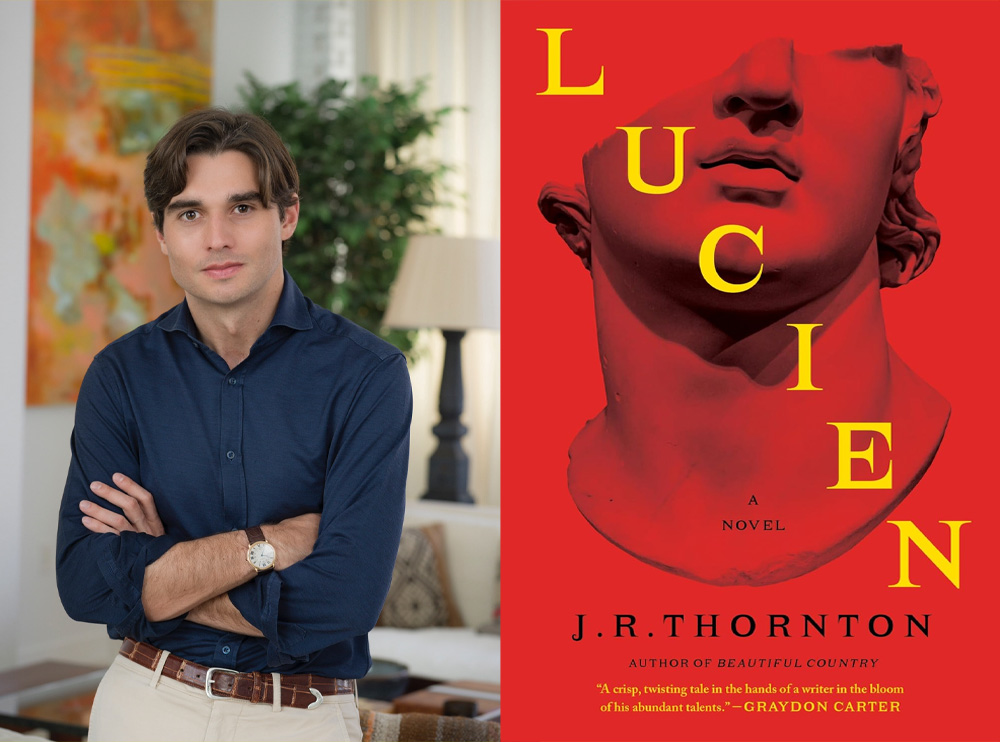
We chat with author J. R. Thornton about Lucien, which follows a gifted yet financially disadvantaged artist who falls victim to the manipulative control of his wealthy, enigmatic Harvard roommate—a piercing exploration of class, ambition, identity, and the perilous cost of reinvention in the tradition of Patricia Highsmith and Donna Tartt.
LUCIEN is a character study of young people trying to reinvent themselves. Christopher Novotny, an awkward son of working-class immigrants, finds himself rooming with Lucien, a charming Gatsby-like figure. By anchoring the novel in the dynamic between these two unlikely friends, what larger truths were you able to illuminate?
Although they appear starkly different at first glance, Lucien and Christopher share something more important than appearances in common. Both characters are outsiders who start out wanting exactly the same thing: to belong. This shared, fundamental desire is a central component to their dynamic and why their friendship works so well.
Centering the story on two outsiders allowed me to explore the world of elite education and the role that privilege plays in admissions. The novel has many insider characters and it would’ve been an entirely different story had I told it from the perspective of a character like Will Gardner, a Groton graduate and multi-generation legacy at Harvard. Outsider characters experience social contexts with fresh eyes and bring a different perspective to analyzing and critiquing them. Their distance gives them a level of objectivity and detachment which enables the storyteller to reveal hypocrisies and truths about a space which an insider might be too close to see.
In their starred review, Publishers Weekly focused on the interpersonal intrigue that makes the story a “wild ride.” How important was that propulsive element to you, balancing an intimate character study with edge-of-your-seat pacing?
Essential. I wanted to write a novel that would pull readers in with suspense and mystery. My goal wasn’t to write a pure “thriller” in the classic sense of the word, but rather take elements of plot and structure from that genre and marry them with the emotional depth of a literary campus novel. I was one of those kids who was always reading late into the night with a flashlight, unable to sleep because I had to find out how the story ended. I wanted to try to recreate that feeling for readers of LUCIEN and write a story that a younger version of myself would have fallen in love with.
You graduated from Harvard in 2014. Unlike Chris, you come from wealth. Why did you tell the story from his perspective rather than his upper-class roommate’s? Was class-consciousness on your mind while you were a student there?
When I started this novel, two of the biggest decisions I had to make were, how much of Lucien’s backstory should I reveal to the reader? and when and how should I reveal that information? I wanted Lucien to dupe the reader in the same way that he dupes the other characters. I included clues for the reader about his true backstory, but only those that were also accessible to others in the novel. In short, I wanted the reader to experience Lucien in the same way that his classmates and friends at Harvard experienced him. That naturally led me to tell the story from the first person perspective of one of his close friends.
I decided on Christopher’s economic background because I wanted a character who would be particularly susceptible to Lucien’s appeal and ill-equipped to spot red flags. Chris’s financial circumstances give him a very strong motivation to go along with Lucien’s scheme to sell forgeries; it wouldn’t be as credible for a student at Harvard to engage in criminal activity and risk all that that entails without some degree of economic necessity. And Chris is a total outsider to the world of privileged students at elite schools, so he has no frame of reference for evaluating someone like Lucien. He’s also not able to call up a friend or cousin who also went to Eton and do some digging into Lucien’s background. Finally, I wanted to create a level of distance between the identity of the narrator and my own identity/background.
Regarding class-consciousness, it was absolutely on my mind.. When I arrived at Harvard I was taken aback by the number of students from incredibly wealthy or influential backgrounds. I’d already attended elite schools like Hotchkiss and Eton, but it still stood out to me how many students I met at Harvard who were the children of billionaires or politicians or famous public figures. I also remember thinking about how difficult it had been to get into Harvard and all the things I’d had to do in high school to put myself in a position to get accepted—and questioning if I ever could have made it on my own without the guidance and resources of my parents. I understood that my place at Harvard was partially a reflection of intellectual ability and work ethic, but also to a large degree the economic circumstances into which I was born. That felt deeply unfair to me—especially in a society that places such a high value on elite academic credentials.
During their very first encounter, Lucien gives Chris the nickname “Atlas.” Why does Chris like the idea of having a new name, and why, as the author, did you choose Atlas?
Having Lucien give Chris his new name in their first encounter immediately establishes their relationship dynamic and reveals salient traits of both characters. The fact that Lucien would think to rename his roommate at all—and at their first meeting no less—makes apparent his absurd level of confidence and the flippancy with which he treats convention; the fact that Chris / Atlas would allow his roommate to do that to him demonstrates his level of passivity and the awe with which he regards Lucien. This renaming scene also allowed me to introduce some foreshadowing with Lucien talking directly about reinvention and rewriting the “fiction” of identity.
From my very first draft I wanted a parallel between Atlas and Lucien that only became evident at the end of the novel, when the reader learns of Lucien’s real backstory. My initial thought was that over the course of the novel Atlas would build resentment towards Lucien—primarily grounded in his perception of Lucien’s privilege—only to realize at the end of the novel that they were far more similar than he had known. Both characters arrive at Harvard as lifelong outsiders and outcasts who attempt to reinvent themselves. Names are central to identity and its significance to a character who is torn between the person he is and the person he thinks he wants to be is undeniable. I forget how exactly I landed on the name Atlas; I know I wanted an unusual name that the reader would remember and would make Chris’s acceptance of it extreme.
Alongside Chris and Lucien is their vividly drawn friend group, each member a complicated balance of bravado and sincerity, rivalry and loyalty. What stereotypes or misconceptions about young men did you work to avoid as you developed them?
I wasn’t thinking about countering male stereotypes or misconceptions when writing those characters. I always start with the basic goal of building authentic, three-dimensional characters that I can imagine interacting with in real life. If I find myself writing a character who is a stereotype —unless that character is serving a very specific purpose—then I’ve likely gone wrong. With the characters in Lucien’s friend group, I was able to draw from my own experiences—from the hundreds of people I met during my time at Harvard—to create composite characters who hopefully have more depth and complexity than flat caricatures.
Writing accurately about artistic forgery requires a lot of research into both painting technique and art history. What was that process like for you? Were there any surprising findings?
The art forgery research was one of my favorite aspects of writing the book. I knew absolutely nothing about it before nor about art generally. In my first draft of the book I put in placeholder names for the painters they would forge—and left all the sections dealing with forgery blank with notes to come back and rewrite once I’d had a chance to do proper subject research. This involved reading and watching anything relevant I could get my hands on. I read biographies and memoirs of famous art forgers, newspaper articles, industry reports on new trends and technologies, academic papers on forgery detection methods and material analysis. I watched documentaries and YouTube videos. I did phone interviews with a couple convicted forgers. I tried teaching myself the basics of drawing and painting to better understand how to write about process or using certain materials.

I’m a very curious person by nature, so for me that whole process was a lot of fun. And I came across a lot of surprising findings and crazy stories. For instance, experts estimate that 40% of all art in circulation is fake. Several of the forgers I read about went to their deathbeds claiming that dozens of their forgeries still hang in museums like the Louvre and the Met. One forger with no formal art education whatsoever created his own “paint-by-numbers” system using stencils to produce fake 19th century naturalism paintings of exotic birds and flowers. And John Myatt, who I interviewed, created forgeries of Matisse, Modigliani, and Chagall among others that passed through Sotheby’s, Christie’s, and the Tate Museum. Myatt didn’t even paint with oils but rather relied on basic house paint.