

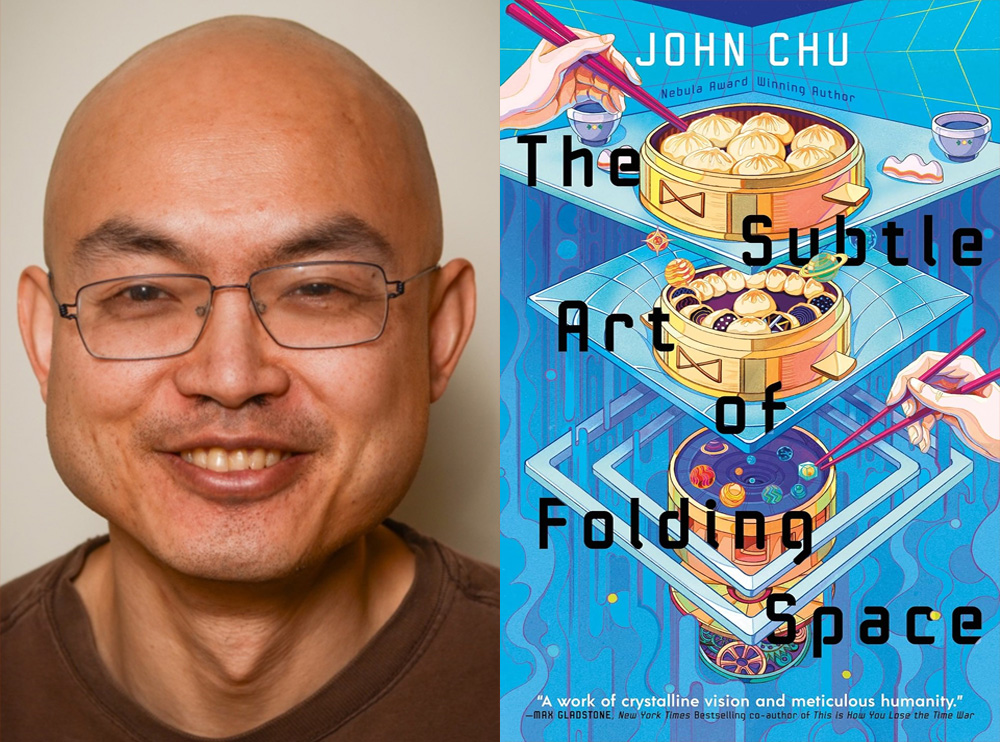
We chat with author John Chu about The Subtle Art of Folding Space, which is an exhilarating debut science fiction novel and channels unhinged physics, generational trauma, and the comfort of really good dim sum. This isn’t your usual jaunt through quantum physics.
Hi, John! Can you tell our readers a bit about yourself?
My day job is in the computer industry. I write my own work and translate the works of others in what is basically my spare time. I love theater, especially musical theater. I’m also a huge fan of figure skater. I’ve been singing since I was a kid. I played violin for over a decade, although not recently. I’m currently teaching myself to play classical guitar.
When did you first discover your love for writing and stories?
I genuinely don’t remember! For as long as I can remember, my parents have always encouraged me to read and, for me, telling stories was a natural extension of that. I remember being in first grade, writing a story and someone telling me that that wasn’t how the world worked.
Quick lightning round! Tell us:
- The first book you ever remember reading: I had to look this up. I think it was Just Me by Marie Hall Ets.
- The one that made you want to become an author: Not the book that made me want to become an author, but the book that made me realize perhaps it wasn’t impossible is the collection Stories of Your Life and Others by Ted Chiang.
- The one that you can’t stop thinking about: Probably Carnival by Elizabeth Bear, an absolutely terrific book that also happened to come along at exactly the right time in my life. I’m a slow reader but I read it in basically two sittings and couldn’t stop reading it despite being horribly sleep deprived.
Your debut novel, The Subtle Art of Folding Space, is out April 7th! If you could only describe it in five words, what would they be?
This novel is about a bunch of things and how they all interact with each other:
Physics: Ellie, Chris, and Daniel are all maintainers, the folks to maintain the physics of the universe, and at the start of the novel, physics isn’t working right.
Food: Daniel is a chef and creates status reports about the universe through food. The novel is populated with all sorts of Taiwanese food.
Frameworks: The novel has all of these structures, metaphorical and literal, that need constant upkeep and defense. Guardrails do not hold themselves. Whether you do this and, if so, how is part of Ellile’s dilemma.
Family: Ellie’s relationships with her sister Chris, her mother, and her cousin, Daniel and how they evolve is the crux of this novel. Ellie is forced to confront her mother’s expectations and balance that against the fate of the universe.
Fun: For all the talk about physics in disrepair and defending guardrails, as much as the story explores difficult family relationships, it is also really zippy and wacky. Ellie is placed with ever more bizarre and absurd situations and she has to work her way out.
What can readers expect?
The readers can expect a taut, fast-paced story that engages with how we and our families survive even as situations get ever more absurd. The story does this in a way that is full of light and humor.
Where did the inspiration for The Subtle Art of Folding Space come from?
The story has a bunch of inspirations:
Me just missing the train at Alewife Station.
For a while, the definition of the kilogram was a lump of metal and its clones… which turns out not to have identical mass, meaning that one of our fundamental constants was not well defined.

An aside in the Feynman Lectures on Physics about how in the turn of the 20th century, physicists thought they’d finally “solved” physics. Then we discovered quantum phenomena.
How the world seem to swirl around me and grow absurd as I dealt with the death of my mother.
Were there any moments or characters you really enjoyed writing or exploring?
There is a section is now one of my favorite parts of the book that would not exist if my editor Jen Gunnels hadn’t asked the right question at the right time. Ellie and Daniel find themselves needing to defuse a car bomb, one that plays around with the laws of physics. It’s a fun section full of weird stuff that tells us a lot about our characters and exactly how deep in trouble they find themselves in.
Did you face any challenges whilst writing? How did you overcome them?
Mary Robinette Kowal talks about how if the reader notices something missing in a short story, they will assume that it is outside the bounds of the story and go with it, but if the reader notices something missing in a novel, they will think the author didn’t think of it. That’s one thing about novel writing that I had to figure out as I was writing this novel. I owe a lot to my editor Jen Gunnels and my agent Eric Showers as well as all the talented folks who read various drafts for asking me the right questions to make sure I wrote something that was paced like a novel.
What’s next for you?
I’m working on the next novel.
Lastly, what books are you looking forward to picking up this year?
I’m in the middle of novel writing, so I haven’t had a chance to really stay on top of what is coming out. However, Amal El-Mohtar’s new short story collection Seasons of Glass and Iron just came out. Ann Leckie’s new novel Radiant Star comes out in May. Cameron Reed’s What We Are Seeking comes out on the same day as The Subtle Art of Folding Space. Finally, I look forward to finishing Harmattan Season by Tochi Onyebuchi. Reading it got put on pause so that I can finish the novel I’m currently writing. Harmattan Season is terrific so far and I have every reason to believe I will love it when I’m done.