
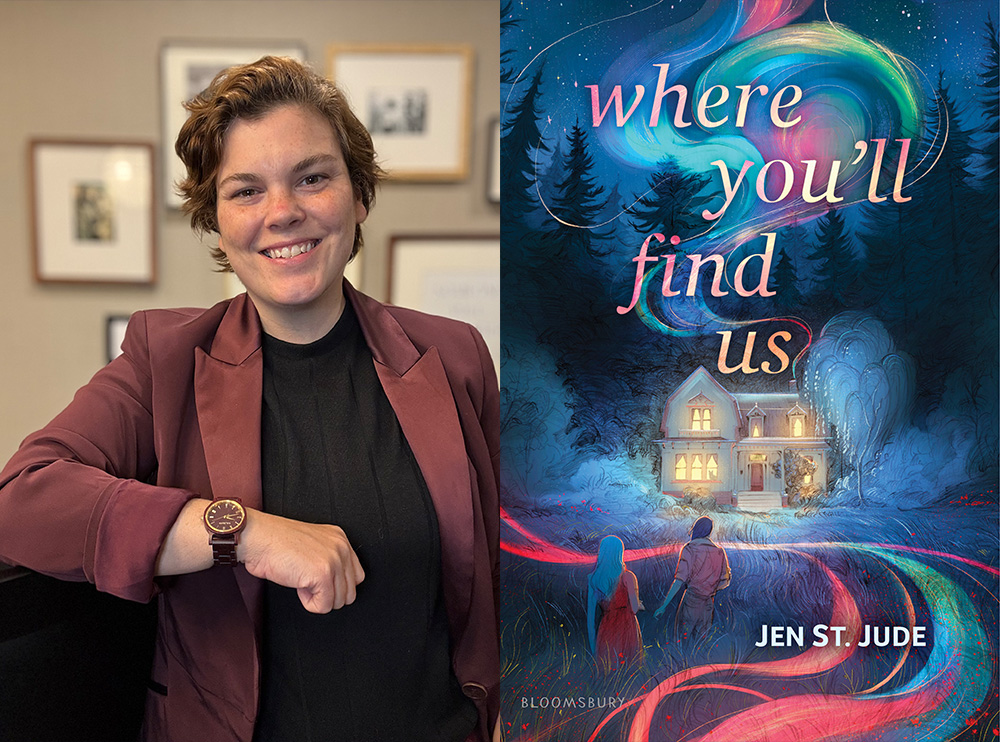
We chat with Jen St. Jude about Where You’ll Find Us, which is a beautifully profound YA novel that follows a trans teen who finds a home where queer kids from all different decades have found refuge from hatred-and from time.
Hi, Jen! Welcome back! How have you been since we last spoke three years ago for the release of If Tomorrow Doesn’t Come?
Hello! I feel like I’ve lived ten lives since then, ha. It’s strange and exciting to have another book out in the world, and I’m so grateful for all the support. I’ve been going by Jude these days as well 😊.
Your latest novel, Where You’ll Find Us, is out now! If you could only describe it in five words, what would they be?
Queer teens find magical sanctuary.
What can readers expect?
Although there are many cozy elements to this story (magical farm house, found family, animals, rainbow sprinkle cakes!) the plot also addresses many types of trauma, prejudice, illness, and isolation. I urge readers to visit my website for content warnings to make sure it’s a good fit for them. Having said that, I always do my best to take care with all of the content and readers’ hearts, and to lead the characters to a brighter place.
Beyond that, readers can expect a story centering gender identity exploration, queer history, and plenty of love of all kinds. I like to think it’s a little funny too, ha. And the last few chapters might make you cry, but I hope in a good way.
Where did the inspiration for Where You’ll Find Us come from?
As I struggled to figure out my own identity, I started to ask myself what it was exactly that allowed someone to do that. Was it easy and obvious for most people? How did people arrive at their labels, their bodies, their identities, with such confidence? Did I just need more time? Or was I not asking the right questions? Or was I really just confused? Or making things up, even?
But I realized I have found myself, and continue to find pieces of myself, in others’ stories. And I’ve discovered fluidity, nuance, and compassion for myself and others by studying queer history. The language and contexts are always evolving, and so are we. I wanted this book to be a love letter to our LGBTQIA+ ancestors, and for their lives to demonstrate how we can survive this current moment in time we are all living through. I wanted to dream up a place that felt magical and safe, and I wanted to bring readers there too.
Were there any moments or characters you really enjoyed writing or exploring?
The ending is my favorite part of the whole book. For all my many messy, chaotic drafts (in one, they all got into a battle with wild turkeys), I knew how I wanted it to end, and that was my guiding light through all of my wandering, musing, and doubting. These characters feel like real people to me perhaps because they’re based on so many very real people with very real stories. I wish all queer people could have time to heal in a house so far from this world, with people to hold them in this one when they inevitably return to it.
Did you face any challenges whilst writing? How did you overcome them?
Oh, so many. The research felt so daunting so I tried to be resourceful with my sources, and leaned on the work of many others. I talked for hours to Hugh Ryan (author of My Bad, Women’s House of Detention, and When Brooklyn Was Queer). I perused oral histories, watched documentaries, and read widely, from books including (but not limited to) works like Before We Were Trans by Kit Heyam, Black on Both Sides: A Racial History of Trans Identity by C. Riley Snorton, Wayward Lives, Beautiful Experiments by Saidiya Hartman, and Coming Out Under Fire by Allan Bérubé.

I also really struggled with tight deadlines since it had taken me ten years to write my first book. And although there was much angst, believe me, the limited time was a gift in its own way (spoiler? Ha). I had to learn to trust myself and my editor, Alex [Borbolla], to not overthink things, to be economical with my time and research, and keep the plot tight and intentional. I am frankly shocked it all came together in the end, but I think it did. I’m proud of this story and grateful to Alex for helping me get there.
This is your second published novel! Were there any key lessons you learned between working on the two?
So many! I have a better handle on the relationships between character, plot, and theme. I
learned more about what excites me as a writer, and naturally, what it feels like to share a story with the world (incredible! And terrifying). Perhaps most of all I learned that I have to be very vulnerable in my writing for the story to feel worth writing. Which is unfortunate, because it’s really hard, and there are sometimes costs involved. And it’s beautiful, too. What a gift to be seen and known. What a privilege to publish queer stories in this moment. I will never stop feeling lucky.
What’s next for you?
The half-true answer is I have an idea for a slightly outlandish adult literary novel, but the truest answer is: a bit of a break. I will always write, and I certainly hope to publish another book one day. But one thing about writing is that it inherently pulls you out of your own life a bit, or even out of your own body. You’re living in your head, in the world of your book, and it demands a lot of time sitting at a computer alone. I have always thought being a dreamy space cadet is a strength of mine, and it is; so much creating happens in that dreaming. But being more grounded, intentional, and present in my life will help me care for myself and the people around me. It will help me become the person who will be able to tell another story that feels worth telling. And I’ve realized I am just now learning how to build a home in myself the way Cal does in Where You’ll Find Us. It’s not easy. I know I need to do it.
Lastly, what books are you looking forward to picking up? Any you’ve read so far this year that you’ve enjoyed?
I read across a lot of age levels and genres, so some recent favorites/most-anticipated include YA books like Devils We Know by L.T. Thompson, This Must be the Place by Kelly Quindlen, There Are Ghosts Here by Adrienne Tooley (forthcoming), Espíritu by Aiden Thomas (forthcoming) and The Divinity Thieves by Aislinn Brophy (forthcoming). And then adult books like My Bad by Hugh Ryan, All This Want and I Can’t Get None by T. Clark, I Love You Don’t Die by Jade Song, How We See the Gray by Rachel León, Crawl by Max Delsohn, and Public Access Afterworld by Jane Schoenbrun (forthcoming).