
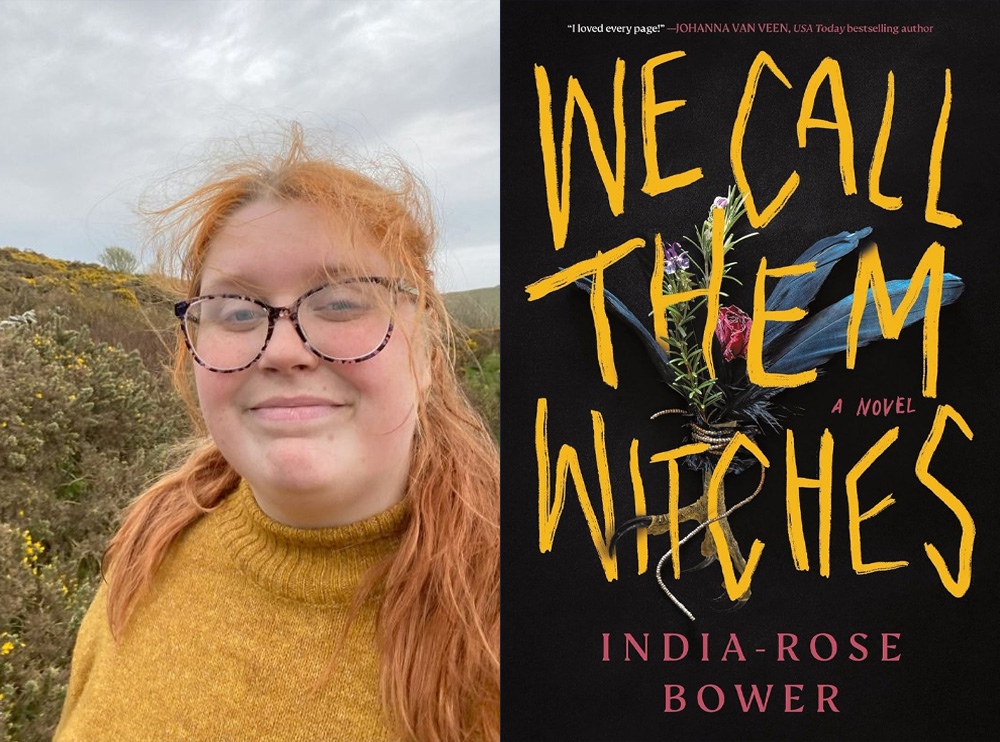
We chat with author India-Rose Bower about We Call Them Witches, which is a queer, post-apocalyptic horror following one woman’s journey across a merciless wasteland to save her brother and confront the dark truth behind the monsters that ravaged the world – with the help of a woman she’s not sure she can trust but can’t help falling for.
Hi, India-Rose! Can you tell our readers a bit about yourself?
I’m a library assistant living in the North of England, mostly surrounded by sheep and geese and moorland. I’ve written my whole life, but I only found my way into horror a few years ago, and I’ve been happily terrifying my family and friends ever since. I have a cat who leaves the room in disgust if I sing, and I like to (badly) crochet weird little things.
When did you first discover your love for writing and stories?
Stories have been a part of my life since before I was born. My family are all big storytellers, but especially my mum and my grandad, who both told me stories my whole life. My mum would make up tales about the places around where we lived, and my grandad was a performer, acting out long, ridiculous ballads or putting on silly troll voices at bedtime. They made it so I grew up in a land rich in stories, they taught me the importance of knowing the traditional tales whilst also showing me the joy in making up my own.
Quick lightning round! Tell us:
- The first book you ever remember reading: Monster Stories for Under Fives by Joan Stimson (there was a great one about a monster called Cyril that plays inside a glass bottle bank).
- The one that made you want to become an author: Pretty much anything by Jaqueline Wilson.
- The one that you can’t stop thinking about: The Salt Grows Heavy by Cassandra Khaw.
Your debut novel, We Call Them Witches, is out now! If you could only describe it in five words, what would they be?
Your childhood fear of darkness.
What can readers expect?
A deeply loving, deeply flawed family just trying to make it through, surrounded by the terrifying emptiness of British moorlands stalked by hungry, screaming monsters. It’s a queer love story and a tale of desperate survival. It’s about the choices we make when fear narrows our vision, but it’s also about love and trust and hope.
Where did the inspiration for We Call Them Witches come from?
I grew up very close to a large wood, where there was also an abandoned hospital. It was fenced off but kids can get in anywhere, and there were plenty of other abandoned buildings in the woods besides the hospital, so I spent most of my childhood playing in a sort of ruined forest like something out of a zombie film. Forests are creepy regardless, and these ruined buildings only made it creepier. I remember running all the way back home after I’d ventured out on my own one day and caught sight of a weirdly bent tree. It wasn’t doing anything, just swaying slightly, its trunk curved in a way that made it look like a hunched woman, watching me from the undergrowth. I had hundreds of experiences like that, times when my imagination got the better of me, and eventually those memories stitched together into something monstrous, something that’s a twisted combination of trees and roots and barbed wire and stone. Something witchy.
Were there any moments or characters you really enjoyed writing or exploring?
The whole family was really fun to write, because there’s so much of my real family in them. Lilian is all the mother figures in my life, Noah and the twins are my sister and cousins. I drew a lot from my own sibling relationships to write Danny and Sara; being an older sister, it was like stretching a new muscle to write from the point of view of a second child. Sara was so fun to write. She’s impossibly stubborn but also very deeply afraid of so many things. She wants to help, to be a grown up, but at the same time she’s terrified of that role. I love a walking paradox, and Sara is absolutely that.
Did you face any challenges whilst writing? How did you overcome them?
Two years before I started writing this book, I got very ill with a chronic illness that runs in my family.
For most of the pandemic, I was stuck in bed, barely able to hold a pen let alone write a whole book. For a while, I gave up on ever being able to write anything longer than a haiku again. By the time I started writing We Call Them Witches, the pain wasn’t gone, but it was (mostly) managed. I would have good days and bad days – and still do – and I was only able to go to my job one or two days a week. Writing was equally a solace and a struggle. It made me feel free from my pain and fatigue on the good days, but there were many more bad days, and on those days, I had to fight just to get a few words down.
Even now, four years after I finished that first draft, I still struggle often. Writing might seem like a

low-energy task, but it really isn’t. It takes up so much energy, from just sitting at a laptop to coming up with the words to put down on the page. It’s exhausting. But it’s also always been my escape, my way to cope with the world and to put into perspective everything I’m dealing with. So while I was hunched in pain over a desk, I was clinging to the hope and excitement I got every time I finished a new paragraph. Disability makes you rearrange your whole life around pain, but writing We Call Them Witches helped me find a new centre for my orbit: joy.
This is your debut novel! What was the road to becoming a published author like for you?
I came across my wonderful agent Alice by entering the Discoveries prize. This is a competition for unpublished women and non-binary authors, and I submitted the first 10,000 words of We Call Them Witches, which was longlisted! So much of publishing is meeting the right people and finding the right team, and I’m so thankful that Alice read my submission and asked for the full manuscript. A few months (and a lot of writing) later, we started working together. Having someone in your corner who knows the publishing world and who gets your book, inside and out, is essential, and I’ve been so lucky to have so many amazing people supporting this book from the very first draft. My best advice for authors is to enter competitions, to go to networking events, and to look for those people who’ll champion your work endlessly.
What’s next for you?
I’m writing. That’s nothing new really, but having a whole new group of readers means I’m writing with a sort of renewed faith. I’m also very busy zipping up and down the country doing panels and talks and meeting lovely people, and I’m getting married later this year. My colleague asked if maybe I had too much planned for this year and I vehemently agreed, before melting into an ooze on the library carpet. Truly, though, I’m loving all of it!
Lastly, what books are you looking forward to picking up this year?
- Milk Teeth by Caitlin Starling
- Buffalo Hunter Hunter by Stephen Graham Jones (I know, I know, I’m behind)
- The Windhover by Lorna Elcock