


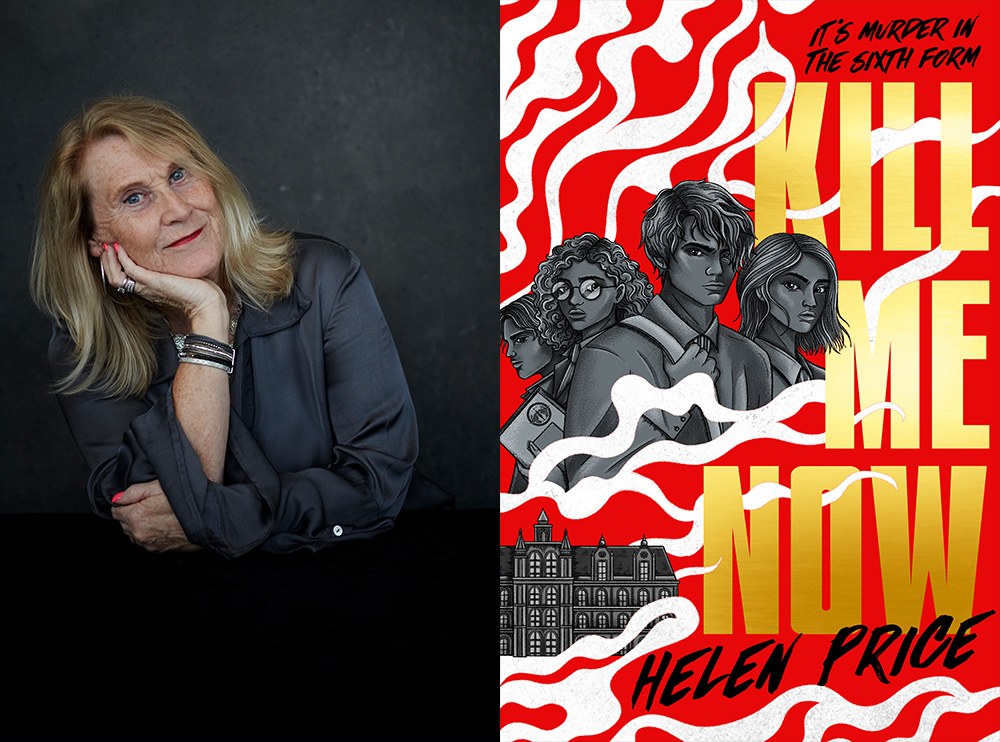
Guest post written by Kill Me Now author Helen Price
Helen Price is a young adult author of high-octane thrillers. After studying languages at university, she built a career in international HR and change management, writing mainly boring stuff like corporate speeches, handbooks, and communications, until fiction lured her in. She honed her craft by studying at The Golden Egg Academy and completed its prestigious mentorship program. Originally from the historic city of Norwich, she now lives in a field in West Berkshire. A black belt in karate, she loves chocolate, her dog, and anything thriller-related, both on and off the page.
About Kill Me Now: Riverdale meets One of Us is Lying, Kill Me Now is perfect for fans hunting for their next A Good Girl’s Guide to Murder obsession. Released February 12th 2026.
Fun fact: the word ‘secret’ (or secrets) appears 43 times in Kill Me Now.
Why? Because secrets sit at the heart of every great thriller. They’re deliciously toxic. Sweet at first. Before they turn bitter. Powerful enough to bind friendships. Before they destroy them.
In most YA thrillers, everyone is hiding something. And the moment a secret is born, tension isn’t far behind. Secrets are seductive. If someone shares one with you, it feels like an honour, an invitation into an exclusive club. But in YA crime fiction, that exclusivity always comes at a cost. What begins as protection, small, contained and seemingly harmless, can swiftly ferment into something sour. In Kill Me Now, it becomes deadly. Secrets don’t stay hidden. They seep into friendships, distort loyalties, and poison the fragile space where trust should live. And that’s where psychological tension thrives.
Adolescence is a time of becoming. Identities are still forming. Moral boundaries are still being tested. The risk of someone knowing who you truly are is beyond terrifying. Teenagers don’t keep secrets because they’re inherently deceptive; they keep them because they’re vulnerable. To reveal the truth is to risk rejection, punishment, or to lose control of their carefully constructed personal narrative.
In Kill Me Now, secrets aren’t simply personal. They’re weaponised, twisted into something far more deadly than the truth.
Set in the claustrophobic town of Langbury, Kill Me Now explores what happens when shame and fear create a culture where silence is mistaken for virtue. When sixteen-year-old Riley North is found brutally murdered, the shock fractures a community convinced of its own moral certainty. The killer sends a message, a chilling warning to the students at Our Lady’s School: “I know who you are. I know what you’ve done.”
Someone’s watching them. And that someone knows the truth. “Keeping secrets comes at a price.” To ensure the tension builds throughout, that price is paid again and again.
In Langbury, secrets lurk in classrooms, friendships and families. Fundamentally, they exist as protection mechanisms. Until they fail. “It’s not a sin to keep a secret, but it is to hide a sin.” In Langbury, a town governed by rigid codes, that distinction swiftly becomes dangerously blurred.
And where secrets exist, lies inevitably follow.
Lies are not simply the opposite of truth; they are the carefully designed scaffolding to contain it. Each lie requires performance. Maintenance. Control. Therefore, any lie hinted at or shared with the reader raises the stakes. “There are as many layers to the truth as there are to the lies we tell to hide it.” Done well, those layers can spawn tension long before the threat of physical danger hits the page.
In Kill Me Now, lies are acts of desperation. Characters lie to protect themselves, to shield others, or to preserve the version of their world they need others to believe. “I’ve never lied to you. I just haven’t told you the truth.” It’s a distinction many teenagers will recognise instinctively – the belief that omission feels safer than deception, even when ultimately, the consequences are the same.
This negotiation between truth and concealment is what drives the story forward. The reader isn’t simply questioning who the killer is, but who anyone really is beneath the surface. What are they hiding? And why? Because in Langbury, exposure doesn’t just lead to embarrassment. It could mean death.
Which brings us neatly to trust – the most fragile element in any thriller.
“‘Trust me.’ Two small words that ask everything.”

Trust in YA crime fiction is rarely stable. It’s tested, fractured, withdrawn and sometimes even weaponised. As Guy Mortimer, Kill Me Now’s unlikely hero, forms uneasy alliances with fellow students in his attempt to uncover the Crosshairs Killer, trust becomes a major gamble. “We confess to the one person we trust because they can’t tell anyone.” It’s a line that captures the paradox perfectly. Trust offers connection, but it also creates vulnerability. To trust someone is to hand them power. Power to control you potentially. Or power to destroy you.
In this respect, Langbury itself acts as an accomplice. A small, claustrophobic town, resistant to scrutiny, invested in appearances. Langbury becomes the perfect pressure cooker. Throw in some secrets, toss in some lies and add a healthy sprinkle of betrayed trust and tension is guaranteed to bubble over. Secrets here don’t just belong to individuals. They belong to the town and those are just as carefully protected, justified and distorted. But when those secrets do come to light, when the ugly truth is exposed, that’s when the tension explodes. Truth is so often described as cleansing. But in Langbury it’s deadly.
“Eventually, we all become the product of the choices we make, the lies we tell and the secrets we choose to hide them.”
Ultimately, Kill Me Now is a story about the very personal reasons we all have for keeping secrets. It’s a story about choice. About the lies we tell ourselves in order to survive. About the secrets we choose to keep because the truth feels too unbearable.
You see, some secrets are secret for a reason.
And in a town like Langbury . . . well, those are better left alone.
KILL ME NOW by Helen Price is out now in paperback published by Chicken House