

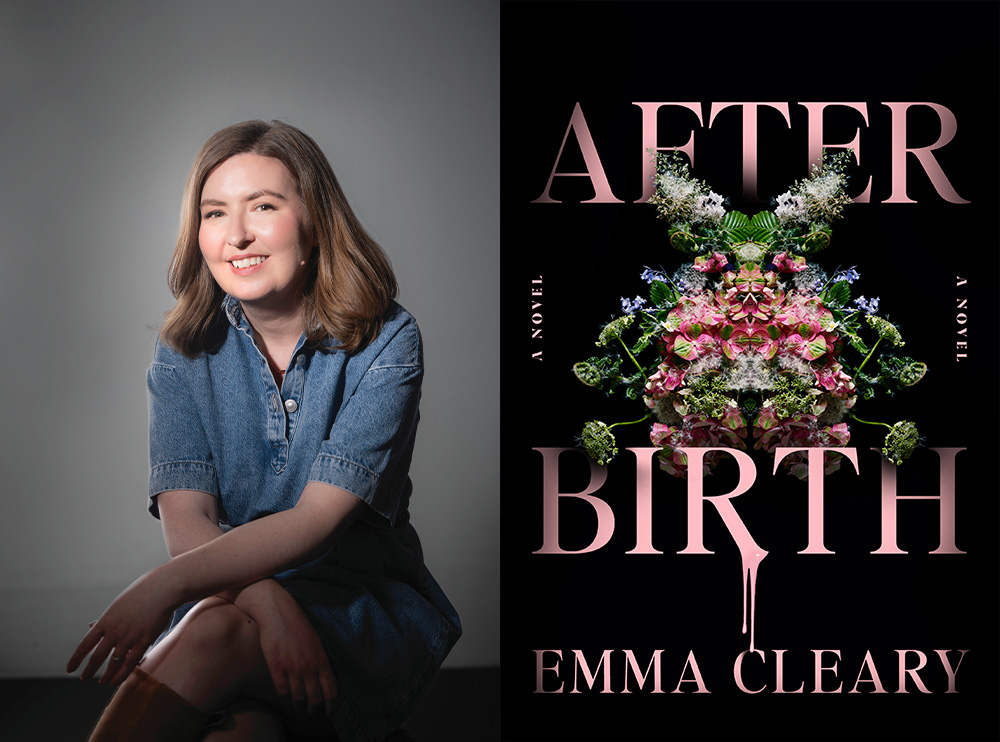
We chat with author Emma Cleary about Afterbirth, which is an unsettling, hypnotic descent into the visceral heart of “mommy horror,” a story of fractured sisterhood, aching hunger, and irrevocable transformation—reverberating with the echoes of classic horror cinema.
Hi, Emma! Can you tell our readers a bit about yourself?
Hello! I was born and raised in Liverpool and have lived in Vancouver, BC for around fifteen years. Growing up, there were always horror novels in the house, so that’s what I read—I also had a pretty strong Buffy habit. I love maps, handwritten letters and community gardens. We’re just getting our garden plot ready for the season. I really enjoy putting my hands in the mud and watching something grow from nothing. It feels a bit like writing in that way.
When did you first discover your love for writing and stories?
I always loved family stories, so my writing is shaped by oral storytelling and a particular sense of humour. When I was about seven I wrote what I can only describe as Ursula fan fiction after watching The Little Mermaid, and turned it into a book with an illustrated cover. I became obsessed with the Brontë’s after a school trip to Haworth—they didn’t have the ropes up in the parsonage back then, and I remember leaning over the small bed and looking out of the window in the children’s study, and maybe even finding their little toy soldiers inside a drawer, though I could be inventing that last part.
Quick lightning round! Tell us:
- The first book you ever remember reading: A book about a ghost girl haunting a school that was maybe told in verse? I have no memory of the title or author, only a vague recollection of the black and white cover—I would love to rediscover it!
- The one that made you want to become an author: My desire to write definitely predated my reading The Secret History by Donna Tartt, but it imprinted on me so strongly that it’s the first book that comes to mind when I try to recollect what I imagined an author to be.
- The one that you can’t stop thinking about: I’ll never get over Hilary Mantel’s Wolf Hall trilogy. I’ve even listened to the audiobooks multiple times. More recently I read Senaa Ahmad’s The Age of Calamities and really admired its range and inventiveness.
Your debut novel, Afterbirth, is out now! If you could only describe it in five words, what would they be?
Yearning sisters conceive something monstrous.
What can readers expect?
A surreal and visceral story of two sisters confronting the idea of motherhood, full of eerie turns. Nursing her own heartbreak, Brooke arrives in Vancouver to care for her sister Izzy as she recovers from reproductive surgery; instead, she discovers that our unfulfilled desires can be strong enough to consume us from the inside out. It’s about the tangled love between sisters, the uncanniness of the female body, and the seductiveness of art.
Where did the inspiration for Afterbirth come from?
I was working on another project that my writing mentor at the time, Hiromi Goto, described as “mommy horror.” It was shorthand for talking about the ways in which becoming a mother, even though it’s often viewed through a soft, gauzy filter, is actually this gory, powerful, primal force that literally alters your skeleton and makes milk from your blood. It makes you at once vulnerable and fierce. After that conversation, I started collecting examples of mommy horror I encountered in literature, art and especially film—horror movies really understand pregnancy. Afterbirth grew from the questions that came up for me as I engaged with those stories, especially questions about transformation, autonomy and monstrousness.
Were there any moments or characters you really enjoyed writing or exploring?
So many! I wrote this book as a kind of tribute to the horror that shaped me across literature, film, and the visual arts. It was a twisted kind of pleasure to gather moments from beloved films like Ringu, The Babadook, and The Descent, take a really close look at them and let their darkness infiltrate the lives of my characters. As a narrator Brooke is preoccupied by the horror movies she consumes, until the horror begins to leak from the screen into her real life. Conjuring ways for this to happen was at once thrilling and terrifying.
Did you face any challenges whilst writing? How did you overcome them?
The biggest challenge was also the biggest reward. There’s such a strong push and pull between the sisters—the way they love each other, withhold from one another, fear one another at times—that getting to the heart of the intimacy and violence of their relationship felt like tapping into something wild and unfathomable. I got there gradually, through paying close attention to the body, and by sustaining the scenes between the sisters until I managed to hit a tender spot, a vein of something shining.

This is your debut novel! What was the road to becoming a published author like for you?
In some ways the road was long and winding. An important milestone was having some of my short stories published in literary magazines, which gave me a little bit of belief in my writing so that I was able to keep going—that’s one of the reasons I’m so passionate about my day job editing a lit mag. Eventually I joined the MFA program at UBC, where I wrote my novel during those early pandemic years. Once I’d written the full manuscript of Afterbirth, it all happened quite quickly—it’s almost a blur! When I got my book deal I was about six months pregnant, and now my daughter is almost two. So it was a slow process of creative discovery, a whirlwind of excitement and interest, then a generous revision process to get to publication day.
What’s next for you?
I’m looking forward to meeting readers at my upcoming book events! I just had a great chat with the receptionist in my dentist’s office about books and the roots of languages and I want more of that, please. I have a couple of writing projects on the go, though they’re both in the early stages, and quite different from one another, which I find really exciting—one is historical and the other is speculative fiction. They have some things in common with Afterbirth, in that they both feature strong relationships between women and they both have an unusual mashup of influences. If Afterbirth is Rosemary’s Baby meets Conversations with Friends, I’m so curious to see how these stories turn out.
Lastly, what books are you looking forward to picking up this year?
I can’t wait to get my hands on a copy of Said the Dead by Doireann Ní Ghríofa, Darkrooms by Rebecca Hannigan, and Library of Brothel by Anakana Schofield.