


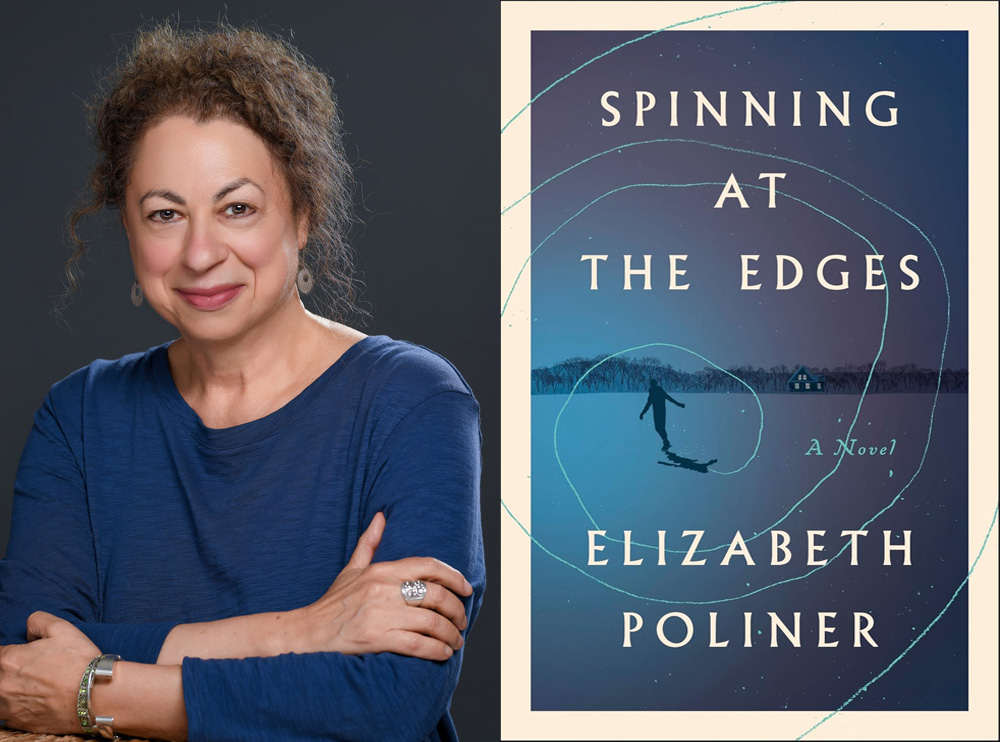
We chat with author Elizabeth Poliner about Spinning at the Edges, which is a captivating novel steeped in history, revealing the bonds of family and community, and the healing powers hidden inside broken hearts.
Spinning at the Edges moves between Nazi-occupied Amsterdam in 1941 and the United States during the contested 2000 presidential election. What inspired you to place these two historical moments in conversation with each other?
At first it was an accident. Stephanie Pearl was the first character to arrive in my imagination, in the year 2000, and she came with two clear attributes: an emotional ache tied to her mother, and the fact that when she was growing up, they occasionally ice skated together—the most joyful part of her childhood. As I developed Stephanie, and as Bush v. Gore unfolded, I saw her as obsessed with the case. For various reasons, I didn’t take the story much further and never figured out who her mother was. But years later, while working on a different novel, As Close to Us as Breathing, I realized that Stephanie’s mother was a Holocaust survivor, which brought these two time periods together.
Once I got working on the novel, it quickly emerged that a theme of law shaped both timelines: Bush v. Gore in 2000-2001 (which ultimately became Ruth Pearl’s concern rather than Stephanie’s), and the anti-Jewish Nazi laws in Amsterdam. I sensed some energy there even before I understood the connection. With time it became clear that in both periods law was being manipulated and misused to gain power, the extreme example of that being the Nazi laws, but Bush v. Gore, with the U.S. Supreme Court deciding along partisan lines (by way of questionable reasoning) the results of a presidential election, seemed, more subtly, to be about that too. With even more time, I realized that this thread was really about how, as shown through law (and its misuses), different kinds of governments impact people’s lives. Arthur Cantrell articulates this toward the novel’s end when he worries that Bush v. Gore marks a shift in America—that the judicial branch of our democracy, by weakening democracy, has taken a step closer toward democracy’s “edge,” and that falling over that edge—into autocracy, say, or dictatorship—could be devastating. The tragic Amsterdam backstory is one example of what it could mean to fall over that treacherous edge.
The novel traces how trauma reverberates across generations—from the murder of Ruth’s sister during the German occupation in the Netherlands to the anxieties of the present-day characters. What interested you in exploring how historical trauma is inherited and lived with decades later?
In the months prior to writing this novel, I was moved by an article I read about how, in scientific studies, the DNA of children of Holocaust survivors was shown to be impacted by the trauma of the parent(s) who lived through the experience. These studies matched, or proved, something I already noticed in human nature: that trauma trickles down the generations in its mysterious way. As it happened, I was already interested in that process of transference, which the studies confirmed, and the dynamic between Ruth Pearl and her daughter, Stephanie, presents one of many possibilities of how that can happen interpersonally. In their case, the traumatized parent is emotionally absent, and the child ends up parenting the parent—living, in a sense, an orphan’s existence, which itself is traumatizing. Stephanie’s aching loneliness, and her tendency to disassociate during the worst of it, is all of that. The analysis can even be taken back a generation, starting with Tessa’s “silence” after Sophia’s death and its impact on Ruth.
I extended the concept to other kinds of trauma, such as Arthur Cantrell’s experience of his father’s violence. Arthur doesn’t know why his father behaved that way, but he finally senses its connection to the imperfect family his father was born into, which makes his father, like Arthur, an inheritor of ancestral pain. As I see it, these experiences of coping with what the generations before have experienced, be it trauma or some other unresolved problem, are universal, or nearly so. And, thus, there’s really not a character in the 2000-2001 time period of the novel who escapes that dilemma just as there are very few in life who escape it.
There’s a recurring circular imagery in the novel—spinning and other ways of going “round and round” like skaters do on an ice rink. How did the imagery of spinning and circular movement in general become central to the story’s themes?
Images in the novel—such as circles, edges, walls, and diamonds—appeared first in their literal sense. In the opening chapter, Stephanie and her friend Rona go round and round at the skating rink, talking as they take laps. But soon enough, the figurative implications of going round emerged, most often as a metaphor for being stuck. Stephanie is stuck in her longing for her mother, and later in her grief for both Rona and Freddy. She can’t move forward in her life but rather circles in place.
Spinning is a kind of heightened going round and round: doing it so fast it’s almost out of control. At the start of their courtship, Sophia spins on the ice for Aaron, flirting with him, and quickly loses her balance. Later, after losing Arron, she again spins on the ice, and does a circular figure eight, as she performs, defiantly and crazily, for the Nazi policemen who are watching her. She becomes their “spinning girl” and ultimately loses her life spinning for them and putting herself at risk in so doing. In the front story, I see all the characters spinning out of control in their way: Willa when she’s triggered by seeing Arthur at the Y and subsequently files an ethics complaint against him, Arthur when he feels he’s being “chased” by Willa in the form of her complaint, Ian when he is rejected by Jase, Missy when she learns about Ian’s suicide attempt, and on and on. Behind all this are two historical time periods, and they are spinning too: the earlier time period of heightened fascism clearly showing a government already out of control, the latter time period of Bush v. Gore showing a government that might spin out of control someday if democratic norms and practices are weakened.
The points of view in the novel are spinning too, something I didn’t think about until near the end of the writing process. But it made me—craft nerd that I am—happy to see this confluence of form and content.
To me, the most poignant example of going round and round in the novel is the journey the Portuguese Jews made in the 1600s to Amsterdam, fleeing Jewish persecution from the Inquisitions, only for the Jews of Amsterdam in the 1930s and ‘40s, upon suffering Jewish persecution from the Nazis, fleeing right back to Portugal—those who could flee and who could make it. I see this slow-forming circle as capturing the endlessness of the story of Jewish persecution.
Did any aspects of writing the book surprise you? In your research, were there particular moments or discoveries that altered the direction of the novel as you were writing it?
Many aspects of writing the novel surprised me. I was surprised when I first realized there was law in both the backstory and front story. I truly didn’t see that coming until I wrote the first scene of the front story (not the first in the book, but the first I wrote), which was Stephanie and her mother visiting the Bishop’s Garden in Washington, D.C. and discussing Florida’s too-close-to-call post-presidential election predicament, dangling chads and all. And then, right after that, I wrote the first Amsterdam scene which involved the two sisters, Ruttie and Sophia, sneaking into Oosterpark and skating there at night, in violation of the ban that Jews do not enter the park. The scene closes with a mention of the “terrible new laws” and lists a few of them, and when I finished writing it I sat there, with my hand over my mouth, astonished to discover law playing a role in both time periods of the story. That moment of astonishment began a long journey for me of exploring law, and how it functioned, more deeply in both time periods.

Another wonderful surprise was learning that the seventeenth century philosopher Spinoza was born and raised in Amsterdam, and I instantly knew he’d find his way into the novel. Learning about Spinoza’s work—which took time; he’s quite difficult—was so enriching for me, and his presence and beautiful philosophy of peace turned out to resonate so well thematically with the novel.
At its heart, Spinning at the Edges explores how people carry grief and uncertainty while still seeking connection and meaning. After spending so much time with these characters and their histories, what stayed with you most deeply?
Many things have stayed with me, but perhaps most of all is the poignant need for all of the characters in the 2000-2001 time period to break free of the isolation of their pain—and how healing it is when they find community. They all find it in different ways, most clearly with Ian, Ruth, and Arthur coming together. But this happens even for Willa, whose heart is transformed, physically and emotionally, in cardiac rehab where she connects with a cohort of other vulnerable, scared people, just like herself.
I’m also moved to recall the moment, near the novel’s end, where Ruth Pearl lists everyone she’ll be seeing soon at Ian’s dance performance—Ian, Missy, Roy Kirk, Maddie, and Arthur Cantrell—and she thinks of them as family just as she puts on her mother’s old wedding ring. The ring, which has survived the long, hard journey from Nazi-occupied Amsterdam to present, comes to represent not marriage but connection and even belonging. That’s a big moment for her and I really felt her journey as I wrote those lines. Stephanie Pearl’s desperate need to connect to Ruth stays with me too, and finally hearing her mother’s childhood story brings Stephanie that sense of connection—and deeper understanding—she has so longed for.
A particular line that has stayed with me is one by Ruth’s father, Jozef, close to his death, when he can’t physically speak but feels he has so much to say to his wife, Tessa, about his “modest but still unfolding understanding of love.” I’m so glad that he’s thinking about love at this moment, and not loss, not bitterness. I think the whole book, really, is about love. How absences of love have impacted the characters, hurting them in different ways, and how community, even community among the broken, can offer just enough love to nudge people forward in life toward more loving futures.