
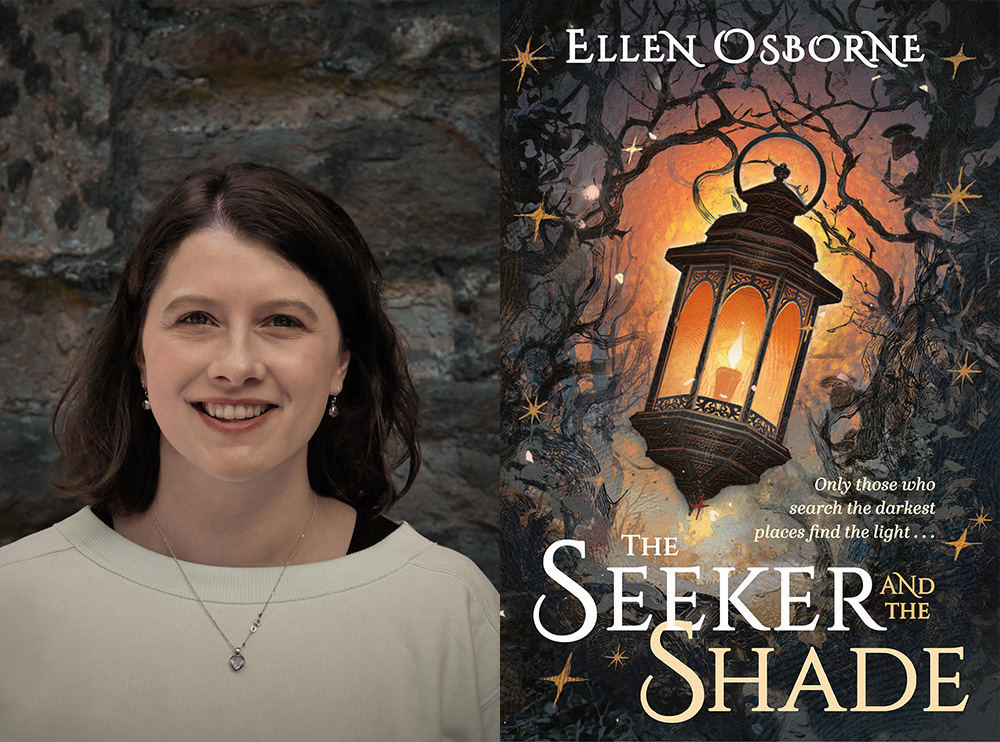
Guest post written by The Seeker and the Shade author Ellen Osborne
Ellen Osborne grew up in Sheffield on the border of the Peak District and still misses the moors. As a child, she spent a lot of time writing long, rambling stories, which somehow over the years have evolved into proper books. These days she lives in Bristol with her young family and you can find her writing around the edges of life. Ellen is the winner of the Guppy Books Open Submission Competition; The Seeker and the Shade is her debut YA novel.
About The Seeker and the Shade: From this must-read debut author comes an intense and compelling romance for young adults featuring all your favourite tropes – enemies to lovers, slow burn, first love, soul- mates, good versus evil. Publishes 14th May – available wherever you buy your books.
Factions, school houses, sides in a war; there’s nothing YA fans love better than picking a side. If there’s more than one love interest, you can be confident we’ll be martialling our energy in support of our favourite – sometimes even shipping the characters that were never supposed to be shipped. Where there’s an ability to unlock or a talent to express, there’ll be a clan to give it a name and shape, and readers will wear their preference as a loud badge of honour.
So why is this genre so obsessed with tribalism? From the ancient beginnings of the YA boom when everyone chose their preferred boyfriend between Twilight’s Team Edward and Team Jacob (though let’s be real, was that ever a legitimate contest?) through to more recent examples like Twin Crowns, where you can favour the leadership style of responsible Team Rose over wild Team Wren (with physical book covers to match!), it seems that there’s never been a time when choosing a side hasn’t been an essential part of the experience.
Them + Me = Identity
The first and obvious answer is that reading is a powerful way to express a sense of self. Whenever we open a book or watch a story, we’re subconsciously looking for ourselves. Whether it’s the choices, background or even just the vibe of a character, we gravitate towards what feels familiar. That’s one reason why diversity and inclusion matter so much and we should continue to champion representation of all readers.
But psychologists go further to say that stories act like mirrors, reflecting bits of our personality back at us – helping us to figure out what our identity actually is. When a character faces a choice, it’s not just a story, it’s an invitation – what would you choose? And when a character makes inevitably devastating decisions, what do you think about that? We love to weigh in, because we love to assert our sense of self and layer over our own unique perspective. By reacting, we’re actually drawing lines around what we care about, how we see the world and what our value system is.
These choices tend towards being black and white because often the characters themselves are understanding their identity for the first time, asking the big questions of ‘Who am I?’ and ‘What ideas represent me the best?’ So we can ask alongside them – and what better playground to explore the answers than the realm of story! Not to mention how fun discerning those labels can be – answering quizzes to get your school house, or as in the hugely popular Divergent series, using personality traits to determine which ‘virtue’ you belong to.
You + Me – Them = Community
Tribes are also excellent openings to interact with a story. We live in a very distinct age of storytelling. We are saturated with stories. Through the rise of fan fiction and cult followings, the ‘canon’ version of a story no longer exists in isolation. Now we can explore the world on our own terms, create within it, or jump into passionate online discourse about it.
Romance gives a great example for how this plays out. Now romantic leads are not just confined to the book, they are brought alive on social media with fan art, exclusive prints, memes and inside jokes. Sometimes I decide to pick up a book based on the fandom conflicts I see playing out! One Romantasy writer I follow has effectively created a social media output from the main character of her book. I already know that central pairing will be right up my street without even seeing a copy of the book – and I’m not the only reader desperate for the release date!
In my opinion, readers pay the material the highest compliment when they find it rich and delightful enough to have fun with. By choosing their ‘side’ within the story, they’re already emotionally invested before the book has even hit shelves.
Us x Them / The World = Understanding
I passionately believe that literature is a safe canvas for us all to navigate the intricacies, wonder and horror of our world, to help us understand why things are the way they are, why people act the way they do, and what really matters to us personally.

In the tribes of Young Adult stories, we see this mapped out to the extreme. There’s an academic theory about storytelling put forward by a famous guy called Lévi-Strauss that talks about ‘binary oppositions’. Basically, as humans, we view the world through opposites, light vs dark, good vs evil, and so on, and when we lean into these concepts in storytelling, we’re allowing our readers to feel the difference between opposing forces rather than trying to describe them.
No wonder then that we see similar ideas crop up time and again in these stories – wars with opposing sides, factions with different characteristics, end-of-the-world-scenarios with green shoots of hope, the love triangle of impossible choice… These are perfect vehicles for us to absorb the contradictions we experience everyday. By translating them into the medium of story, and turning up the contrast, we can actually see them more clearly.
In my debut, THE SEEKER AND THE SHADE, the route to being a caster or a seeker is not the same, and the roles attract different personalities. Casters must be perceptive and seekers must be brave. But crucially, they’re both needed, and they both need each other. At its heart, it’s a story about how the best partnerships embrace difference. The ‘tribes’ of a story have a curious power to root us, while at the same time, expand our understanding of those who think differently – ultimately drawing us into a deeper connection with them.
So what are you waiting for? Pick your side!