


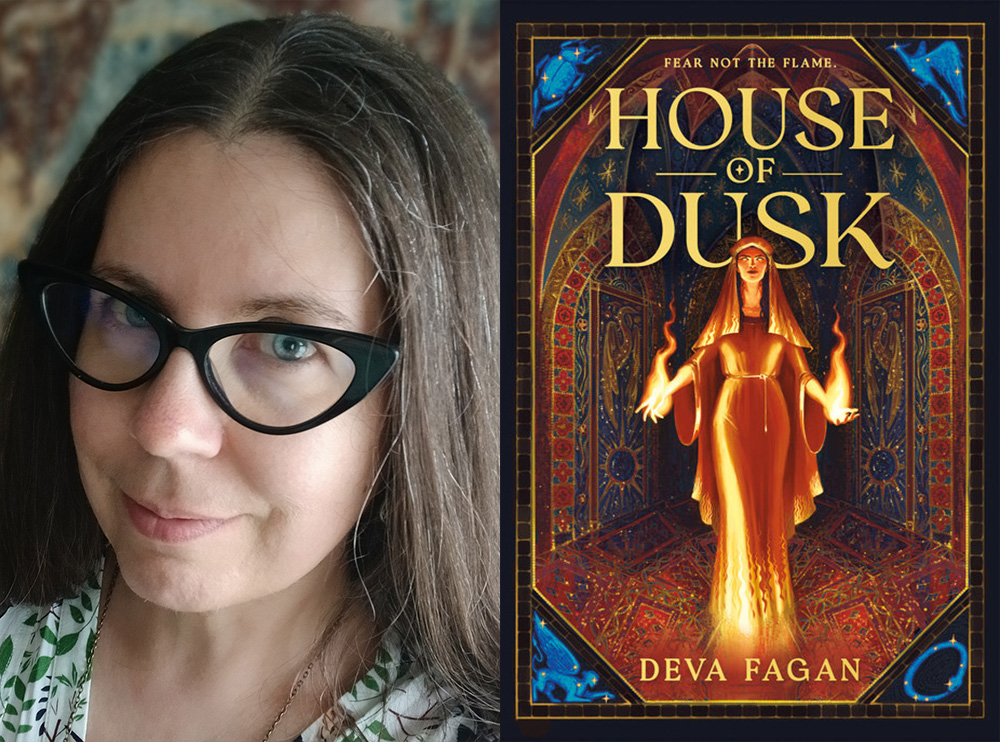
Guest post written by House of Dusk author Deva Fagan
Deva Fagan writes fantasy and science fiction for all ages. When she’s not writing, she spends her time reading, doing geometry, playing video games, LARPing, and drinking copious amounts of tea. She lives in Maine with her husband and their dog.
About House of Dusk (out August 26th 2025): A romantic epic fantasy featuring a fire-wielding nun grappling with her dark past and a young spy caught between her mission and a growing attraction to an enemy princess. With complex relationships, a rich and mythic world, and brisk pacing, this standalone novel is perfect for fans of Tasha Suri, Samantha Shannon, and Shannon Chakraborty
I met my husband at a LARP. We were both elven paladins fighting valiantly against the hordes of evil when his shield was shattered, leaving him vulnerable. At roughly the same moment, I was struck down. He knelt beside my bleeding corpse and…stole my shield so he could keep fighting! (He did return to make sure I survived, and he returned my shield, and we’ve been together 25 years now so I did forgive him!)
But LARPing has brought more than true love into my life. It’s also taught me so much about storytelling. Here are a few of those lessons:
Black Plastic Tarps and Halloween Zombies
Like many LARPers, I dream of running a game in a real castle with museum replica props and movie quality FX. But like many LARPers, I don’t have the budget for this! More often than not, my “dungeon” is a garage covered in black plastic tarps, a smoke machine, and three NPCs wearing Halloween zombie masks. But that’s okay! Because what really makes the story come alive isn’t a perfectly rendered environment that’s completely true to life. It’s the horrific groans of the zombies as they loom out of the darkness. It’s the gorgeous grimoire prop sitting in the center of the room, surrounded by a ring of flickering (electric!) candles that an eerie glow across the scene.
You don’t need to describe every single detail in a scene. If you can put your effort into making a few vivid elements stand out, that can be all you need to fully ground your reader (or your player) in the world, fighting to seize the cursed grimoire from the zombie horde.
The Random Pickle-Seller versus Twenty Pages of Carefully-Crafted Lore
One of the most frustrating things for me, early in my LARPing career, was this: I’d spend hours writing up a twenty page plot full of juicy, complicated lore.Then I’d send it out, expecting players to jump all over it. But no. They ignored it to spend more time with the random pickle-seller I sent out last-minute with barely any backstory and absolutely no plot significance.
The thing is, you can’t always tell what’s going to click with people. And while there were definitely times I went back to rework my twenty-page plot to make it more appealing, more often than not I chose to let it go and put my energy into giving that pickle-seller a cool backstory and figuring out a way to work them into the story.
As a storyteller, I have to be flexible and adaptable. I’m an outliner, but that doesn’t mean I stick to my outline no matter what. Sometimes a plot element I’m convinced is the Best Thing Ever turns out to be boring when I actually try to write it, while some other tidbit I throw in while drafting ends up becoming a major plot element.
A Fate Worse than Death
When I first started running LARPs, one of the things I dreaded most was coming up with the Big Climactic Battle plots. The sort of encounter where the entire town rallies together to fight off some enemy. The thing was, I’d always been more into the lore and the role-playing elements of LARP. A giant fight seemed…boring. Partly because the games I played all had magical healing and resurrection. What was the worst that could happen? There wasn’t a serious threat of death, so what did it really matter if an army of demons was marching on the town?

Fortunately, I had plenty of more experienced plot-writers to learn from. I had examples of Big Climactic Battles that truly devastated me as a player. Battles where if we lost, an ancient and irreplaceable library could be destroyed. Battles where the enemy didn’t WANT to fight us, and we were in a desperate race against time to free them and it was killing, not being killed that was my biggest fear. Battles where more was at stake than just my life.
Because that’s what really matters.. Not the fight itself, but what the characters are fighting for. In both LARP and fiction, I always want to dig deeper, to ask whether there’s something harder, more costly. A fate worse than death.
So those are three storytelling lessons LARP given me: focus on a few evocative details, be willing to adapt, and dig deep for meaningful stakes. If you also love story-telling (or just really want to slay some zombies) I encourage you to look for a LARP in your area and see what it can teach you!