


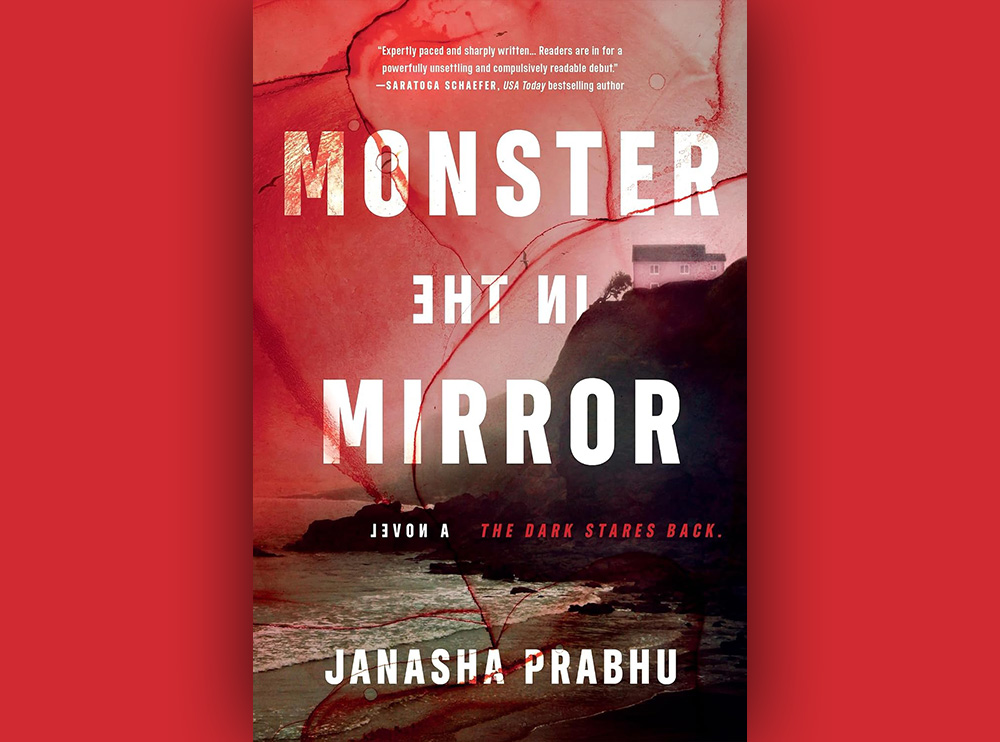
Dark, twisty, and atmospheric debut thriller for readers of The Quiet Tenant and The Butcher.
Intrigued? Read on to discover the synopsis and an excerpt from The Monster in the Mirror by Janasha Prabhu, which releases on October 20th 2026.
Her uncle was a serial killer. The town whispers, could she be a killer too?
On the night Jiah Rai was found cradling her girlfriend Georgia’s dead body at the bottom of Wailing Cliff, everyone suspected her. There wasn’t enough evidence to charge her, but the town refuses to forget. Murder must run in the family. Jiah’s uncle was a convicted serial killer, and while he died behind bars, his legacy lives on in Jiah and her sister. It doesn’t matter that they’ve lived in Dumont their whole lives―they have never fit into the insular white community, and perhaps they never will
But legacy isn’t done with Jiah just yet. A few years later, a threat from Georgia’s brother threatens to crumble the shaky peace Jiah has rebuilt. Desperate to feel safe again, Jiah decides to take matters into her own hands and seeks support from her best friend, Estrella. After all, Estrella has been there for Jiah ever since they met after Georgia’s death. But when Estrella never shows up to a dinner party, a series of texts lead Jiah to the beach below, where she finds a body positioned exactly how her uncle displayed his victims over a decade ago. The killer mocks Jiah, hinting they know about her secrets, too. But is Jiah really the monster Dumont thinks she is? As Jiah hunts the killer, she begins to realize she might be unable to save the next victim…and that she may not want to.
Chapter 1
The rabbit lying gutted on my front porch had, of all things, a note pinned to it—held perfectly in place by a long stick shoved straight through its right eye.
I’d pulled into my driveway and there it sprawled, lit up like a macabre prank in the headlights of my car. I stepped around the blood. There was so much, I could smell it. It ran, trickling in wet lines from the body, and now it pooled thick and dark on the wood. I heard the faint patter of it where it dripped down through the planks to the ground below.
It’s going to stain, just sitting like that, I thought. A bitch to get out. You may have to repaint.
I knelt by the body carefully, slowly, setting my grocery bags down beside me, making sure I didn’t crush the eggs. I flipped on my phone light.
The paper note was thin and baby blue and covered in text. The stick punched a neat hole through the top of it, skinny and jagged. I grabbed it. My fingers shook a little from the adrenaline.
My gaze drifted back to the rabbit. It didn’t look wild. It looked like one of those big-eyed ones that hopped around their straw pen at the pet shop in the mall, little noses twitching. The ones with the floppy ears.
Bunny, I heard in my head, a voice from another time.
The other eye, the intact one, was milky-white, glazed, and unseeing. The bunny’s soft belly gaped wide, slit from sternum to hip, glossy innards slipping out to curl in loops against its matted fur. Despite all that, the killing blow had been the broken spine. I could tell by the angle of the long torso that whoever did this had taken that thin line of bone between two hands and jerked it in on itself. Could tell by the shy peek of its bones through the blood and the fur. Everything else came after.
Flies already buzzed around the body in the summer heat. I pressed two fingers into the fur at the rabbit’s back, feeling for warmth, and glanced over my shoulder toward where I’d parked my car in the drive. The yard rolled away in shadows, the trees lining it even more indistinguishable. It was a cloudy night, humid and dark. I heard nothing but the murmur of the wind through the woods, the distant crash of water against rock down on the beach below my house.
Don’t you think he could still be out there? I asked myself. Don’t you think you should get inside? He’s spilled blood.
I got up, unlocked the front door, and stepped inside, leaving the rabbit behind. Madeline, my blond streak of a cat, came immediately to curl around my ankles, and I was thankful for her warmth, for the light I kept on in the living room. I’d adopted Madeline with Georgia a few weeks after we started seeing each other—a spur-of-the-moment, spontaneous decision made after sex and too much wine. Georgia had named her the moment she’d seen her.
I hadn’t sensed anyone outside, but the blood slicked damp on my fingers, fresh. I was tired and hungry, the beginning of a horrible headache edging along the back of my skull. If Clark Graves was still watching me in the dark, I was no match for him in my current state.
Because it had to be Clark coming for me. I knew the moment my headlights illuminated the dark wet seeping down my porch steps.
Before it was the thick red sludge splashed over my windshield while I was at work, following the lewd graffiti at Reid Park, calling me a whore. Prior to that, the drunken rants in front of the Abbey, the one bar in town, and even farther back, the restraining order, after he left me with a black eye. All of it always led back to Clark.
Funny how a man I barely knew—had hardly ever spoken to—had become a shadow in my life. All because I loved his sister, his twin. Because I witnessed the unthinkable the night Georgia fell to her death.
I went to the kitchen to wash my hands and put the eggs and milk in the fridge. I poured a glass of water, pulling my sweaty, tangled hair back from my face after I’d drained it. Then I pulled the note from my jeans pocket and smoothed it in my hand to read it. I noticed an unfamiliar phone number printed below the words.
Only then, as my eyes slid over the lines of typed letters, did I finally feel afraid. Bile rose in my throat, sour and sickening. There was a distant thudding in my ears. For a moment, I couldn’t catch my breath, but when I did, the words on the note were crystal clear.
Your sister walks alone every night, it read. When it gets dark, it’s hard to see her. If I ran her over, what do you think the police would say?
Accident or murder?

Chapter 2
Dumont, like a lot of things, wore a mask.
Some mornings it was just a town—a small, seaside community nestled to the rugged breast of east New York. It was a two-hour train and bus ride to the city and closer to Montauk than Manhattan. A stubborn knot that consisted of a grocery store, two gas stations, one outdated mall, the police station, a hospital, and a convenience store with one pharmacy. It all fell together into a picture-perfect postcard, battered and caressed by the wind that blew in from the ocean.
Some days though, Dumont was disjointed, a drunken look into the mirror. The unfamiliar face looking back.
The forests grew dark and deep, their shadows and tangled roots pushing the rest of the town away. The sea shoved from the other side, the waves like hard fists. The old Victorian houses watched over it all, an audience of yawning windows and creaking porches, of dark eyes and rot-damp mouths.
Despite this, the town was close-knit. It was safe, everyone said. The kind of place to raise a family, settle down, knock on a neighbor’s door and expect to be greeted with a smile and an invitation inside.
Safe if you ignored the iced cliffs in the winter, the reckless college parties on the beaches during the summer, the deadly riptides that could snatch even the strongest man off his feet. Safe if you ignored the whispers, the words behind closed doors, believed the headlines and went about your way, telling yourself that nothing like that could ever happen to you.
A safe town, until you looked closer, deeper. Until you found yourself staring into the dark jaws of a monster, and then realized you were looking at yourself.
After all, push anything you think is innocent, weak, or soft too far, and it will undoubtedly turn on you the moment it gets a chance.
Later that night—when I couldn’t sleep, and I felt sure Clark had gone—I scrubbed the blood from my porch and thought about what I’d do.
In the end, the blood did leave a stain.