


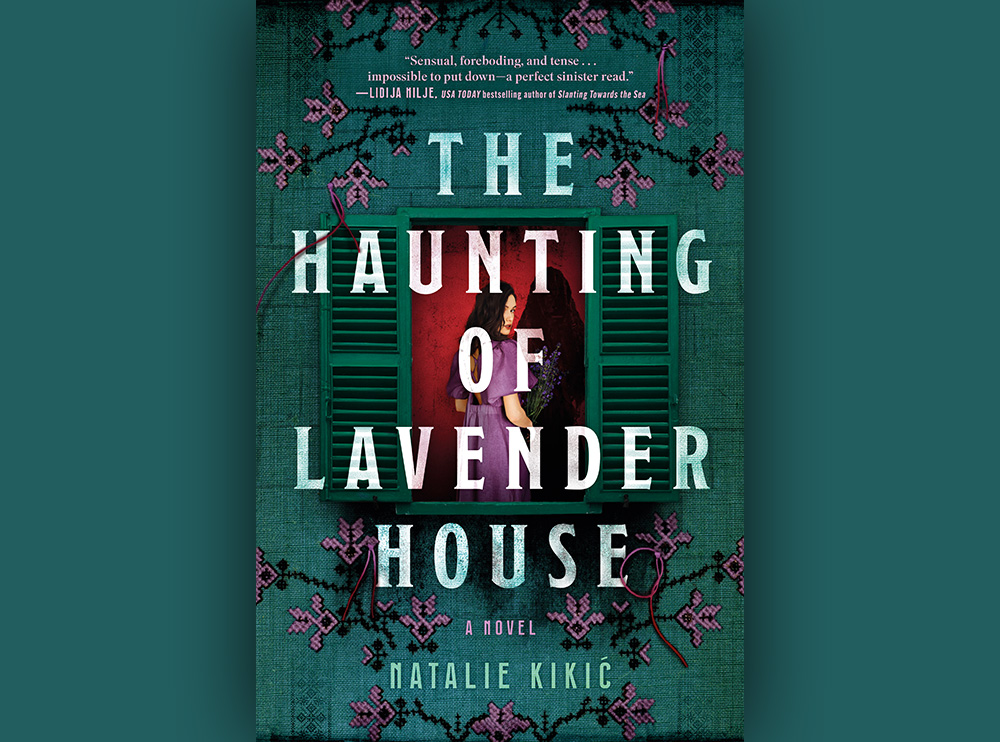
A crumbling home surrounded by lavender fields. A decades-long curse. A nightmare from Croatian folklore with a thirst for blood. The Lost Apothecary meets The Hacienda in this multigenerational, haunting gothic saga set on the Adriatic Sea.
Intrigued? Read on to discover the synopsis and an excerpt from The Haunting of Lavender House by Natalie Kikic, which releases on October 20th 2026.
2026. All Petra has inherited are tales of loss. Which is why, after her mother’s passing, she is shocked to learn that her grandmother is not dead like she’s always believed, but alive and living on Tolba, a small island in Croatia. Desperate to find her last surviving family member, Petra ventures to her ancestral home, famed for its sprawling lavender fields. While she’s happy to be reunited with her grandmother, rarely does a night go by that Petra doesn’t lose herself to vivid nightmares and the dizzying sense that something—or someone—is always watching in Lavender House.
1895. Whore. Sinner. Witch. No matter how many people Magdalena heals, the rumors persist. So, when she’s asked to help the matriarch of Lavender House, she seizes the opportunity to rehabilitate her reputation. As Magdalena races against time to heal the ailing woman, she finds herself unexpectedly falling for the son of her greatest enemy, the man responsible for her ostracization. But are true love and acceptance possible for a woman who has always lived on the margins?
Back in the present, Petra finds it increasingly difficult to ignore the rumors plaguing her family: that a mora, a spirit from Croatian folklore, haunts Lavender House for revenge. As the sole heir to Lavender House, Petra must discover the truth of her inheritance, or else fall prey to the same curse that claimed her family.
Through the intersecting stories of Petra and Magdalena, Natalie Kikić’s gorgeous debut asks us to consider the lengths to which we go to belong, the cost of choosing love, and what it really means to be a monster.
EXCERPT
The island looms on the horizon, emerging from the water like an emerald mirage.
As the ferry draws closer, I wait for it to come: a tug near my heart perhaps, a flush of warmth spreading through my chest. That feeling people always talk about when they discover their roots, venture to their ancestral homeland. After all, Tolba is where my mom grew up, where she met my dad, where he died. But all I feel is a faint churning in my stomach, a prickling down my spine. This island has only ever been a mystery, a place never meant to be found. My mom made sure of that.
As a curt voice calls across the ferry, my mind clambers to interpret: Final stop. Tolba. Inhaling a deep breath of briny air, I skim the worn letter in my hands. Though it’s written in sprawling Croatian, I’ve reread it so many times that I’ve memorized the translation:
Dear Petra,
Thank you so much for reaching out, and for telling me about Marija’s passing. It pains me that she deceived you about my death. But it also doesn’t surprise me, with the way she abandoned me, our home, so harshly.
Would you like to come visit? I would dearly love to meet you.
With love, Your baka, Karmela
I stare at the word baka. Grandmother. I’m still getting used to the idea.
A photograph had accompanied the letter. I slide it out from behind the parchment. The back reads Jugoslavija 1989, while the front features two women.
I glance over Karmela’s modest blouse and honey-blond hair to focus on her smile. It’s gentle and inviting—an encouraging sign. I’d always been envious of my friends with grandmothers. The sage wisdom they passed down. The soft affection they emanated in a simple touch, a silent look. Maybe, now, I could have that too.
For a moment, I close my eyes and let my dreams dance across my mind: me arriving, us embracing. Her showing me her rustic home, where we eat and talk and laugh together for hours. Ever since I lost my mom, I’ve felt lost and adrift, but Karmela would change all that. Once we were together, I would finally feel whole again. At least, I hope.
My throat tightens as my eyes stray to the other woman in the photo. Some people have said I resemble her, with our matching dark hair, the spray of freckles over our twin noses. But I have never looked this radiant: tanned skin glowing against a summery red dress, wavy locks tumbling over slim shoulders, a carefree smile splayed across her face. So different from the serious woman I grew up with, who preferred muted colors and kept her hair meticulously pinned up. Back then, she wasn’t Maria, as I knew her, but Marija.
Majka. Mom.
The person who no longer exists from the country that no longer exists.
A part of me feels I should be sadder that I’m making this journey without her. But gazing at her taunting smile, all I can think of is one word burning in my chest: Liar.
A boisterous laugh pulls me back to the present as the ferry docks. The other passengers have already risen, their voices chat-ting excitedly in Croatian, brimming with rich ch’s and trilling r’s. Tucking the letter and photo back into my purse, I attempt to maneuver to the back of the line. Amidst the bustle, I accidentally step on a woman’s foot, and she curses, giving my vintage Manolos a sour look. They used to belong to my mom, and though I didn’t share her love of luxury brands, shoes were the one exception. I’d hoped the low, chunky heels would make a good impression on Karmela, but my feet already ache for release. “Sorry,” I say quickly. “I mean, oprostite.” The word tumbles out jagged and awkward from my mouth. It’s been years since I’ve spoken the language. To hide my embarrassment, I pull out my phone and double-check the last message from Karmela. She
had given me her phone number at the end of her letter.
Naći ćemo se na mulu. I will meet you at the pier.
Anticipation surges through me. As I heave my suitcase down from the luggage rack and step onto the landing outside, sunlight floods my vision. I lower my sunglasses from my head, squinting to make out the details of the island before me.
A row of wooden boats line a cement pier, bobbing up and down in a gentle current. Rugged rocks line the shore, transforming into rustic buildings with orange-tiled roofs and quaint cafés with umbrellas perched over picnic tables. Interspersed among them rise tall cypress trees, like deep green slashes of a painter’s brush. But what draws my eyes the most is the water.
It’s . . . ethereal. A bold shade of aquamarine, the subtle waves flashing like gems catching the light. Far different from the dark, murky water I’m used to back in San Francisco. The stunning scene should put my mind at ease; instead, it makes me wonder: Why would my mom abandon such a beautiful place?
I turn my attention back to the pier. I’d read online there are currently less than 120 residents on the island, yet it seems like a quarter of them are gathered here, waiting to greet the new arrivals. I search the crowd for some sign of Karmela, but all the faces blend together. Everyone is a stranger here, even family.
As I carefully step down the ramp off the ferry, the people converge on the other passengers, kissing and hugging with the exuberance of long-lost family and friends. I scan the crowd again with nervous excitement, combing my bangs into place and fanning my oversized blouse away from my sweaty skin. A few people turn and stare, their eyes scrutinizing. Where is Karmela?
I’m about to pull out my phone when I hear my name. “Petra Babić?”
A tall, bearded man with dark hair and sunglasses emerges from the crowd, approaching me with quick steps. He looks about my age, in his late twenties or early thirties. “Yes?”
“Super,” he says, though his tone is less pleased. “I’ll take that.” As he reaches for the handle of my suitcase, I instinctively pull it toward me.
“I’m sorry, who are you?”

The man frowns as he raises his sunglasses onto his head. “You are here to visit Karmela, right?”
“Yes,” I hesitantly agree.
“I am Luka, her neighbor. She asked me to come get you.” A slight accent curls his words, though it’s not as harsh or heavy as others I’ve heard. As he speaks, he skims my figure, arching a stern brow at my shoes.
I stand up straighter, wiping a bead of sweat from my brow. Why didn’t she tell me this? I reach for my phone, to check if I missed anything.
As if he read my thoughts, Luka says, “She only asked me a few hours ago. I didn’t bother to send a message.” He takes out his own phone from his pocket. “I’m the one texting you. Karmela doesn’t have a phone, so she uses mine.”
Staring at the screen, I think of the stream of messages Karmela and I exchanged over the past few weeks. They were short and sporadic, just enough to arrange this trip. Still—the thought that they were being filtered through a random guy irks me. My shoulders sag in disappointment. Why didn’t Karmela come to greet me herself?
“So, can we go?” Luka asks, cocking his head. “Not all of us are on vacation here.”
I cast him an irritated look. I certainly wouldn’t call meeting estranged family after your mom died a vacation.
“Sure.” I grab my suitcase, following his lead toward a golf cart parked nearby. There are several other golf carts on the pier—it seems to be the preferred method of transportation.
As Luka lifts my suitcase onto the back, a man with tanned, leathery skin walks by, his eyes raking over my legs before he throws me a wink. “New girlfriend?” he asks Luka in Croatian.
Luka scoffs in response. “No. Karmela Petrov’s granddaughter.” My grandparents’ surname. “From America,” he adds in a scornful tone.
A spark of irritation flares in me, though I’m not sure which part bothers me more—the guy checking me out, or Luka’s dismissal. But then the man’s leery smile vanishes, and his eyes widen with astonishment—or fear.
Luka doesn’t seem to notice though. He settles into the driver’s seat beside me, then asks in a brusque tone, “Ready?” Despite the wave of anxiety that washes over me, I answer,
“Yes.”
Excerpted from The Haunting of Lavender House. © 2026 by Natalie Kikić, used with permission from Park Row Books, an imprint of HarperCollins.