

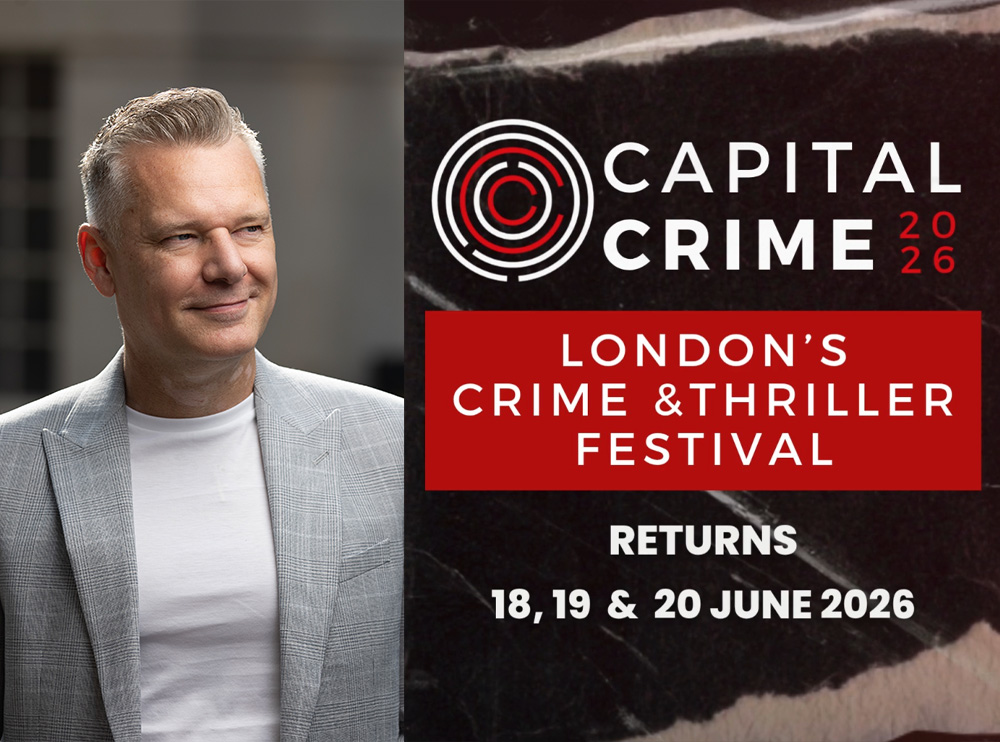
Today we’re delighted to be joined by the exceptional David Headley, one of the most influential people in the UK book industry and far beyond. He is talking to us about his career so far, legacy and Capital Crime, London’s biggest celebration of crime writing. Capital Crime takes place on the 18-20 June 2026, so you still have time to snag a ticket.
Hi, David! Please introduce yourself and explain what Capital Crime is.
I’m David Headley, co-founder of Goldsboro Books, founder of DHH Literary
Agency, co-founder of Capital Crime, and host of podcast Confessions of a Book Collector. My life has been built around connecting readers with stories, whether that’s through bookselling, representing authors, interviewing writers, or creating festivals and communities around books.
Capital Crime grew out of a very simple idea: readers deserve a festival that feels built for them.
Of course, publishers, agents, and authors attend, and that’s wonderful, but my ambition was never to create an industry gathering. I wanted to create a true readers festival. A place where people could meet their literary heroes, discover new voices, and feel part of a passionate community, which is what still excites me most.
How did the idea for Capital Crime come about?
It started in the back of a cab in New York after attending ThrillerFest. I remember thinking: why doesn’t London have a major crime festival that truly reflects the scale and passion of crime readership?
Crime readers are incredibly loyal and community-driven. They’re adventurous; they don’t mind trying new things or discovering debut authors.
We wanted to build something warm, exciting, accessible, and entertaining. A festival where readers felt welcomed rather than intimidated. Capital Crime was built by readers, for readers.
What excites you most about Capital Crime this year?
Our brilliant programme. It never stops amazing me seeing thousands of readers gathering because they love stories, meeting their favourite writers, and finally seeing the online friends they only ever meet at Capital Crime.
One of my favourite things is watching someone arrive, desperate to see a huge bestselling author, and then leave clutching three debut novels they’d never heard of two hours earlier. That feeling of discovery is magical.
Personally, interviewing authors has become one of the unexpected joys of the festival for me. Interviewing Kate Atkinson was a huge moment because it was the first time I’d really put myself on stage in that role. I was nervous because I admire her enormously and wanted to do her justice. Readers loved it. The same happened with Adele Parks. People kept commenting on the chemistry and how entertaining and natural the discussions felt.
I learnt that readers want real conversations: spontaneity, humour, and honesty.
Something genuine rather than hearing polished answers they could find online. That gave me enormous confidence, and this year I’ll be interviewing Jeffrey Archer and Clare Mackintosh. No pressure!
The Capital Crime Social Outreach Initiative is commendable. What does it mean to you and how would you like to see it expand?
Reading should never feel exclusive.
Books changed my life, and stories have this extraordinary ability to build empathy and understanding. They allow us to step into other lives and experiences. That feels incredibly important to me.
The outreach initiative matters because it helps remove barriers. It shines a light on publishing and demystifies the industry for younger people who love books and reading but perhaps don’t believe there’s a place for them within it. There absolutely is.
There are so many different careers within publishing, bookselling, festivals, marketing, editorial, publicity, and rights, and we’re passionate about getting that message out to younger people from diverse and lower socioeconomic backgrounds.
I’d love to see the initiative continue expanding into schools, libraries, and community groups because if we want reading culture to thrive, we must actively nurture future readers. Publishing sometimes talks a great deal about readers without always truly listening to them. I think readers are hungry for connection, authenticity, and spaces where they feel they belong.
How do you find the perfect balance with pairing authors?
The key is chemistry and conversation. Sometimes authors are paired because they write similar books, but often the best discussions happen when two very different personalities unexpectedly spark off each other.
I prepare obsessively. I do my homework because readers are giving us their time, and time matters enormously. This means creating enough trust and confidence that the conversation can become natural and surprising. A bad festival panel feels performative and predictable. A great one feels alive.
What do you want attendees to walk away from Capital Crime with?
Happiness, honestly.
In a world constantly fighting for our attention, spending hours with stories is an act of trust, of giving our time.
I want readers to leave feeling inspired, rewarded, energised, and excited about reading. If someone walks away from Capital Crime carrying books they can’t wait to start, having laughed, discovered new authors, met people who share their passion, and feeling happier than when they arrived, then we’ve succeeded.
What qualities do you look for in an author or book you’re featuring? What does the selection process entail?
First and foremost, it must be a great story.
But beyond that, I’m looking for books that give me that physical fizz of excitement when I read them. That instinctive feeling that this is special and that readers are going to fall in love with it too.
Publishing can become very trend-driven, with everyone chasing whatever worked yesterday. Our job is to look through the noise and try to discover what readers will love next.
How does this differ from the same process with Goldsboro Books and its subscriptions?
There are similarities because both are rooted in discovery and trust. At Goldsboro, we’re often reading manuscripts six to eight months ahead of publication and backing books very early. Readers trust our instincts, and that relationship means everything. I do think people underestimate how visionary Goldsboro was at the beginning. Daniel and I were trying to add value back into physical books at a point where much of publishing was looking towards digital and cutting back on hardbacks.
We believed readers still wanted beautiful books. Not just stories, but sentimental objects they could treasure.
At first, not everyone understood what we were doing. One publisher even referred to us as “an anomaly,” which I thought was rather rude at the time. But eventually they understood. Publishers started sending us manuscripts absurdly early and actively asking for our support. That’s when I realised Goldsboro had become influential. The moments that still move me most are seeing authors walk into the shop and seeing stacks of their books everywhere. You see these huge smiles and wide eyes because, for many authors, it’s the fulfilment of a lifelong dream.
How do you balance all your successful businesses while making time for yourself?
I’m not sure I ever fully switch off – books aren’t just my job, they’re genuinely my passion. The pandemic was probably the most frightening period of my professional life because there were moments where it felt like everything we’d built might disappear. I realised just how extraordinary my colleagues are. They went above and beyond for the business, for readers, and each other. I’ll never forget that loyalty, resilience, and sense of belief in what we were building together.
The experience left me feeling incredibly grateful – for the people around me, grateful for readers, and grateful that we survived it together.
If I ever really need to take time off, I know my team will look after everything for me.
Who has been your favourite podcast guest so far, and who would you love to have on?
That’s impossible to answer because every great conversation is memorable for different reasons. What I love most are moments where something unexpected happens and you suddenly see a different side of someone. Those moments are great because they feel human and unscripted; I think that’s why I’ve increasingly loved interviewing authors live too. Readers respond to honesty and warmth far more than polish.

As for dream guests, the list only seems to grow longer every year.
Your journey into this world is fascinating. Could you share your story and how you came to found Goldsboro Books?
Daniel and I started as booksellers simply because we loved books, and we knew there were millions of people around the world like us who wanted signed first editions and beautiful collectable books.
We had both left seminary and were looking for new careers, but we still carried that sense of community, storytelling, and bringing people together.
We were ambitious, passionate, probably slightly stubborn, and absolutely convinced readers would respond emotionally to beautiful editions.
Thankfully, they did.
What we discovered very quickly is that bookselling isn’t about selling products.
It’s about emotion, connection, excitement, and trust.
I think physical books matter because they become embodiments of feelings and memories. A bookshelf isn’t just decoration. It’s a biography of someone’s life in physical form. That’s why beautiful editions matter so much in a digital world. They allow readers to hold onto the feeling a story gave them.
What would you like your legacy to be?
That I helped people discover books they loved. Everything else, the festivals, the podcast, the shop, the agency, all come back to that simple idea.
Stories matter because they build empathy and connection. If I’ve helped create spaces where readers feel happy, inspired, and connected to books and to each other, then I’d feel very proud of that.
What advice would you give anyone looking to break into the industry?
Be curious. Read widely. Listen carefully. Publishing is a relationship business built on enthusiasm and trust. I’d also say: don’t become cynical. The people who make the biggest difference are usually the people who still genuinely love stories and still get excited by discovery. That excitement matters.
What would your ideal Capital Crime look like in the future?
I’d love to see Capital Crime expand internationally into other cultural and capital cities. That’s been a long ambition of mine, and I think seeing that happen would probably be my proudest moment for the festival. At the same time, I never want it to lose the warmth and sense of intimacy that readers love about it now.
Building a festival that feels fresh every year is an enormous amount of work because readers expect us to keep evolving and surprising them. But they deserve that effort. The fact we have around a 98% return rate still amazes me. That kind of loyalty means everything.
In ten words or less, please summarise Capital Crime.
Where readers and writers come together through unforgettable stories.
Capital Crime, London’s biggest celebration of crime writing, takes place 18-20 June 2026. Learn more here!
Will you be heading to Capital Crime? Tell us in the comments below!