

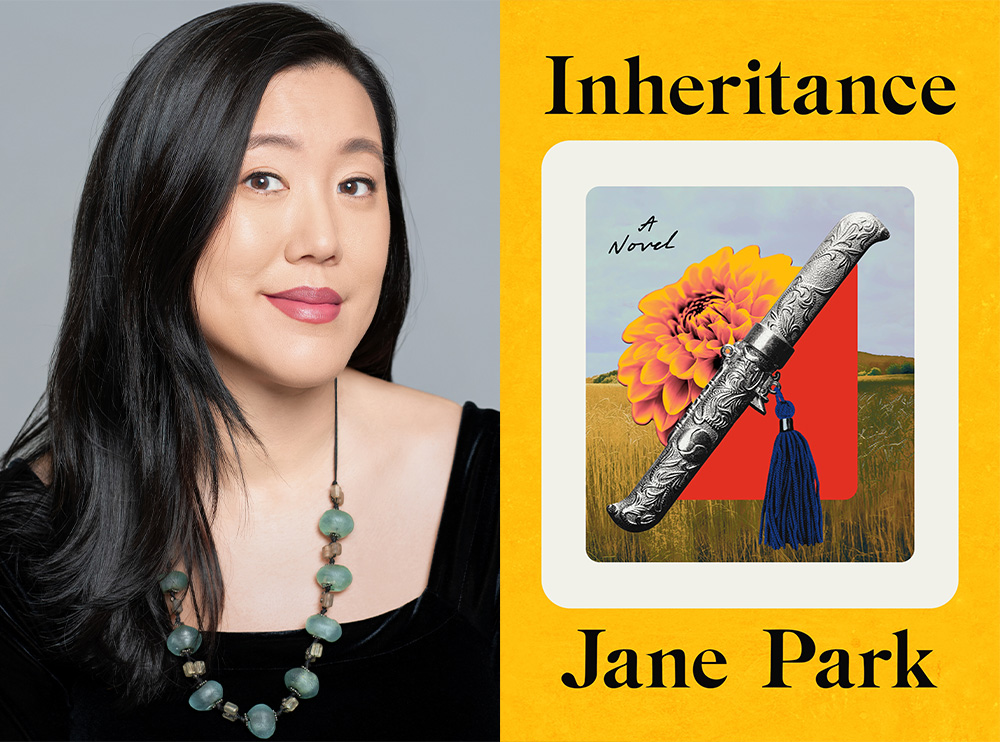
We chat with author Jane Park about Inheritance, which follows a young woman who returns to the prairies, where she revisits her immigrant childhood and confronts a haunting guilt, in this debut novel by a brilliant new talent.
Hi, Jane! Can you tell our readers a bit about yourself?
I am the author of Inheritance, my debut novel. I am a second-generation, Korean Canadian living in Calgary, Alberta. I am currently raising two sons. I’ve moved around a lot and lived in many different places, but I have always had an interest in kyopos—diasporic Koreans.
When did you first discover your love for writing and stories?
I became a writer through reading. Growing up, my parents ran various small-businesses, and they would drop me off at the library, where I spent a lot of time reading books. I read without discernment: all the books from Sweet Valley High and Babysitter’s Club, and a lot of Archie comics. In tandem with my reading, I made my own books—as a child, I wrote stories where my lead protagonist was always a blonde girl. Now, as an adult, I write about diasporic Koreans.
Quick lightning round! Tell us:
- The first book you ever remember reading: I don’t remember the title, but it’s about a baker who creates the world’s biggest blueberry pie and the subsequent problems that results from making it. At the time, I had never eaten a blueberry pie, and that book held so much wonder for me.
- The one that made you want to become an author: There are so many great books that made me want to write, but the one that struck me, like an ice axe, was Eva Hoffman’s Lost in Translation—it’s a memoir about growing up with parents who survived the holocaust and how that trauma transferred to her. She also writes about the immigrant experience—from Poland to Canada, and then to the US. She was one of the first writers I read who wrote about the immigration experience and I remember my brain exploding while reading her book.
- The one that you can’t stop thinking about: Elena Ferrante’s Neapolitan novels: Ferrante writes with such propulsive, spell-binding force. Also, the Bible– there are so many things I wrestle with and ruminate about afterwards.
Your latest novel, INHERITANCE, is out April 7th! If you could only describe it in five words, what would they be?
Longing, loss, loyalty, beauty, and hope.
What can readers expect?
My novel is about the Korean immigrant experience—during the 70s and 80s, there was a huge wave of Koreans that came over to Canada and the US. I noticed particular trends among my kyopo friends and I write in my own observations in my novel. Also, emotionally, I hope that my readers will experience a range of emotions from sadness to joy, and despair to hope.
Where did the inspiration for INHERITANCE come from?
In 2006, I was sitting at my desk, feeling dissatisfied with life. One day, at work, the voice of an unhappy tax lawyer descended upon me and I wrote the beginning paragraphs of what would eventually become this novel. I wish I had the discipline to write consistently, because there were many multi-year stalls. But the unhappy tax lawyer’s voice was faithful in appearing whenever I had time to write.
Were there any moments or characters you really enjoyed writing or exploring?
I really enjoyed writing the mother character. I have a real soft spot for the Korean women of my mother’s generation—they suffered so much and lacked a vocabulary for mental health. I also loved writing about the prairie sky, which holds so much emotion. A prairie thunderstorm is truly a spectacular sight to behold.

Did you face any challenges whilst writing? How did you overcome them?
Consistency was a challenge. I would feel inspired and write a few pages with some beautiful sentences that I was proud of, then abandon the novel for months, even years. It takes discipline to sit at a desk and write. When I had kids, I stopped writing altogether until I hit a mental low, and the only thing I wanted to do was finish writing my novel.
What’s next for you?
There is another novel, but my first one took almost two decades to publish, so statistically, I could be dead before I finish my next one. After finishing this novel, I started my MFA at the University of British Columbia and took courses in other genres. I might take a break and dip my toes in another genre. I really like screenwriting, which is a quicker form for me to write, and I have loved Creative nonfiction.
Lastly, what books have you enjoyed reading this year? Are there any you’re looking forward to picking up?
I am so proud of other Korean Canadian novelists that published last year: particularly Ann Y.K Choi’s All Things Under the Moon—a historical novel about a Korean woman living under the Japanese occupation—as well as Jinwoo Park’s The Oxford Soju Club, a spy-thriller which explores the Korean diaspora. There’s also been some great Chinese Canadian books about the second-generation diaspora like Su Chang’s novel The Immortal Woman, Rachel Phan’s memoir Restaurant Kid, and Teresa Wong’s graphic memoir, All Our Ordinary Stories. As for future reads, I want to dip my toes back into poetry and crack open Marie Howe’s anthology.