
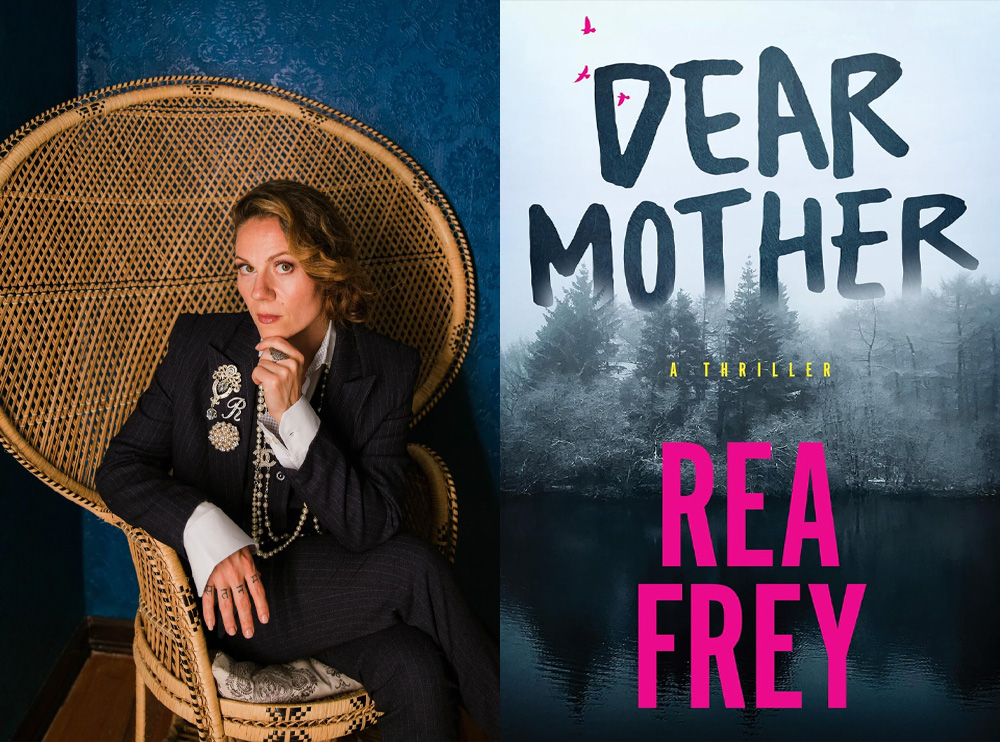
Guest post written by Dear Mother author Rea Frey
Rea Frey is the #1 bestselling author of a dozen books. As a book doula, she has helped hundreds of authors land agents and publishing deals. A Silver Falchion finalist, Book Pipeline’s Film Adaptation Winner, Target’s Book of the Year Finalist, and voted one of Marie Claire’s Best fiction writers, Rea’s work has been optioned for film, featured on Good Morning America, CBS Saturday Mornings, and in The New York Times. To learn more, visit reafrey.com.
About Dear Mother: In a tense thriller set deep amid the forests of the Pacific Northwest, a determined mother works to uncover the secrets of her family’s dark past, fearful of what their history may reveal. Releases April 28th 2026.
Unless you live off-grid and offline, then you know: AI is here in a big, big way.
As an author, I initially shied away from this technology completely. AI? Scoff. Never going to use it! My nose was raised sky high, and I wiped my hands of this nonsense.
And then… Well, then I was curious. As I dove deep into all things AI, I marveled at its ability to get shit done so much faster than I was used to. Who needed an intern for $25/hour when I could just put in a prompt? Like so many others, I went down the ChatGPT and Gemini rabbit holes to understand its assets and very clear limitations.
As an author and book doula (yeah, it’s a thing), I help other writers share their stories, a process I’ve done nearly a thousand times. In the last year, however, a notable pattern has emerged: every single nonfiction author I work with is using AI.
How do I know?
Because I’ve trained myself on IT ALL. I know instantly if someone has used AI.
And guess what? Everyone is using it. Your favorite influencer. That celebrity who just dropped a memoir. The LinkedIn thought leader who posts three times a day about “disruption.” The aspiring author who just paid a book coach (hi) to help them write their story. According to a 2025 survey, 99% of authors have used AI to generate at least part of their manuscript. I am not exaggerating. I wish I were.
Look. I get it. It’s magic. You type in a prompt, and something comes out that, on first read, sounds reasonably good. The problem is that it all sounds the same. Scroll through Instagram for ten minutes. Read five LinkedIn posts. Pick up two self-published books from the last year. You will encounter the same sentence structures, the same transitional phrases, the same rhetorical tics, over and over again, as if the entire internet has been ghostwritten by the same invisible hand.
Because it has.
The publishing industry is starting to wake up to this. Just this week, Hachette Book Group—one of the largest publishers in the United States—pulled a forthcoming horror novel after widespread allegations that it was AI-generated or heavily AI-assisted. The book vanished from Amazon and the Hachette website within hours. In a separate incident, Entangled Publishing pulled a debut romance novel after readers flagged passages they said bore the telltale signs of AI-generated writing: awkward phrasing, repetitive sentence structures, and a flatness of voice that felt more algorithmic than human. Two books, two publishers, two authors whose careers may never recover, all in the same week.
In my opinion, this is becoming more than just a fringe issue.
The legal landscape is shifting just as fast. The U.S. Supreme Court recently declined to hear a challenge to the Copyright Office’s position that AI-generated works, absent of any meaningful human creative input, cannot be copyrighted. What does this mean? If you want to own what you write, a human has to actually write it. Meanwhile, authors are suing AI companies for using their books to train models without permission or compensation. More than 70 authors, including Dennis Lehane, Lauren Groff, and Jodi Picoult, signed an open letter demanding that publishers pledge never to release books created by machines. The Authors Guild is now offering a “human-authored” badge for book covers, so readers can tell the difference.
Read that last sentence again. We need a badge now to prove a human wrote a book?!
I saw all of this coming. A few years ago, I signed a contract with a company that wanted to use AI to help nonfiction authors write their books. I told them, plainly, that it would never work. There was literally no way an author could answer a few questions, and then AI could spit out a good book. I worked with these authors, and they all said the same thing: “I feel like I’m editing someone else’s book!” I left, and the company crumbled shortly thereafter.
Rather than retreat from the technology, however, I leaned in. I trained myself on it deeply enough that I can now identify AI-generated text the way a sommelier identifies a shitty wine. And what I’ve learned is that AI has tells. Distinctive, recurring, almost comically predictable tells. Once you see them, you cannot unsee them.
Here are a few:
The contrast sentence. AI loves to set something up only to knock it down. “This isn’t about X. It’s about Y.” “Not because of A, but because of B.” (I swear if I see one more social media post that begins with NOT BECAUSE, I’m going to lose my mind.) These constructions show up constantly, and they give prose a stiff, debate-team quality that no human writer would sustain for long.
The em dash—used everywhere—to create the illusion of spontaneity—that is actually just a tic. (I will never, ever forgive AI for taking away my em dash!!!)
The unnecessary quotation marks. AI puts “quotes” around “words” to signal that it knows a word is being used in a “special” way. It does this constantly. It is “interesting.” It is “worth noting.” It is, frankly, exhausting.
The declarative definition. AI is obsessed with telling you what is and isn’t. “Courage is not the absence of fear.” “Leadership is not a title.” These lines sound profound for about half a second before you realize you’ve read them a thousand times.

The false intimacy. “Here’s the thing.” “Let’s be honest.” “I’ll say it plainly.” AI uses these phrases to simulate a human voice. They are the literary equivalent of a chatbot saying, “Great question!”
The 11-point font. One of the easiest ways to tell if a client of mine has been using AI is that they give me their documents in 11-point font instead of the standard 12-point font. If it has headers, it makes a 13- or 17-point font. AI loves odd numbers. Humans love even numbers.
If you are using AI to write (and again, you are), please, for the love of all things holy, do this one thing: ask it to scrub its own language. Specifically, instruct it to eliminate contrastive sentence structures, remove common AI transitional phrases, avoid defining things declaratively, and stop using em dashes or excessive quotation marks. Then, and this is the part people skip, read it out loud. Line by line. Ask yourself: Does this sound like me? Does this make me feel something? Is there a single sentence here that only I could have written?
If the answer is no, then you have more work to do.
AI is a tool. A genuinely useful one, for many things. I use it. I will keep using it. But writing, real writing, the kind that makes a reader feel less alone, the kind that changes how someone sees the world, the kind that earns a copyright and a publisher and a reader who stays up too late because they can’t put that book down… writing like that requires a human being. It requires your specific, weird, hard-won perspective. It requires you to sit with a blank page long enough to come up with something new.
The em dash epidemic is here. The question is whether you’re going to catch it—or cure it. (See what I did there? A rogue em dash! I’m a rebel, what can I say? You’re welcome.)
Whether you’re going to blindly keep writing and posting nonsense, or use that magnificent gray matter between your ears is up to you.
Write like a human. Review your next piece, catch the AI tics, and rewrite for your own authentic voice.
Somewhere out there, AI just wrote a better ending to this essay. But guess what?
I didn’t use it.


I highly doubt that 99% of writers are using AI. I am a screenwriter and non-fiction author. I have never used AI in my work, and I never will.
There are things I know that I want to share. I am learning to be a better writer with the help of how to books and essays. It’s been a while since I’ve read Orwell’s “Politics and the English Language” and I wonder what he would say about AI. I recall his emphatic admonition against using tired metaphors.
Could you share where that 2025 survey statistic came from? I can’t find it online anywhere. Thank you! This 2025 survey is widely cited, however, and paints a very different picture, suggesting that far fewer author use generative AI, and that almost half say they don’t use it and don’t plan to in the future : https://insights.bookbub.com/how-authors-are-thinking-about-ai-survey/