


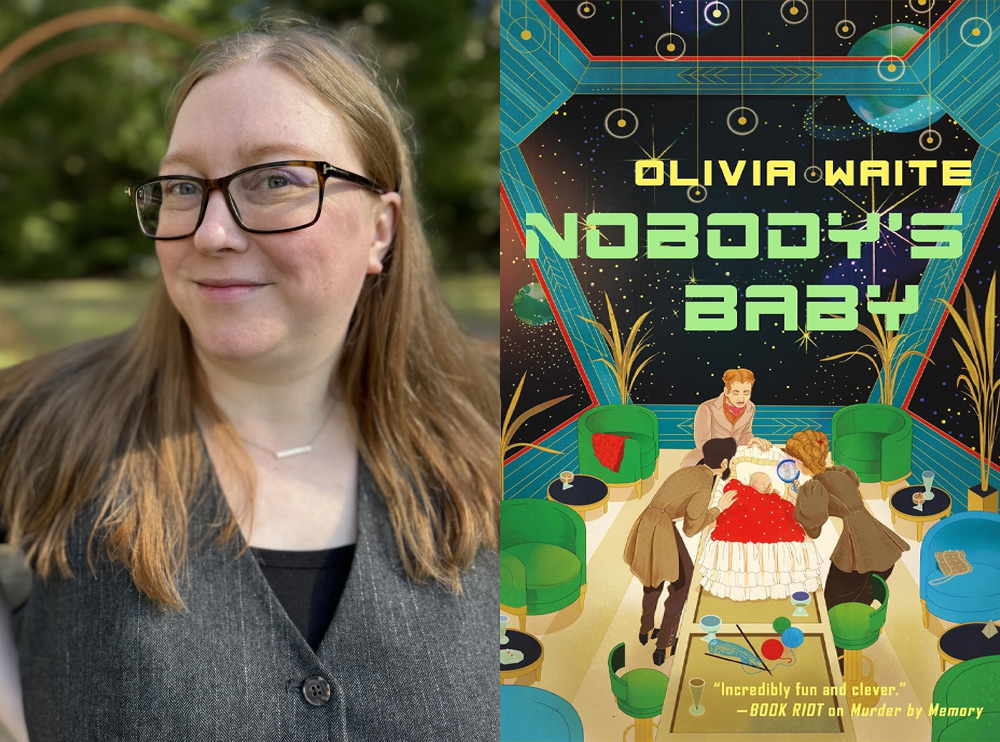
Guest post written by Nobody’s Baby author Olivia Waite
Olivia Waite writes queer historical romance, fantasy, science fiction, and essays. She is the romance fiction columnist for the New York Times Book Review.
About Nobody’s Baby: Becky Chambers meets Miss Marple in the second entry of this cozy sci-fi mystery series, helmed by a formidable no-nonsense auntie of a detective. Released March 10th 2026.
The history of science fiction is full of people eager to bring imagined future tech into the present day. We dreamed about flying machines hundreds of years before we knew how to make them. We watch Star Trek, or read Hitchhiker’s Guide to the Galaxy, and think how wondrous it would be to have a single tablet that could hold an entire library. (And it is! Though the end of Douglas Adams’ series, famously a bummer, also features the Guide being purchased by a company that has sinister and violent uses for it in mind, which … is perhaps more realistic than optimistic, as it turns out.)
So when I described a mohair lace fern shawl knitted by a character in Murder by Memory, my sapphic sci-fi mystery set on a generation ship — and which has an extensive Library of its own, though it stores memories rather than books — I thought it might be fun to turn that imagined shawl into a real pattern for readers here on Earth.
Ah, the hubris.
I consider myself an experienced knitter, unafraid to steek or modify patterns or tackle vintage instructions with long-forgotten terms even your grandmother was too young to learn. I never saw a technique I wouldn’t attempt. Colorwork? The more complex the better! Brioche? Absolutely! Cables and lacework and the adding of beads? Let’s go! By the time I finished Catherine Clark’s [Ixchel](https://www.ravelry.com/patterns/library/ixchel) in gold and black yarn with a holographic glitter, I felt absolutely fearless.
And I knew that just as reading a book is different than writing one, writing a pattern was going to be worlds away from simply following one. Knitting professionals know what they’re about, and I am still very much an amateur.
It still floored me.
I swatched. And swatched again. And again — again — again. The number of variations I tried hit twenty-three in my notes, and after that I stopped counting. I have a folder full of sketches for different frond shapes, different starting strategies (one blade at a time, or all three at once?), angles and stitch counts and big and small versions. All told, it was about eight months of work on top of my full-time job, with periodic breaks so I didn’t make my chronic hand issues worse. (Ask any older writer about their carpal tunnel or RSI, and learn your stretches while you’re young and bendy, folks!) There were probably simpler ways of solving the problems I’d set myself — but Murder by Memory was already out in the world, including the detailed description of Violet’s shawl.
I had knit myself into a corner, and now I had to knit my way out.
My working yarn became a lifeline through the labyrinth as I slowly built a system and knit one — then two — then three samples, establishing that the basic structure worked but refining the details a little each time.
Let me confess: there are things I cannot yet tell you about this shawl. Violet has her secrets, and Dorothy doesn’t know nearly all of them — though our ship’s detective will learn a few more next year when her third story comes out. Knitting has been associated with hidden messages ever since Dickens wrote about Madame DeFarge, cackling beside the guillotine as she worked the names of victims into her yarn. Knitting communicated troop movements and supply line information to Allied authorities in WWII, and knitting needles were part of many female spies’ toolkits. Censors in occupied Belgium even outlawed the posting of knitting patterns, fearing that women were using them to transmit messages to the Resistance.
As release day for Nobody’s Baby crept close, I ended up with a reasonably straightforward system where each blade is made of stacked units of four fronds, with some fronds doubled and others single. The pattern is free for download on [Ravelry](https://www.ravelry.com/patterns/library/violets-fern-shawl)! It looks beautiful, and a little alien, and includes all the secret challenges I set myself. The overview schematic is lovely and clean. The charts, however, are *massive*, and I am anxiously awaiting the first email from a knitter to tell me where my counts are off or which row has an error in the decreases. I did hire a tech editor, in all good faith and innocence, but their excellent feedback required me to rewrite everything from scratch.

This was also my first experience with knitting chart software, which is a whole mind-boggling universe of its own. I tried almost as many software apps as I did shawl starts: it felt like I was turning my brain inside-out.
Textiles and tech have always been, if you’ll pardon the pun, intertwined. The first punchcards were made for the Jacquard loom to weave designs into fabric. We sent men to the moon using knitted core rope memory, also known as LOL memory, for “little old lady.” Like computer code, knitting is a binary system: there’s knit stitches and purl stitches, and everything else is essentially slight variations of one or the other. Theoretically this means it is possible to knit, say, the source code for [Doom](https://knittingdoom.tumblr.com/), and some brave soul is currently doing just that. In 2018, the Advanced Textiles Research Group at Nottingham-Trent experimented with knitting gold wire into long antennae for satellites, because the knit fabric could be compressed for launch and then expanded once the satellite reached space.
But even with all this futuristic fabric, there are some things human hands are still best at. We invented weaving and knitting machines centuries ago and revolutionized the global textile industry — in both good and bad ways — but when NASA designed spacesuits for the Apollo missions those cutting-edge fabrics were all hand-stitched by actual seamstresses, because they were more accurate and reliable than any machine could be. Only people could make those seams airtight. Car factories are full of robot arms, but clothing factories are just rows and rows of people putting sleeves in with sewing machines not much different from the one I have here at home. Every garment you’re wearing right now was created by a person — and usually by someone paid far less than such intensive work deserves.
Human clothes, like human bodies, are stubbornly organic.
This is not going to be my final pattern. I’m planning a follow-up for the third book, titled The Double Dorothy. Maybe the second time writing a pattern will be easier — maybe not. Maybe it’s like any kind of writing: every story poses its own challenges, and must be approached on its own terms. If you’re not feeling the stretch in the writing muscles, you’re not learning anything.
I can’t wait to get started.