


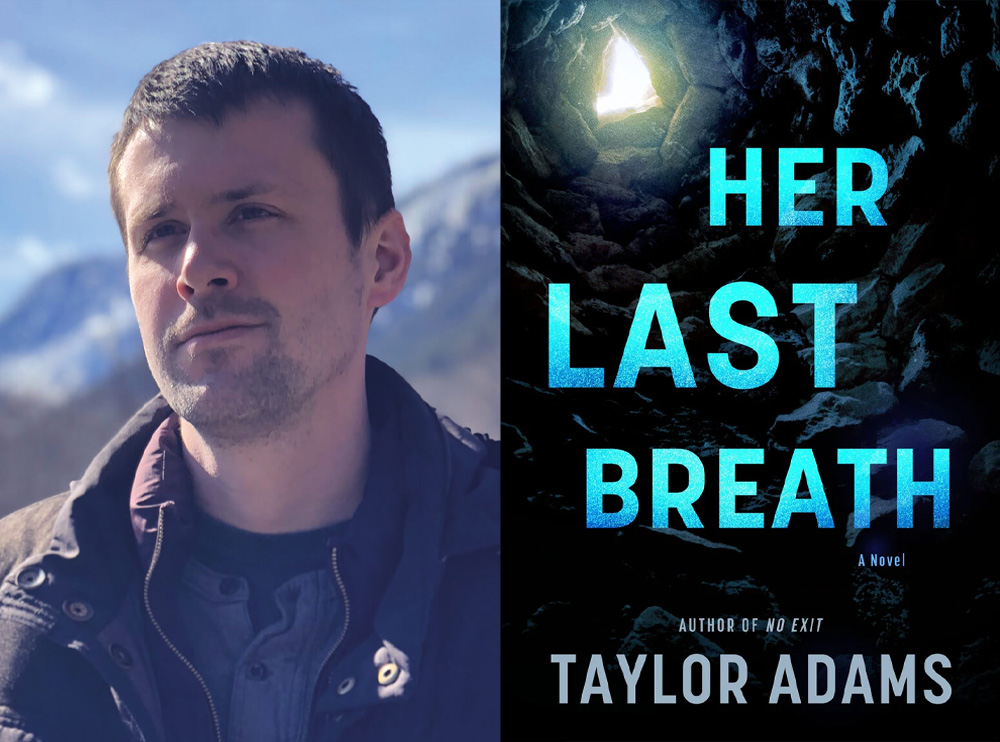
We chat with author Taylor Adams about Her Last Breath, which is a story of two friends who embark on an ill-fated caving expedition—and the dark truth of what happens deep underground. PLUS you can read an excerpt at the end of the interview!
Hi, Taylor! Can you tell our readers a bit about yourself?
I’m a Washington-based thriller author who loves trapping characters in terrifying situations! So naturally, a cave was a perfect setting for my newest book.
When did you first discover your love for writing and stories?
I was pretty young! While growing up near Seattle, my first attempt at a novel involved Mount Rainier (a big deal for us Washingtonians) erupting and destroying the surrounding area. It… didn’t go well, but everything you write is practice, and no word is wasted. Even from the start, I was fascinated by characters stuck in high-stakes survival situations.
Quick lightning round! Tell us:
- The first book you ever remember reading: JURASSIC PARK, by Michael Crichton. I was too young to understand most of it, but I loved the dinosaur attacks!
- The one that made you want to become an author: Also JURASSIC PARK. Dinosaur attacks!
- The one that you can’t stop thinking about: INTENSITY, by Dean Koontz. The best thriller I’ve ever read, and a huge inspiration for the kinds of books I try to write.
Your latest novel, Her Last Breath, is out now! If you could only describe it in five words, what would they be?
THE DESCENT meets NO EXIT.
What can readers expect?
Friends with secrets. Unreliable narrators. Claustrophobia, suffocation, and spiders. Random-but-true cave facts. And the most horrifying death I can imagine.
Where did the inspiration for Her Last Breath come from?
I’ve been in a few caves before, and I’d always thought the extreme psychological pressure of those tight underground squeezes would make a compelling setting for a thriller. I loved THE DESCENT, a 2006 monster movie where the movie’s cave setting is arguably even scarier than the monsters themselves. I also watched tons of YouTube videos of real-life cavers navigating nightmarishly-small crawlspaces and I remember thinking that with how sensory and immersive reading can be, this scenario could make for a uniquely intense reading experience! So that was what I aimed for with HER LAST BREATH – the simple, primal terror of being crammed in a tight space, far from help. Readers have told me that the novel gave them physical reactions ranging from panic attacks to wanting to throw up, and that’s exactly what I’d hoped for!
Were there any moments or characters you really enjoyed writing or exploring?
Both main characters, Tess and Allie, were extremely fun to write as they grow and change in response to the escalating danger. The story is structured a bit like an onion, gradually revealing new layers to each character, and that allowed me to have some fun with timing their developments. And of course, the story’s climax centers around surviving the most hellacious physical situation I could imagine – a ten-inch crawlspace, flooded with ice-cold water, hundreds of feet underground. I basically tried to visualize my own personal nightmare, which was surprisingly fun. The cave itself is a villain, too, and it’s probably been my favorite villain to write!
Did you face any challenges whilst writing? How did you overcome them?
In addition to being a survival tale, it’s also a psychological mystery and even framed a bit like a police procedural, as a detective tries to piece together the events inside the cave. This secondary timeline was extremely tricky to incorporate. A cave is a very limiting setting, even more so than a snowed-in rest stop, and the tunnel’s linear layout forced me to think carefully about every cat-and-mouse engagement. I reimagined the story numerous times in the outline stage, and then rewrote the full novel itself as at least a dozen separate drafts. It was a lot of work, and there were moments when I worried it wouldn’t come together, but I’m proud of the end result.
What’s next for you?
Honestly, probably a vacation (with no caves!). I just turned in my next (not-yet-titled) thriller manuscript to my editor and I’ll be busy fine-tuning that one in the coming months. And of course, I’m currently brainstorming ideas for my next book as well!
Lastly, what books are you looking forward to picking up this year?
I can’t wait to read the new Alice Feeney, MY HUSBAND’S WIFE – I’m constantly blown away by her storytelling craft and misdirection. I’m eagerly awaiting Riley Sager’s upcoming THE UNKNOWN and Tracey Sierra’s WARNING SIGNS (check out her incredibly suspenseful debut, NIGHT WATCHING). And I also just picked up Joe Hill’s KING SORROW and I’m already loving it!
EXCERPT
Prologue
We’re losing her.
Detective Layla Washington feels helpless waiting for updates, and this latest text message is the most ominous yet.
A young woman is trapped in a remote cave system miles inside the Cascade Range. She’s injured, exhausted, and lapsing in and out of consciousness. Rescuers have managed to extract little information from her—not even a name—and at this point questioning the victim is a waste of air and time. The team’s sole priority is rescuing her before she dies.
As Washington understands it, the woman is inside a limestone tunnel just a few feet high and eighteen inches wide. A cave-in sealed her inside the crawlspace sometime last night, and now she’s pinned on her stomach by dense rockfall on all sides. One rescuer compared it to being stuck inside a smaller-than-average coffin.
Slowly filling with rocks.
In pitch blackness.
Alone.
For the past eighteen hours.
It’ll be all over local televisions by six tonight. The rescue operation is now dozens strong, mostly volunteers and local experts, and will double when reinforcements arrive from Portland. The incident commander is an old fire chief from Salem, just a few years younger than Washington herself, and he runs an efficient show.
An underground manager and several specialized teams—medical, rigging, litter—are currently racing to clear rock debris, hand-deliver oxygen bottles, and rig a pulley system down hundreds of feet of narrow, labyrinthine tunnels. They’d found the trapped woman by the echo of her screams, but it took hours to trace her exact location and even longer to safely reach her.
Underground lifesaving operations are rare and uniquely difficult: part confined-space rescue, part firefighting, with a dash of mountaineering thrown in for good measure. Much of this particular cave can only be traversed single file, risking bottlenecks and traffic jams while equipment is passed from rescuer to rescuer like a human daisy chain. Phone and radio signals are unable to penetrate rock, limiting communication to line of sight. Every inch of progress is incremental and dangerous. The primary directive of any rescue is to not require rescuing yourself, and one team member has already been seriously injured.
Time is not on the woman’s side. Each of her physical needs is a ticking clock—air, hydration, energy, body temperature—and one will inevitably run out. With every text message Washington receives, her stomach flutters with dread.
Three hours ago, there was modest hope in the old fire chief’s texts:
Made contact with victim. TL can touch her fingers thru 4-inch gap in rock. Confirmed head trauma, dislocated/broken ankle, lacerations/bruising.
Two hours ago, worry started to creep in.
Losing consciousness. Exhaustion.
Then, finally:
We’re losing her.
And an hour of silence.
While she waits, the sixty-something detective has been doing what she does best: butt-in-chair research. The cave system is a natural formation called the Devil’s Staircase, located on (and under) an isolated tract of logging forest miles from the nearest public road.
The region has numerous other, more popular caves, but the Devil’s Staircase seems to be the perfect carnivorous plant: remote enough to be dangerous, accessible enough to lure in amateurs. With a moderate hike and a written permit from the lumber company that owns the land, local adventurers can see stalactites the size of tree trunks and gardens of impossible rock formations growing in fungal tendrils. The photographs are undeniably striking.
However, more curious (and foolish) interlopers sometimes ignore the warning signage and explore deeper, where the lower tunnels tighten into treacherous crawlspaces and the dangers multiply. Under millions of tons of earth, a single disturbed rock can trigger a fatal collapse. Pockets of trapped carbon dioxide can become invisible death traps. Groundwater levels can rise and fall without warning. Worst of all, some of the cave’s most cramped tunnel crawls—termed squeezes by enthusiasts—are as narrow as ten inches wide.
What would possess this unknown woman to venture to such a depth? The most inviolable rule of cave exploration is to never go alone. Either she was incredibly reckless—or she was fleeing something even deadlier.
Detective Washington hopes the woman survives to tell her story.
The mountains, seen from Washington’s second-floor desk in the Stevens County Sheriff’s Office, look like sleeping giants cloaked in evergreens. On a drizzly afternoon like today she can barely see them at all. Somewhere out there a young woman is locked inside a vault of rock, fighting for every breath.
Keep fighting.
She’s a tough gal, the incident commander had texted earlier. She’s got sisu.

Odd word choice.
Washington had to look it up—apparently sisu is a Finnish term for grit and determination in the face of hardship. There’s no English-language equivalent for it, because sisu isn’t derived from any single act of bravery. It’s tireless, sustained, long-term.
Worryingly, recent rainfall has also flooded the trapped woman’s crawlspace with several feet of groundwater. By all estimates she should have died of hypothermia yesterday, but apparently she’d managed to lift herself up onto stacked rocks and suspend her body a few inches above the deadly cold. It couldn’t have been comfortable, but it kept her alive. She’d understood that prolonged contact with the water meant death.
Sisu, Washington agreed. Whoever this woman is, she clearly has some survival skills. The detective can’t help but root for her.
Keep me updated, she’d texted back. She’s a POI in a homicide.
This was also no ordinary caving accident.
A body was discovered outside the Devil’s Staircase. By the time Washington herself had hitched a tooth-rattling ATV ride up the mountain at six this morning, the site was already thoroughly contaminated by the rescue operation. It’ll be a miracle if much physical evidence survives at all. But the violence of the death is unmistakable: the decedent suffered a fatal gunshot wound and stained the rocks with several liters of blood.
And the trapped woman knows what happened.
According to a few fragmented communications gathered hours earlier, she’d apparently battled for her life against a killer, or even multiple killers. Maybe she’d defeated them. Maybe they’re still out there, making preparations to strike again.
Keep fighting, girl. They’ve almost got you out.
But the rescuers are racing against uncaring physics. The woman is fading with exhaustion, her air is becoming unbreathable, and the water is rising. Sisu buys only so much time.
Washington checks her phone. It’s already been seventy minutes since the last update.
Since: We’re losing her.
This young survivor has already defied the odds once. Hopefully she can do it a second time. And then, once the rockfall is cleared and she’s hoisted inch by inch into the blinding daylight—when she’s stabilized in a hospital room, hydrated, rested, bandaged, and ready to speak—she can sit with Detective Washington and tell her story from the day’s beginning.
Every detail, from the moment she left her front door.
Who are you?
And what happened to you?