


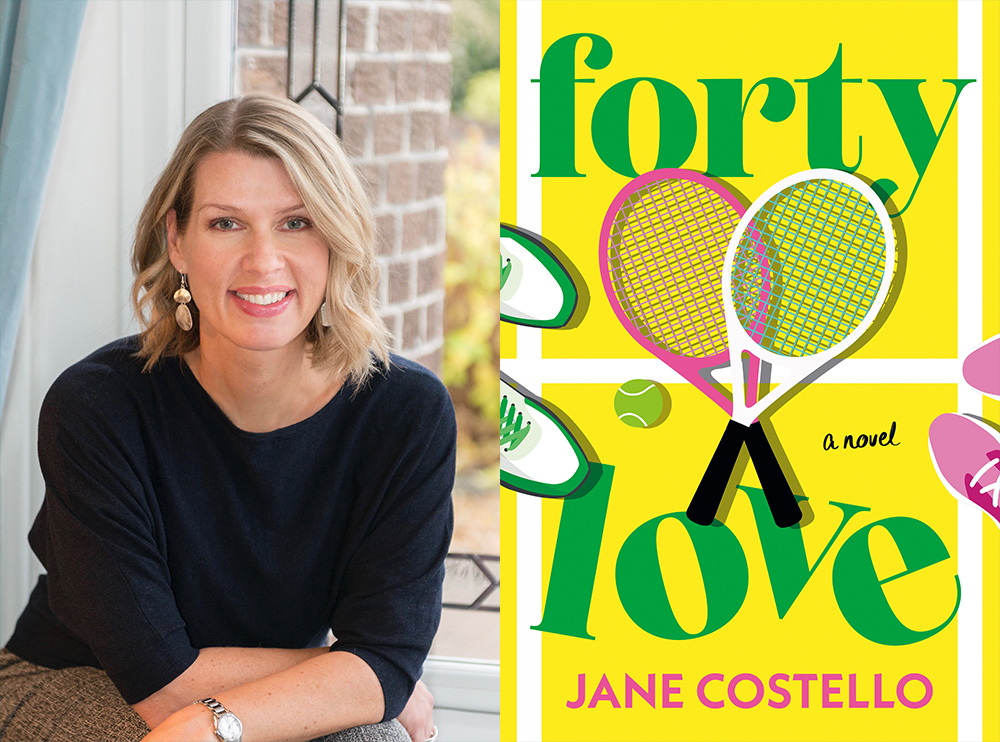
Guest post written by Forty Love author Jane Costello
Jane is the internationally bestselling author of 15 novels, a two-time Romantic Novelists’ Award winner whose books have been translated into 26 languages and selected for the Richard & Judy Book Club. Her newest book, Forty Love, is available now. Jane was born in Liverpool, England, and still lives there with her husband Mark and three ridiculously tall sons.
About Forty Love: A fun, sexy rom-com about a woman who discovers it’s never too late to pick up a racket and take another shot at love. Released May 19th 2026.
My career began on maternity leave, that famously relaxing period of life, when, slightly delirious from lack of sleep, I decided the obvious solution was to write a novel.
The idea for what would become my debut Bridesmaids came to me as I was sitting in a pew at a friend’s wedding. That book launched a career that made me a Top 10 bestseller and saw my work translated into 26 languages (which I mention because I can no longer do the splits so it feels like one of the few things I can still brag about).
There is a lot to love about being a novelist: spotting my books at airports on vacation, travelling the world to meet readers, hearing that you’ve made them laugh or cry – especially when it’s for the right reasons. Most of all though is the very act of creating a story, weaving a plot, building characters.
This is a dream job in so many ways, yet, somewhere around my mid-forties I began to recognise that certain aspects of a writer’s life were quietly driving me mad.
There is truth in the stereotypical image of the author as a recluse; as a profession we spend hours in our own company and is most suited to those who are happiest that way.
Personally, I can take me or leave me. I’m far happier around friends and colleagues, a people person by nature. Quite simply, I enjoy being sociable. Yet the contrast with the first part of my career, when I’d worked as a journalist in a busy, high-energy newsroom, was stark.
The pandemic was difficult. Homeschooling three kids while trying to hit deadlines is not recommended, yet I had no choice. As restrictions lifted, I started to see friends again, but these were not daily interactions and, as anyone with kids and a family life will tell you, co-ordinating diaries was like trying to organise a military operation.
Everything changed for me one day as I was watching my youngest son enjoy a group tennis lesson in the club just around the corner from my house. Even accounting for a seven year old’s capacity for fun, they were having the time of their lives.
‘I wish I’d learned to play tennis when I was that age,’ I said to the woman next to me.
She replied: ‘What’s stopping you now?’
It had never occurred to me. I’d never had a lesson in my life. I was way too busy with work. It wouldn’t be right to spend what little spare time I had doing something just for me. Nobody else. Would it?
But she was persuasive. That weekend I enlisted a girlfriend to come with me to a ladies ‘social tennis’ session. It would be the start of one of the great love affairs of my life. No, I don’t mean I met a guy.
I mean I joined a team, started playing in a league, watched Roger Federer up close on Center Court in Wimbledon. I went to Spain for a ‘coaching trip’, that involved a respectable amount of training and an even more respectable amount of rosé wine.

Tennis has given me friendship, fitness, laughter, healthy competition and the most effective therapy I’ve ever found for perimenopausal anxiety.
It has also given me a book: Forty Love, a romantic comedy about a single mom called Jules, whose friends persuade her to join a beleaguered women’s tennis team to take her mind off her daughter’s backpacking trip around Europe.
My experiences discovering the sport in my forties very much inspired the book, even if I have been at pains to report that every other element of it is fictional, and yes that does include the steamy chapter that takes place in an equipment shed.
The deeper I got into both tennis and that manuscript, the more I recognised the parallels between the two. There are some days on court when the ball does exactly what I ask and I feel like I could play forever. There are others when I want to hurl my racket into a hedge. I have ‘given up’ and convinced myself I will never be able to play to an acceptable level more times than I can count. I’m usually back on court the following day.
Writing is no different. Some mornings the words arrive like a gift. At other times, they are horribly elusive. But you are required to show up anyway, regardless of what type of day you’re having. My other big lesson in both is that perfection is impossible, yet both demand the pursuit of it. There’s always someone better, or faster, for whom it all seems to come effortlessly. And the really weird thing is that that knowledge doesn’t diminish my urge to improve, only sharpens it. Nothing I ever do will be enough.
Most of all though are the highs and lows, which feel extraordinary. A match won, a book finished; a promotion for my team, a new bestseller. They are moments of pure joy which are all the sweeter in the knowledge of how fleeting they are.
Perhaps that’s the truest parallel of all: in both tennis and writing, the game is never really over. All you can do is keep at it and be grateful for every day you do.