

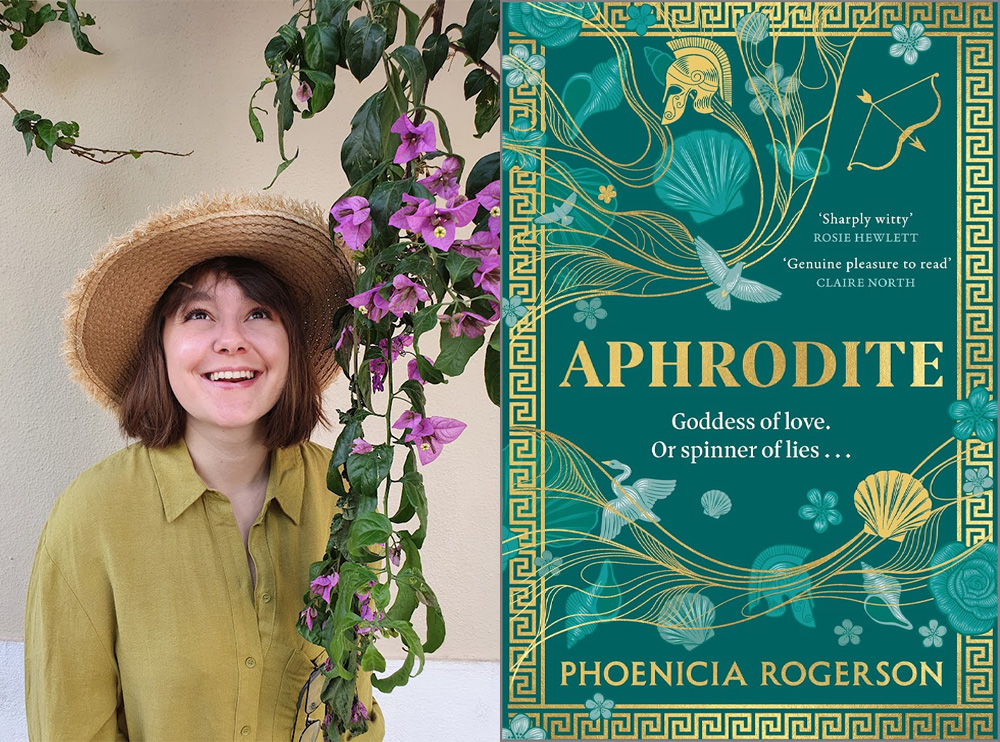
We chat with author Phoenicia Rogerson about Aphrodite, which is an enrapturing feminist tale that brilliantly reimagines the story of Aphrodite and how she transformed herself from a lowly outsider to the darling goddess of love.
Hi, Phoenicia! Welcome back! It’s been about two years since we last spoke, so how have you been and what have you been up to?
Busy, but I don’t think I really know how to be anything else! Recently, I’ve been deep in the edits for book three(!), knitting the single biggest project I’ve ever made (I think it’s going to weigh about 3kg when I’m done with it), and embarking on a particularly silly project to walk all of London’s tube lines, because I have to leave my house sometimes.
Your latest novel, Aphrodite, is out November 11th! If you could only describe it in five words, what would they be?
In the style of a noughties tabloid:
Fake Goddess’ Olympic Revenge Spree
What can readers expect?
If I haven’t given myself away already with the way I write, the tone is irreverent. It’s muti-POV with the characters speaking as though they’re in an interview, and it follows Aphrodite, and the drama of the Greek gods all the way from their births to the end of the Trojan War. She starts out as one of the Fates, weaving the future of the world, until she decides to lie her way into Olympus instead. Only, that’s not all it cracked up to be either, so she takes some rather radical action to fix the world.
And there are footnotes! I’m very excited about the footnotes!
Where did the inspiration for Aphrodite come from?
Aphrodite rather snuck up on me as a character! She’s incredibly prevalent in the background of other myths, but it was only when I started looking more closely at her that I realised how complicated her character is.
She’s one of the oldest gods, and she remembers the time before they were in power, which is such an interesting perspective when your entire cast is immortal. This puts her in the unique position of having one foot in the world of the gods – and all their drama – and one foot out of it! She also has a level of freedom that none of the other goddesses do, which makes for some wonderful chaos.
Were there any moments or characters you really enjoyed writing or exploring?
Ares was probably my biggest surprise. I didn’t have the best impression of him going in, but he’s so clear and straightforward about who he is, and he loves Aphrodite so much, it makes him incredibly refreshing to write after some of the twistier characters.
I specifically enjoy his interactions with Cadmus – think grumpy dad pretending he doesn’t love the puppy you brought home – which leads to his and Aphrodite’s mutual attempts to stop their daughter from dating this shiny mortal hero, which goes about as well as any parents’ attempts to stop their daughter dating anyone.
Did you face any challenges whilst writing? How did you overcome them?
I don’t think I’ve ever written more words for a project as I did for Aphrodite. Since the time span is so long (many thousands of years), and I’m such a perennial nerd for Greek mythology, I was endlessly trying to sneak in just one more story about this or that side character. With so much material at hand – and material that wasn’t concerned about making sense chronologically between sources – it was tricky shepherding it all into a cohesive order.
Given that I work in software, I feel like I should have a hi-tech solution to this, but what I actually did was move key events around on post-it notes forever.

Another challenge with Aphrodite is that the gods weren’t – to put it lightly – nice people. When your entire cast do objectively monstrous things at various points (looking at you, Zeus), it’s an adventure to balance being honest about those events while still having characters that readers can root for. Soppily, my general response to that is love. Showing who and what they care about, and why they behave the way they do, goes a long way to soften them. Even Zeus.
This is your second novel! What were some of the key lessons you learned between writing the two?
Not everyone reads like me! It’s been a real delight hearing readers talk about the different ways they interacted with Herc, some of which I never would have guessed, and being able to include some of their feedback into Aphrodite. That’s how I ended up with my beloved footnotes – they’re clues to the context of all the side characters: where they come from, how important they are, and what Aphrodite thinks of them.
It’s really pushed me to think about books differently, which has been a wonderful surprise.
What’s next for you?
Well, I handed in a draft of book 3 the other day… Though it hasn’t been announced yet, so I’m going to be cagey and mumble the rest of this, mumble mumble. Let’s just say, it’s technically a sequel.
Lastly, what books have you enjoyed reading this year? Are there any you’re looking forward to picking up in 2026?
Most recently, I’ve loved Hekate by Nikita Gill, Iron Widow by Xiran Jay Zhao, and The Final Revival of Opal & Nev by Dawnie Walton. Probably my most anticipated for 2026 is Frances White’s The Bone Door, because I loved her debut so very much.