


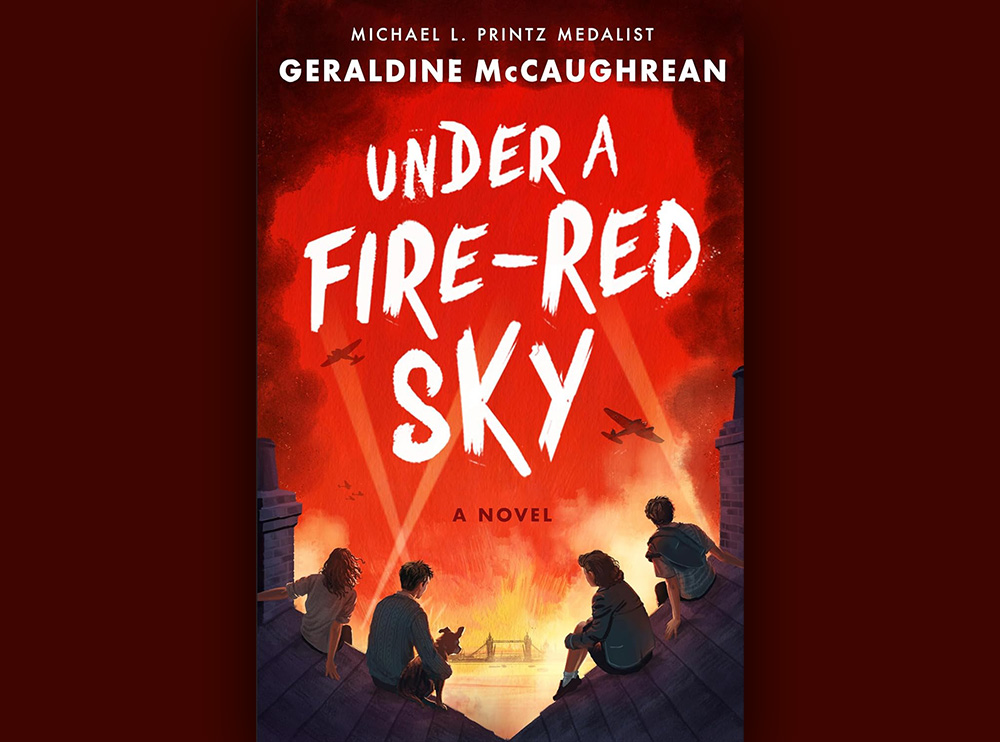
From award-winning and New York Times bestselling author Geraldine McCaughrean, an utterly immersive and unforgettable novel set during the London Blitz, inspired by the author’s father.
Intrigued? Well read on to discover the synopsis and an excerpt from Geraldine McCaughrean’s Under A Fire-Red Sky, which releases on November 4th 2025.
With World War II on their doorstep, the children of Greenwich, England, are being evacuated. But on the train meant to take them to safety, four of them decide they aren’t ready to leave home. They climb out the carriage window just in time, forging an unlikely friendship.
With their school taken over by the fire service, they spend their days trying to be useful. Lawrence is building a secret machine. Gemmy searches bombed-out homes for things of value—only to find an adorable mutt she can’t even give away. Franklin wants to join the fire service, even if it means lying about his age. Olive looks after her father, haunted by the deaths of his fellow firemen.
Together, the four friends roam the streets of London, discovering their resilience amongst the secrets of the city. But as the Blitz unleashes a barrage of bombs, turning the sky ragged with flame, can they keep one another safe?
Beautifully researched and full of both heartbreak and hope, Under a Fire-Red Sky is a celebration of friendship during even the darkest times.
BEFORE THE WAR
Olive
The June sky was so ferociously blue that it had stunned the landscape below it into silence. The air wavered into ripples. In the far corner of the sky—high, high up—a pretty little airplane rose and dipped laboriously through the blueness. Lying on the grass, Olive watched it pass overhead. Even then, its engine seemed to be flagging in the heat. She jumped up and waved to the pilot— couldn’t see him, of course, but there was bound to be a pilot, so she always waved to planes.
From her hilltop vantage point she watched a child riding a pony and a man walking his dog. A train scattered sparks from un- der its wheels then disappeared into a tunnel. But it was the distant sound of a clanging bell that sent Olive running down the hill. The crew was “out on a shout.” Her father wasn’t aboard the fire engine, but Bunny Hare spotted her and waved—even offered her a lift back to Invicta Road.
“Hop in quick. Where’s your dad today?” asked Jenkins.
“Dentist,” she said. “He got permission. Where you going?”
“I’d rather fight fires than have my teeth fixed,” said Bunny.
“Plane down! Crash landing. Near One Tree Hill,” called Spring-Heel Jack from the driving seat.
Olive sat between two pairs of boots, her fingers tightly crossed. It wouldn’t be; it mustn’t be. But, when they arrived, she saw the plane. It looked no bigger than it had in the sky and she knew at once that it was the same one. This time she didn’t wave. The figure in the cockpit could not have waved back.
“Don’t look, darlin,” called Bunny Hare.
Flames licked at the smashed wings and cockpit, like rabid dogs. Still sitting at the controls, and with flames for hair, the pilot sat perfectly upright. The sight would never leave her. She could no more forget it than forget her name.
“Get the tail numbers before the tank explodes,” shouted some- one.
“We need to know where he took off from,” said another. “To notify them!”
“His name’s Johnny,” said Olive to the empty cab of the fire engine. The engine’s hoses were pointing at the plane, but spitting only useless dribbles of water; earlier the crew had nigh emptied the tanks fighting a grass fire. After a few useless minutes, the men came back to the fire engine and raced it backwards—in case the plane exploded and took them with it. “Anyone think they know him? No?”
The others shook their heads. “He’s some mother’s son, poor lad.”
“No examiner in there with him: he must have known how to fly.”
He would always be “Johnny,” Olive told herself. That way, she could talk to him and he would continue to exist. People still need names even when they’re dead, don’t they? Or else they might be forgotten and not get remembered.
Months and months later, “Johnny” was still safe in her head, living an intricate life peopled with all the friends, villains and princes her imagination came up with. No one knew but her. Only “Johnny” would ever know that she had rescued him from non-existence. Perhaps he would even be waiting for her at the gates of Heaven.
At home, she wrote to him in a notebook—cheerfully, telling him interesting news. She intended never to say anything sad.
But, out in the street, people and newspapers were starting to talk about scary things that Olive didn’t want to be true. They had begun talking about war breaking out in other countries, across the sea. The old men in the pub had gone back to talking about their war—The Great War—the war to end all wars. They refused to believe that another such war was even possible . . . and Olive was all in favor of that.
WHEN SCHOOL ENDED
Lawrence
Britain was “Preparing for the Worst.” Now, in school, the pupils practiced sitting under their desks or walking single file to the bomb shelters. Those scary “alien faces” marching across the quad were classmates trying out their gas masks. Some pupils had already been sent away to somewhere safer, in case a war really happened.
Lawrence’s parents wanted him to go, too. He told them it would rob him of a good education, and that Invicta School was still open to dozens and dozens of older pupils. That wasn’t strictly true, but he had far too much to do to get evacuated.
Then, just as the new term had got underway, Invicta School was suddenly full of men hanging their helmets on the coat hooks in the corridors, their long boots facing the walls. The term was over before it had even begun. Pupils of Invicta were to collect swiftly written reports then go home and pack, ready to be evacuated. Their school had been handed over to the fire brigade.
Lawrence would have liked to tear up his report.
Lawrence can be rather intense, it said.
His mother asked, “What does it mean?”
“It means he’s a pain to teach,” said his father, and cracked his newspaper irritably—which was the signal to leave him alone.
Lawrence was indeed intensely annoyed at being called “intense.” And by his favorite teacher, as well! What did it mean? Would his teacher Miss Conty prefer him lukewarm? Lackadaisical? Lazy? If Miss Conty had said, Lose yourself, Lawrence, that would have suited him just fine. He could get on with his Project.
The Project was pinned up on ten drawings taped to his bedroom wall. If his days were free of school, he would be able to get on and build it: his secret. His masterpiece of invention. His flying machine. His “aviette.”

But, all at once, there was no school. To his rage and bewilderment, Invicta School had been given to the Fire Service in readiness for a war that hadn’t even begun. Pupils were to evacuate to somewhere “safer than Blackheath.” If Lawrence resented his report, he resented far more being pushed out of his school simply to convenience a bunch of firemen. Worst of all was the thought of his invention never getting built at all.
THE WOULD-BE FIREFIGHTER
Franklin
There was a bell on every landing of every house in Trinity Street, where Franklin lived. It summoned the firemen from their houses, to run to the nearby fire station. If their bells rang during the night, every man in the terrace rolled out of bed and ran like blazes, red braces hanging down, leaped their garden walls and ran up the hill. They were local men, all with wives and families, all living in the same street in Enfield.
That bell was a noise fit to wake the dead—but Franklin didn’t mind the clamour. At the sound of the bell, he was out of bed and running—well ahead of his father. The garage doors across the front of the station unfolded in zigzags to reveal the waiting engines. Somewhere a fire had broken out. There might be children—pets—old people needing to be rescued. (Soon, there might even be bombing . . . or so people were saying.) Franklin sprinted right up to the doors.
But no further.
He wasn’t allowed to fight fires. He was in school, with more than a year to go before he could apply to join up. Even now, when everyone was saying there might be a war, the Auxiliary Fire Service wouldn’t let him join up! If his father caught him hanging about the station, he would slap Franklin and tell him to stop making a nuisance of himself—tell him he would never make a fireman in a month of Sundays—tell him it took more than a milksop to fight fires . . .
So, after seeing the men report for duty, Franklin traipsed back home, still listening to the sound of the engine’s bell jangling into the distance. A bright moon showed him the cricket wicket he had chalked on the fire-station wall, so as to practise his bowling.
But Franklin wanted most of all to be on the other side of that wall—unreeling hoses or sliding down the silver pole, pulling on boots—to do battle with battalions of flame.
His mother wasn’t in bed. “Isn’t it bad enough your father risks his life without you wanting to do it, too?” she said. Then she hes- itated. Plainly she had been waiting for him to come back before breaking some piece of news he wouldn’t want to hear.
“Your father and I are going to evacuate you to the country- side: keep you safe. Keep you out of trouble. There’s lots of chil- dren going. No arguments.”
Franklin said nothing; it wasn’t worth arguing. A distant fire engine was ringing its bell and it felt like a summons to follow his dreams . . . But what could he do but let himself be transported, like some olde-worlde convict shipped out to Australia for a crime he hadn’t committed?
Next day, Franklin scrubbed the cricket wicket off the fire- station wall, so no one else could use it. He left behind the chalk dust and his dashed hopes, to be swept clean away.
THE RUNAWAY
Gremlin
Susan Rowe meant to own a van one day. On her way to the rail- way station, she had walked through the woods and seen a van leaning against a tree, its back door hanging open. Nothing important to a girl on her way to Elsewhere.
But one day—in the future some time—she might own a van. Not in Greenwich, of course. She intended to go somewhere far away from Pops and his horrible girlfriend Lizzy Lala. Her father had often threatened to evacuate Susan to “somewhere they would knock seven bells out of her.” But why not catch one of the school-evacuee trains? “Operation Pied Piper,” they were calling it. It would be worthwhile just to be anywhere that her father wasn’t.
Besides, it would be a laugh, since she didn’t even go to school these days. (Her father had called school a waste of time, and for- bidden her to go any more.)
Now, while lying in the luggage rack on board the train, she kept thinking of that van and whether she could have fixed it up—made it into a den—even got it moving—learned to drive it! She knew the area. She knew her way around. Why go to a strange place when you can stay on familiar turf? Should she abandon the train and let it carry away all trace of “Susan Rowe”? That name weighed her down like a sea anchor, pinning her to rock bottom. From now on, she planned to be “the Gremlin . . .” But she just couldn’t make up her mind about that old van in the wood . . . Should she stay or should she go?
EXCERPTED FROM UNDER A FIRE-RED SKY. COPYRIGHT © 2025 BY GERALDINE MCCAUGHREAN. EXCERPTED BY PERMISSION OF FLATIRON BOOKS, A DIVISION OF MACMILLAN PUBLISHERS. NO PART OF THIS EXCERPT MAY BE REPRODUCED OR REPRINTED WITHOUT PERMISSION IN WRITING FROM THE PUBLISHER.