
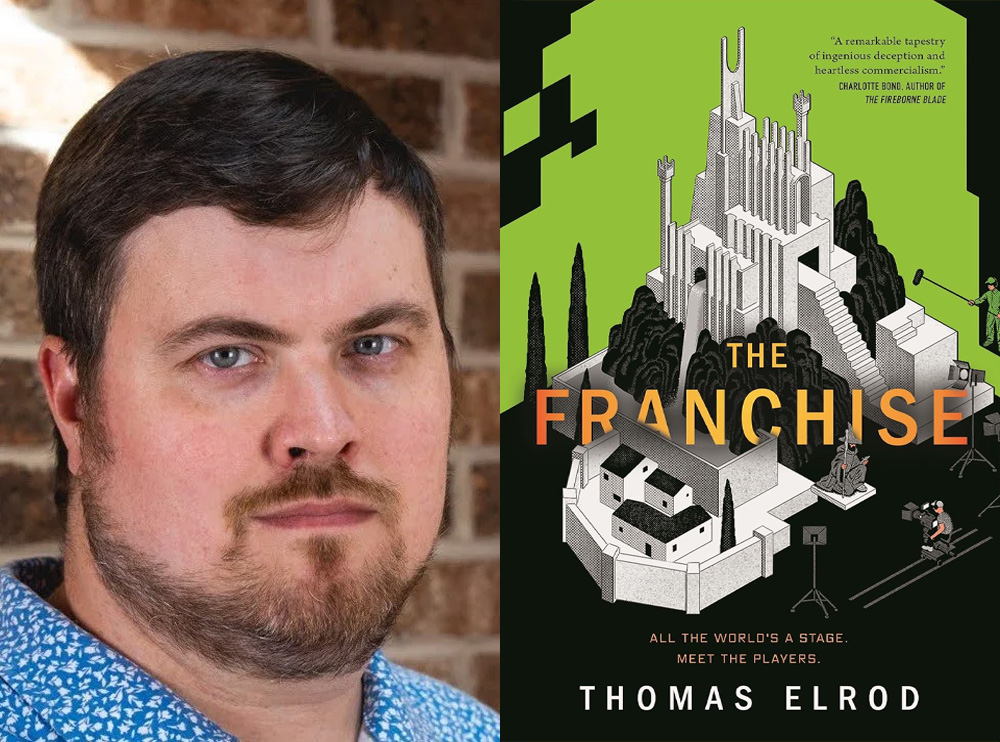
We chat with author Thomas Elrod about The Franchise, which is an epic tale of a Hollywood-owned fantasy world where nothing is quite as it seems to the people who live and die at the studio’s whim, think Game of Thrones meets The Truman Show!
Hi, Thomas! Can you tell our readers a bit about yourself?
I live just outside Philadelphia with my family, and although I’ve been writing my whole life The Franchise is my first novel. Other than that, my life is not full of too much excitement! I like reading, watching movies, browsing through record stores, and rooting (or despairing) for the Philadelphia Phillies.
When did you first discover your love for writing and stories?
The first story I ever wrote was in first grade, when I wrote an explanation of the history of Groundhog Day from the perspective of the groundhogs. (There was even some fake etymology in there with how the groundhogs invented the word “shadow.”) Over my school years I was fortunate enough to have many teachers who encouraged my creative writing impulses in many ways. So I’ve always been writing and telling stories, usually speculative fictional ones, since about as long as I could write.
Quick lightning round! Tell us:
- The first book you ever remember reading: The first actual novel (not a children’s picture book) I really remember reading was either My Teacher Is an Alien by Bruce Coville or Sideway Stories from Wayside School by Louis Sachar. I guess both were pretty formative to my interests.
- The one that made you want to become an author: It’s a bit of a cliche, but when I was nine years old I read The Hobbit and The Lord of the Rings for the first time and it really sparked something. Probably those books and a lot of the H.G. Wells I was reading at the same time cemented my interest in wanting to write.
- The one that you can’t stop thinking about: I think the best book ever is The Canterbury Tales. It’s not a novel but it certainly has a lot of novelistic elements. It has everything in there, really. Satire, genre-bending, moral and ethical debates, politics, fart jokes. That’s the book that keeps on giving.
Your debut novel, The Franchise, is out now! If you could only describe it in five words, what would they be?
Middle Earth Reality TV Show
What can readers expect?
The book has a big hook (what if The Truman Show were Game of Thrones?) and it certainly delves into that concept in detail. But it’s also a book about point of view and identity, and so I think readers can expect lots of playing around with who is telling what part of the story, how it’s being told, and how the telling affects the characters or even shapes who they are. It’s a very self-aware novel, in a lot of ways, and I hope readers find that fun.
Where did the inspiration for The Franchise come from?
I am really tired of how our pop culture and entertainment products have all become extensions of various intellectual properties. And even the long-running franchises out there feel very worn and out of ideas. But I’m also aware that all this IP is tied to the long-term financial interests of very large media conglomerates, who can’t just stop making them and move on to something new. Too much of, for example, Disney’s portfolio is tied up in things like Marvel or Star Wars for them to actually stop making Marvel or Star Wars things. So what happens to a culture that can never grow or evolve or make anything new? That’s really where the seed for the idea of the novel came from.
Were there any moments or characters you really enjoyed writing or exploring?
A lot of my characters are not very smart. A few have intentionally cultivated a way of living that rewards their ignorance and complacency, but they move through the world kind of unaware and unengaged with what’s actually happening. In real life those types of people can be maddening, but in fiction they are quite fun to write. I was able to mine a lot of humor out of characters who don’t know or can’t know what’s going on, and their attempts to figure it out are where most of the conflict comes from.
Did you face any challenges whilst writing? How did you overcome them?
The story is told in a circular, non-linear way, but the earlier drafts were much more straightforward. My editor and I talked about it and decided there was a better way of telling the story by first coming into the world at a later point in the plot, and from a different angle. The reshaping of the narrative in that way – and keeping all of the details straight – was tough but ultimately worth it. The book is better now, and builds momentum faster even as it often doubles back on itself.

This is your debut novel! What was the road to becoming a published author like for you?
It took a long time! I had written a different book, which is how I landed my agent, but we couldn’t sell it and so I had to work on something else. That became this project, and even then it took a long time to shop around and eventually land a contract. Then even longer for the book to go through all of the various editorial, production, and marketing stages it needs to go through before it hits shelves. Patience is really a key virtue all aspiring authors should cultivate. But now I’m excited that people can finally read it, so the wait was definitely worth it.
What’s next for you?
I’ve written a second novel, which should be out next year, which is a little different than this one but also plays with genre in some interesting ways that I hope people respond to. And now I’m working on developing future projects with my agent, and hopefully we’ll be able to sell those as well. Always writing, that’s the key!
Lastly, what books are you looking forward to picking up? Any you’ve read so far this year that you’ve enjoyed?
The Republic of Memory by Mahmud El Sayed is one I’m really looking forward to reading. Generation ships, political turmoil. Sounds just up my alley. Recently I’ve read Notes from a Regicide by Isaac Fellman, which was also about politics and art and was terrific. And I enjoyed Nicked by M.T. Anderson, which is a very fun, comic medieval heist story about trying to steal the bones of Saint Nicholas (based on a real event, evidently).