


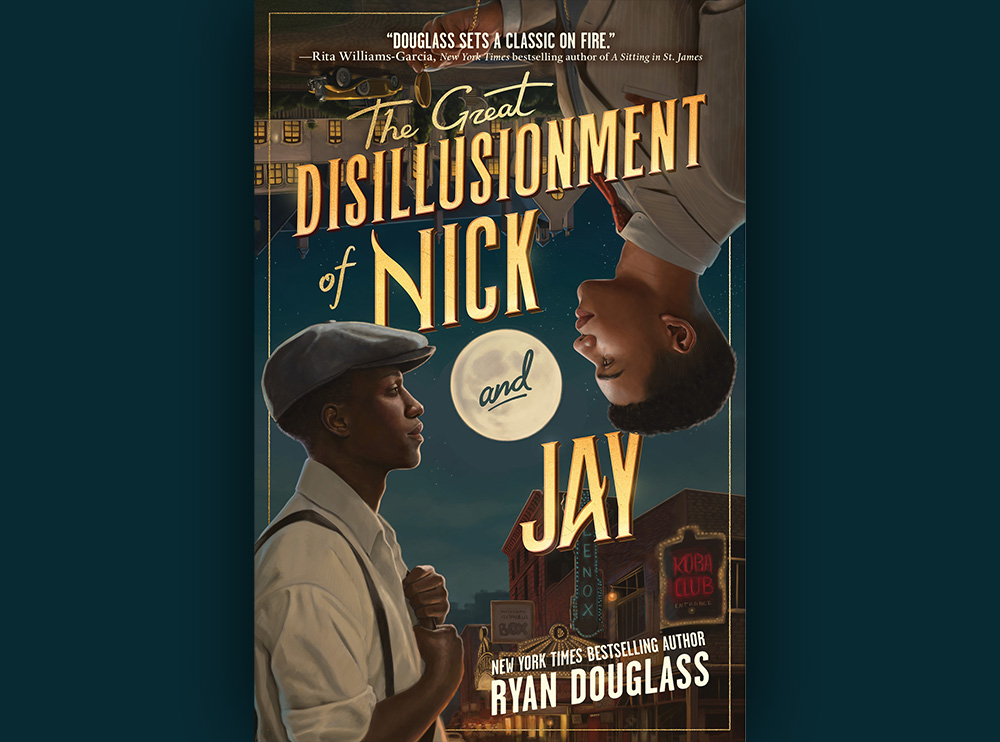
From New York Times bestselling author Ryan Douglass comes a gripping and tender reimagining of The Great Gatsby about the pursuit of happiness—and love—in a society built on cruelty and secrets.
Intrigued? Read an excerpt from The Great Disillusionment of Jay and Nick by Ryan Douglass, which is out now.
Seventeen-year-old Nick Carrington wants nothing more than to leave Greenwood, Oklahoma, behind and make a name for himself in the papers. But when tragedy strikes, dreams turn into a twisted reality. Forced to start anew in Harlem, only a letter of acceptance from the prestigious West Egg Academy is able to pull him back into the world.
But the supposedly integrated private boys’ school is more of a catchy headline than a fact, with the same prejudices Nick left behind back home. And his secret but growing feelings for the founder’s wickedly charismatic son, Jay Gatsby Jr.— who dances past society’s conventions with practiced ease—only add more complications.
When Nick’s cutting pen exposes dangerous truths about West Egg and leads to perilous consequences, he and Jay must decide whether to spend a lifetime outrunning trouble or be the ones to light the match. Can they not only fight back but triumph? Or will the powers that be win yet again?
Chapter 1
Time always moved slowest when I wanted something. I wanted to know why Isaiah had invited me to talk.
He didn’t say what was on his mind, but I knew it was about what I did on the porch in that moment of poor judgment all those years ago. It had been the pit of my shame ever since. I knew the day would come when we’d have to talk about it. I just didn’t think it would be today.
I sighed and fell back against the wooden shelves. It was nearing the end of my shift and the time showed 4:54 p.m.—only six more minutes until I was free.
Free from brushing mud out of shoelaces, polishing church shoes, and attaching straps to slingbacks.
Warm air blew through the room’s window—the only breeze I had in this place. It was always hot in here, on account of Mr. Wallace’s protest against air-conditioning. “The world don’t need more machines,” he said. “More machines means more toxins. More toxins means shorter lives, for all humankind.”
Mr. Wallace was a shoe-shiner but make no mistake—he was whip-smart. I never would’ve connected air-conditioning to doomsday, but it made sense I guess.
I wiped sweat from my forehead as the floor creaked beyond the door. Mr. Wallace was approaching the backroom from the parlor.
I quickly closed my pocket watch to sort the remaining shoes into boxes, but then Mr. Wallace opened the door and the watch slipped from my fingers, rolling across the carpet and stopping at his shoe.
He reached one of his long arms down over his belly and picked up my clock, eyebrows tensed as he handed it back to me. “You dropped something,” he said.
“Thank you, sir.” I took the watch and tucked it into my shirt pocket.
My mentor looked around at the mess. “How long does it take to box a few shoes, young man?” he asked, his tone carrying a sting of judgment.
“Sorry, Mr. Wallace,” I said. “I got distracted.”
By all my memories with Isaiah, I didn’t add. The fact we’re growing different, like a sweet gum and a black gum, each in its own swamp.
Mr. Wallace looked at me like he knew something was wrong. “What’s on your mind, son?”
What would I say? Friendship meltdowns?
I could talk to him about some things. More than I could talk about with Pa—that’s for sure. But I knew what was between me and Isaiah was for us to work out.
Mr. Wallace sat on a stool with fatigue. He’d worked for generations. His shop was a staple of the community. It had outlasted every business that popped up and called it quits soon after.
“If it’s about your father,” Mr. Wallace said, “you know what I’m going to say, Nick.”
Ah, there was a change of topic that felt daunting, but somehow more approachable. He’d advised me on my issues with Pa before. Like a rooster in the morning, he told me to forgive him—forgive him! Cock-a-doodle-doo.
“With respect, sir, I can’t forgive somebody for something they ain’t sorry for,” I said, before he got around to saying it.
“You stay waiting on people to apologize to you, all them grudges gon’ crush you like a ripe grape!” he said. “Do you want to win, or do you want your grudge to win?”
“I suppose I want to win,” I mumbled.
He leaned back with righteousness. “So . . . ask yourself what your father’s choice in denying you apprenticeship is teaching you about your own sovereignty. Take the lesson, leave the pain.”
“Sovereignty, sir? Like power?”
“Not quite.” Mr. Wallace pulled a dictionary out from a drawer under the shelves. “That would be the A definition. I, myself, prefer the B definition.”
He looked like an explorer in his loose canvas pants, spouting out knowledge. “Freedom from external control, or autonomy,” he read from the dictionary, while looking at me over his glasses. “Your sovereignty is your choice. It’s what leads you in life. If you intend to be a writer, it shall be that you become one, whether you have your father’s blessing or not.” He closed the dictionary and placed it back in the drawer.
“See, we don’t need apprentices and masters,” he went on. “It’s the structure of things, not by necessity, but because each of us makes a choice to uphold this order. In reality, each of us needs only the discernment to guide ourselves.”
It’s funny. I knew I could do things and be someone without my father’s blessing, but I so desperately wanted it. He was my blood. All I had since Mama passed and Daisy moved away.
I began sorting polish into the pockets of a wooden case. “Papa thinks I don’t got enough brains to write for The Star,” I said. “So, if I do end up writing, it would have to be for someone else.”
“Did he say that?” Mr. Wallace asked. “That you don’t have brains?”
“Naw, but he implied it.”
“Perhaps have another talk with him and ask for his reasoning—ah, ah,” Mr. Wallace said, pulling a black canister from my hands. “Careful, this shouldn’t be with the polish.” He placed it on a side table.
“What is that, sir?”
“Toxic chemicals that will burn your skin to the bone if you touch ’em!” Mr. Wallace crooned like a dramatic stage performer. “I should have warned you before leaving it out on the worktable.” He stretched to pull a safe box down from a top shelf. “Mrs. Millie has forgotten the combination to her late husband’s safe box and has asked me to crack it open.”
Mrs. Millie was my neighbor. She was about seventy years old, and one of the first to buy land some twenty years ago from Mr. Gurley when he started selling plots to Negroes looking for a new start. Lots of my elders was coming from tenant farms where they worked like slaves for a tunic and some cornmeal.
Since Greenwood was new, we still acted like folks on the run. We were real secretive with our money, like storing cash in a shoe-shiner’s shop secretive. If the white folks ever came to loot us, they’d go straight for the banks, never here.
Mr. Wallace screwed the top off the canister. He dipped a pipe cleaner into the soppy stuff and then rubbed it along the door of the safe. “This locked safe? Think of it like your life. You could waste it trying to find the perfect series of clicks to open the door. Or you could work smarter and not harder.” He continued to delicately rub the substance in a rectangle. I could already smell burning steel from what it was doing.
“There are many ways out of a trapped situation,” my mentor said calmly. “Not just one combination. My personal favorite is sulfuric acid, otherwise known as grease. This stuff is highly dangerous, son—you may want to stand back.”
In seconds, the grease caused the metal door to curl and melt off the safe, sending tendrils of dark smoke into the air between us. Inside was an ocean of banded dollar bills.
“What?” I exclaimed. “That’s slick!”
Mr. Wallace let out a long whistle as he pulled some money out and inspected it, seeming impressed. “Never knew Old Man Francis had it like this.”
He was fascinated with the sight of money—typical for the son of Easter Wallace. His father was a reckless kleptomaniac who stole his old master’s safe before escaping his farm for Greenwood. He taught his son safecracking, and though Mr. Wallace followed a more legitimate career, best believe he still knew how to crack one open.
“Say, out of curiosity, how do you make that st—” My question hadn’t left my mouth before a hard object smacked me on the side of the head, landing with a clack at my feet. “Ow!”
The object was still rattling slightly between my brogans—a small pebble that had been hurled in from outside.
“What in the—?” Mr. Wallace limped toward the window and barked, “Who’s there?”
“Sorry!” came a familiar voice. “I didn’t mean to throw it that hard.”
I felt a throbbing in my temple as my old friend’s open hands appeared in the shop window.
“Sorry, Mr. Wallace,” Isaiah repeated.
“Don’t be throwing rocks through my windows, boy!” Mr. Wallace screamed.
I started laughing.
“Sorry!” Isaiah called, backing away across the grass. “Sorry!”
Mr. Wallace turned around. I stood up and ran toward the window, sprouting out of it so my upper half could be outside.
“A pebble?” I asked. “Really?”
“Just trying to toughen you up.” Isaiah sauntered forward with a smile, drawing closer to me across the field. “What time do you get off? I wanna show you the Vanderbilts’ estate.”
Ah, the Vanderbilts. They were the rich family he’d become a groundskeeper for. Isaiah moved up in life faster than me, that’s for sure.
I pulled out my watch and found the hands showing five p.m. “Right about now! But I’m supposed to be home before the sun goes down.”
“Well, move back! I’ll help you finish up.”
I moved, and he climbed clumsily through the window and landed with a thud.
Mr. Wallace was stringing up a money bag with Mrs. Millie’s cash. He raised an eyebrow at Isaiah. “You break something, you paying for it!” he said, then left to go back up front.
Isaiah looked judgmentally at him and then my work quarters. “What’s got his buttons in a bunch?”
“He’s sensitive to violence,” I said. “Mr. Wallace is a gentle man.”
“Is that why you work here?”
“No,” I said, fitting two shoes in a box like puzzle pieces. “I work here because I don’t have a choice.”
I could feel Isaiah rolling his eyes. “Nick, you always have a choice in being a shoe-sniffer.”
“What a terrible way of framing it! We all need a shoeshine every now and then.”
“Not the point.”
“Then what is the point?” I turned to face him and then caught our reflections in the wardrobe mirror. Even our fashions were more at odds lately. I wore a flat cap and loose shirt with suspenders to hold my knickerbockers up. He wore a blue suit that fit his muscled form and a matching fedora that complemented his square face. Isaiah’s hair underneath was in close-cut, brushed waves. His complexion was a warm, reddish brown, like chestnut. Mine was similar, but a bit darker.
Three weeks ago, we’d finished the school term, likely our last, and now our futures were the main focus of our lives. Isaiah thought about where he was going more often than I did, and anyone could tell from our clothes that he was destined for greatness and me, for less.
“The point is,” Isaiah went on. “We gon’ be eighteen soon and you still letting life control you, like you some kind of tumbleweed. I ought to call you Tumbleweed Carrington.”
“Tumbleweed is a nice name,” I said, turning away to put the final pair of shoes in its box. “Maybe it would suit me better. I’m named after my grandfather, after all.”
All I could do was joke in the face of Isaiah’s criticism. He talked opportunity all day! Never music, family, romance—the stuff we used to discuss. Just what I should’ve been doing to move up.
What if I didn’t wish to climb as fast as he did in the first place? The world he’d gotten into scared me—its pristine polish, its strange emptiness underneath. It was as if the main purpose of being rich was to impress people rather than to be happy.
I didn’t say anything about it. I preferred not to touch a sore conversation, and to keep the remnants of our friendship intact.
I finished up my final duties and called, “Bye, Mr. Wallace!” as I grabbed my satchel off the coatrack.
I curled out the window, slid down the little gap between the bricks and grass, and fetched my bike from its post outside. Isaiah followed close behind.
We rolled into the streets, where golden sun stretched across the cobbled road. We biked through the channel of brick and wooden storefronts as the shopkeepers reversed their signs from Open to Closed. The radio operators hung their headphones on the wall and the mail trucks returned to the post office parking lot.
We were headed past the city and toward the big oil derricks at the end of town. The big, latticed triangles, shaped like Christmas tree angels, manned a strip of country road that separated Greenwood (the Colored district) from the rest of Tulsa, which was white. It was best to travel the road by car and to keep a look out for white people hunting down Negroes. I’d never travel it by myself, but with Isaiah, I could make it through without feeling scared.
The rustling of crickets and cicadas grew louder as the noise of people faded and darkness set in. Here, with no one around us, I nearly remembered that moment—the moment I messed up our friendship. But then, his voice took me out of it.
“You’ll love it, Nick,” Isaiah panted, slightly out of breath. “I promise.”
Soon enough, a glowing streetlamp showed us to the first sign of white Tulsa. It was a little train post at the bottom of a hill. I followed Isaiah up the street that flattened out to a private property. A stern guard in black uniform stood by an iron gate protecting a grand house.
“Hi, Edward!” Isaiah sang as we approached. “I left something in the courtyard, if you don’t mind.”
“Of course, Isaiah.” Edward gave a friendly smile and twisted a key through the gate and pushed it open.
It gave a groggy squeak, and the courtyard expanded before us. A short walk brought us to the heart of the space: a huge pool of light blue water, with palm trees forming columns beside it. These trees, which threw shade everywhere, took me to a tropical place. The house was three stories, with arched windows, a big balcony, and pillars connecting the floors.
I spied a woman at a third-floor window watching us enter, and a familiar discomfort set in my bones. The discomfort that led me to find work in Greenwood rather than Tulsa.
“It’s getting so dark already,” I noted, feeling anxious.
“No offense, Nick, but your pop needs to lighten up on the curfews,” Isaiah said, as he sat on the edge of a fountain and crossed his legs like he owned the place.
“None taken,” I replied. “Maybe he’d listen to you if you told him.”

Isaiah laughed. “No way I’m listening to a lecture on the dangers of the white man. The white man pays me well here. I say if I stick it out for a year, smile, and trim hedges good, I can work my way up to a Touring.”
My friend thought having a nice car would solve all his problems.
“That’s no good,” I said, sitting beside him. “Because then you’ll leave Greenwood, and I’ll have no friends.”
“Well, you might have more if you put yourself out there!”
“Out where? I don’t want to put myself anywhere. I want to be a turtle.”
Isaiah ran off to a white veranda between the fountain and pool, perhaps to get a better look at my pathetic self. “You ought to learn to be a hare!” he said, folding his arms, leaning against the wood. “That brings me to what I wanted to talk to you about. If you’re interested, I’m sure the Vanderbilts can find you a nice job that would level up your money.”
I looked up at the woman in the window again. “I don’t think that lady wants me here.”
Isaiah looked up too. “I know Mr. Vanderbilt better than the missus, but I would hazard that staring back makes it worse.”
I took my eyes off the woman, but she continued to watch me. I could feel it.
I found a wobbly version of myself in the clear water of the fountain as I pondered Isaiah’s offer. Deep down I may have been tired of being such a dewdropper. “Perhaps I should get a better job,” I said. “Say I leave Greenwood to write for some paper outside this town. What could Pa say about that?” I met Isaiah’s eyes and felt a boldness creep into my bones. “What law is there says you have to work in the town you grew up in?”
“Not one.” Isaiah shrugged. “You could potentially take the first train up North tomorrow morning. But where would you go?”
“Chicago,” I answered.
He raised his eyebrows. “Not New York?”
“New York is too far,” I said. “And possibly too big. And too close to the water. I’d hate to drown.”
“So, you want to be somewhere better,” Isaiah said, his tone softly asking for assurance.
“Yes,” I admitted. “Not here, in Oklahoma, but if I could see more of the world, I think I would find my place in it. To become charming and adaptable, like you.”
Isaiah laughed lightly, accepting the compliment with a muted grace.
A low noise—a hiss—came from the grass, and then sprinklers around the property turned on, spraying us with water. I looked up to the window again and the woman was gone. Had she done that?
“Probably a sign it’s time to go,” Isaiah said, holding up his arms to shield himself from the spraying mist.
He broke into a jog down the pathway toward the gate, and I followed.
[no ornament]
Once home, I waited on my front porch in the dark for a moment, watching lightning bugs glow every few seconds around me. At last, the air was cool outside, but I hated this part of the day.
I unlocked and opened the door, stepping over the threshold as quietly as possible.
“Nick?” Pa called from his study, before I’d even closed the door. “That you?”
I found him in his room—a cave of the fixations that fueled his writing. His walls were covered with newspaper clippings from The Tulsa Star. They told of politicians trying to take our rights away and the rising heroes who would save them. On his desk, a burning candle sat beside a big globe, and behind the desk, a three-dimensional sailboat jumped out of its frame.
He gave me a glance, in between clacks on his typewriter. “Where have you been out so late?” His tone was direct. But his focus? On anything but me.
“Isaiah was showing me the fancy estate he works at now,” I said.
Pa paused his typing and faced me gravely. “You went to that side this late?”
“Yeah, he invited me after work. It was the only time I could go. But Isaiah got all kinds of connections over there and they all know him.”
Pa crossed his arms and furrowed his brow, a mixture of disappointment and quiet anger on his face. “But they don’t know you. They don’t know you from a wild hog, and they damn sure won’t treat you any better.”
I knew this already. Every other day it was some dismissive lecture about how little I knew of the world. How I’d only understand things when I was older. I was sick of it!
“I don’t think I should have a curfew anymore,” I said. It came out almost against my will. My words drenched the room in uncomfortable silence, and I regretted them right away.
Pa looked very confused. Then he started to laugh—something he rarely did. “That’s an odd statement because you’ve never had a strict curfew.”
“I mean I don’t think I should have to be home before dark. I don’t think . . . well, I think I’m old enough to come home when I please.”
“When you please.” Pa raised an eyebrow at me. “Nick, what are you talking about? What do you have to do at seventeen, besides go to work and come home? Are you looking to be traumatized by the world?”
I couldn’t quite explain to him what I wanted . . . a chance to explore life without worrying about trauma at all. The confidence to move through the world like I belonged in it. Like Isaiah. He was effortless. He didn’t waver. The only way I’d get like him was by breaking free from my father’s rules.
Pa looked from my eyes to my feet. “Your weight is down,” he said. “There are boys far more strapping than you being taken down every day. White folks are trying to take a young man down as we speak, over a rumor he’s attacked a white woman in an elevator, for which there is no evidence. Do you know what that means?”
I shrugged. I knew he’d tell me anyway.
He leaned forward in his chair. “It means a white man needs no true motivation to want to kill a Negro. Don’t ever tell me you should do what you please, Nick, until you’re really out there on your own. Understood?”
“Yes, Pa.”
I had to resign. He exited the conversation as if it were a story he had finished printing, already forgotten in favor of his next lead, and placed his full attention back on his work.
I stormed to my own room, heart in my chest. Maybe if I didn’t have to go somewhere else for work in the first place, I’d have no reason to be out late, sir!
I closed the door to my room and plopped down at my desk. I kept a little Chinese fan my mother had brought back from New York when she went to help Uncle Beet, Auntie Lorraine, and my cousin Daisy move seven years ago. Mama was in heaven now. A fire at her hospital took her away, but the fan helped keep her nearby. Next to it was this rolled-up map that Daisy gifted me before she left. She found this map at the train station; someone had left it behind.
In my annoyance, I unraveled the map. It showed the world in perfect detail, and it was labeled by color, which showed colonial possessions. So many places in the world were owned by people who weren’t from there originally. The colonizers tried to control them but they still found joy. Their spirits were invincible!
I traced my finger over the printed image, mapping exactly where I wanted to go. French West Africa and Brazil were at the top of my list. There were Negro boys there too, fighting back against control, but the boys there had different customs of living entirely.
Perhaps their fathers didn’t doubt their ability to brave the world on their own. Perhaps they were in control of their own destinies.