

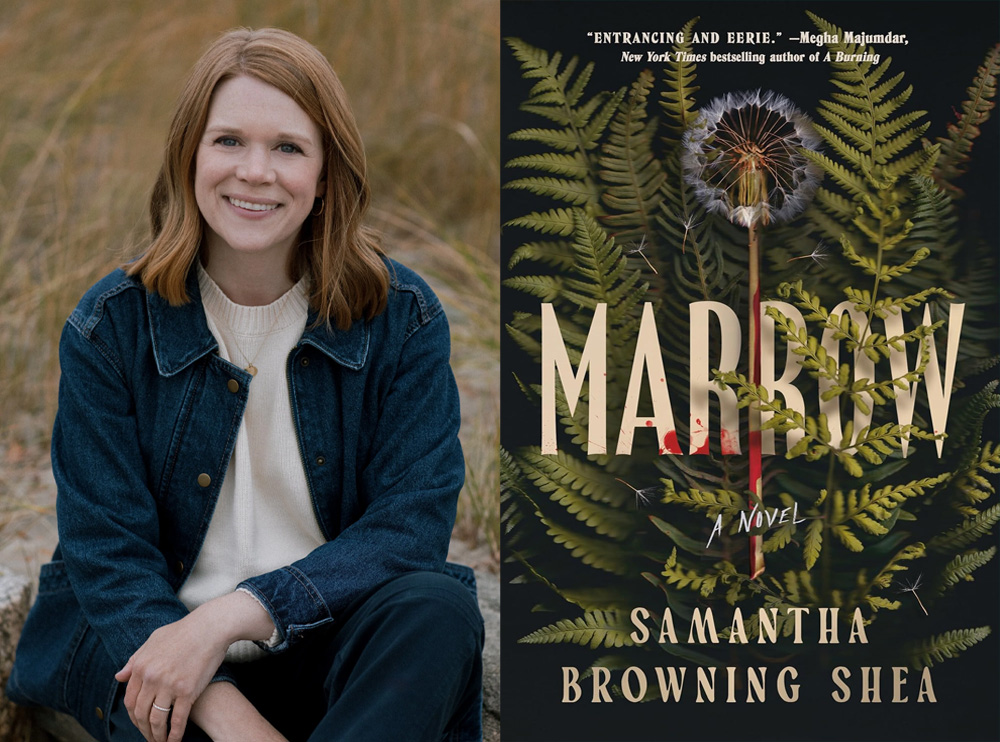
Guest post written by Marrow author Samantha Browning Shea
Samantha Browning Shea is an author and the vice president of Georges Borchardt, Inc. literary agency. A graduate of Colgate University, Samantha lives in Connecticut with her husband and their two daughters. Marrow is her debut novel.
About Marrow (out September 9th 2025): A searing take on femininity and power, Marrow transports readers to a small island off the coast of Maine, where a coven has done the seemingly impossible.
When I was seventeen, I became fixated on a TLC show called A Baby Story. It was the kind of show that slotted easily into the television ecosystem of the early aughts, which was shaped by soft voyeurism and the commodification of personal transformation. In thirty minutes, the show moved with uncanny efficiency from pregnancy announcement to crying infant, from a woman’s name to her new title: Mom.
At the time, I watched A Baby Story the way another teenager might watch porn – secretly, obsessively, almost religiously. Not because I wanted children. Not even because I wanted to become a mother. I watched because the show offered something that, in retrospect, I was desperately searching for: a narrative blueprint for becoming a woman.
The premise was simple, trite even. A woman, usually in her late twenties or early thirties, navigates her third trimester in front of the camera. She is framed by soft lighting, her belly round and firm. She shops for a stroller. She debates “natural” childbirth. She attempts the Lamaze-breathing we watched her learn in a birthing class eleven minutes before. There is no narrative arc besides the biological one. Pain builds. It peaks. Then, release. A baby emerges. A woman is born.
I didn’t realize that what I was watching was not just a show about childbirth, but a show about identity collapse. A woman enters the frame as herself and exits it as something else, someone else – a mother.
In a media environment oversaturated with hyperfemininity, motherhood seemed like the most legible form of grown womanhood available to me. A Baby Story functioned as a soft-focus mythology builder. It sold motherhood not as an experience, but as a kind of moral horizon. In these stories, labor was a rite of passage, the body a crucible, pain a necessary precondition for becoming “real.”
There was no mess. No postpartum depression. No climate anxiety. No ambivalence. It was, instead, a culmination – a kind of punctuation mark at the end of girlhood’s run-on sentence. The world that existed before the baby was rendered peripheral, blurry, less important. It was easy, at seventeen, to believe that this was aspirational rather than ideological.
Now, with distance – and with more nuanced portrayals of womanhood available to me – I see A Baby Story as one of the earliest pop-cultural texts to usher me into the cult of motherhood: that subtle but pervasive belief that to be fully female is to be selfless, giving, emptied out, both physically and emotionally. The show’s most consistent visual motif was the laboring woman: sweaty, primal, overcome. It was mesmerizing to watch her struggle. And it was comforting to know that once the baby was born, the struggle would be over. She had arrived.
But there is no arrival, really. And that fantasy – the idea that womanhood is something you can only inhabit through suffering – damages the women who buy into it. It warps their relationships with their own bodies and prepares them to equate love with pain.
I haven’t watched a full episode of A Baby Story in years, though sometimes I still look up certain mothers, the way other women in their late thirties might look up a childhood crush. I wonder about the women, about what came next for them. I wonder if they felt the sort of transformation the show promised, or if they felt like they lost something along the way.

Mostly, I wonder about the seventeen-year-old version of myself: hungry for direction, visualizing my future through the grainy lens of TLC reruns, believing that the most transcendent version of myself would begin in a hospital gown, with a contraction monitor beeping steadily beside me.
I don’t fault her. She wanted to become someone whole. But now I understand that womanhood doesn’t need to be proven through pain. It doesn’t need to be marked by a child. It doesn’t need to be earned.
In the wake of the Dobbs decision, I can’t think about A Baby Story without seeing it for what it also was: a soft-lit tool of the patriarchy, quietly scripting women into a vision of femininity that ends with self-sacrifice. The show marketed itself as a celebration, but in a post-Roe world, that framing feels less like nostalgia and more like prophecy – an early primer in how the culture prepares women to give themselves away, not just willingly, but with gratitude.
It’s not that motherhood is inherently oppressive – as the mother of two young daughters, I can attest that motherhood has also brought me moments of incredible joy – but the fantasy that A Baby Story offered was never just personal. It was political. And for a generation of girls raised on stories like it, we weren’t just watching women become mothers. We were watching them disappear.
I want more for my girls.