
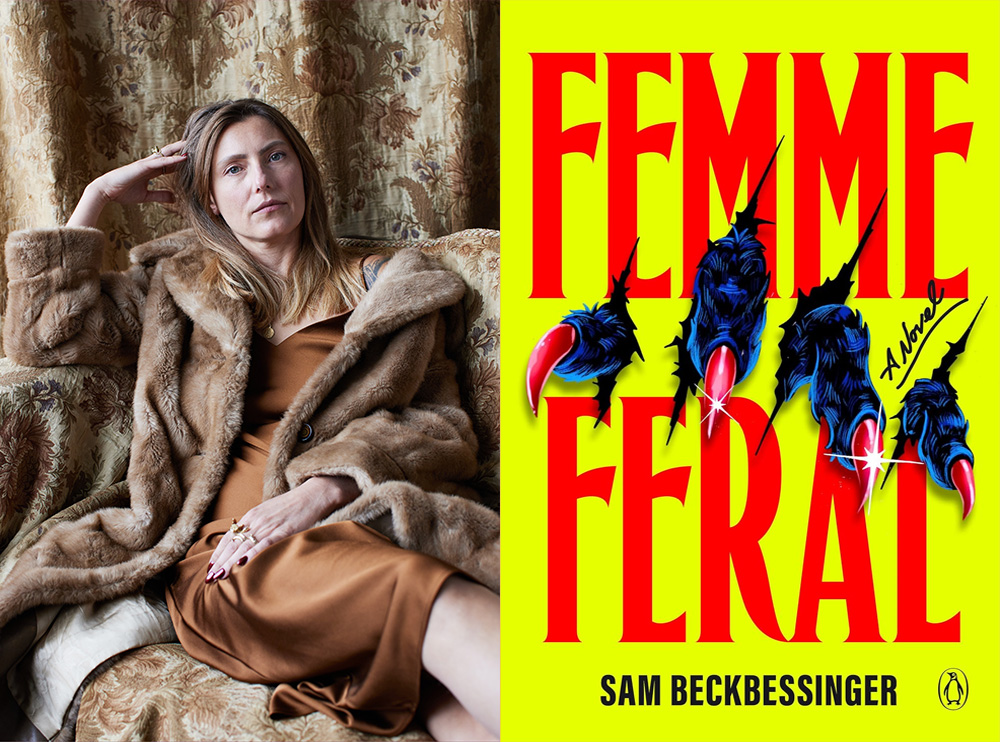
We chat with author Sam Beckbessinger about Femme Feral, which is a deeply gratifying, highly addictive and provocative read, Femme Feral is an exhilarating expression of feminine rage, with a warning: If you swallow your anger, it’s sure to come back with a bite.
Hi, Sam! Can you tell our readers a bit about yourself?
Hiiii, fellow nerds! I’m a very dorky horror novelist, although over the years I’ve tried my hand at many different types of writing. I’ve published picture books, a YA novel (co-authored with my beloved friend Dale Halvorsen), kids’ TV shows, a Marvel story, a bestselling nonfiction book about getting out of debt (the true horror), and I’ve been blogging for almost two decades, although mercifully most of it’s now lost to the ghost plains of MySpace/Blogger/Tumblr. I’ve had many odd jobs over the years, from being Ronald McDonald’s ghostwriter to working in tech, and I now teach creative writing at Bath Spa University. I was born on a farm in South Africa (my first pet was a donkey named Mr Magoo) but I now live in London. I’m obsessed with D&D, spreadsheets, and Buffy the Vampire Slayer. I’ve just published my debut adult novel, Femme Feral, which is about a hyper-competent woman who thinks she’s going through perimenopause … but she’s actually becoming a werewolf.
When did you first discover your love for writing and stories?
I was a really weird kid, and I think books were more real to me than people were. My parents were voracious readers, preferring a fun yarn to dry literature, and I was lucky enough to grow up in a house strewn with books. My dad loved cowboy books and adventure stories; while my mum got me hooked on horror from an age that worried librarians. I don’t think I ever started writing so much as I never stopped: I loved making up stories as a kid, and I spent my teen years writing fan fiction, making zines and filling endless notebooks with terribly emo teenage poetry. My best friend and I were so obsessed with Tolkien as teenagers we taught ourselves to write Sindarin. Books have always been the great love of my life.
Quick lightning round! Tell us:
- The first book you ever remember reading: A truly morbid picture book called Poor, Poorly Pig about increasingly terrible disasters happening to a pig, which for some reason I found screamingly funny.
- The one that made you want to become an author: Carrie by Stephen King. I read it when I was about thirteen and felt I’d never read anything so true about the horrors of adolescence. Although, thinking about it, one of the first things I ever wrote was fanfiction of The Lion, the Witch and the Wardrobe on my family’s old Packard Bell computer when I was about eight, imagining me and my little brother found a doorway to Narnia behind our local KFC, so maybe that. Honestly, I can’t remember a time in my life I ever didn’t want to write stories, although how one becomes “an author” is something I’m still trying to figure out.
- The one that you can’t stop thinking about: At least once a day I hear a thought in my head that sounds like it was whispered directly from Merricat from Shirley Jackson’s incomparable We Have Always Lived in the Castle. That character lives in the basement of my brain.
Your debut novel, Femme Feral, is out now! If you could only describe it in five words, what would they be?
Fury, furry, fangs, ferociosity … and I hope funny?
What can readers expect?
- Femmegore catharsis
- Perimenopausal fury
- A skewering of techbros and productivity culture
- Good girls gone feral
- Werewolves, but not the sexy kind!
Where did the inspiration for Femme Feral come from?
About a decade ago I was walking around Cape Town on my way to a friend’s birthday. It was one of those perfect picnic-dress days, a spring-in-your-step song-in-your-heart kind of summer afternoon. Then I realised some dude was following me. I did the things all women do. Reached into my handbag and clutched my keys. Scanned for easy exit routes or an open shop I could dash into. Sped up my walk, but not too much, because you don’t want to over-react or trigger his prey drive. This wasn’t the first time I’d been followed, obviously, but something about this time was different. I wasn’t only afraid, I was furious. I’d been having a lovely day until this creep ruined it! And I found myself having a fantasy I’d never had before: that I could reach into my bag and pull out a gun, turn to him, and make HIM feel afraid.
This was a shock. I’ve never been an angry person. I hate guns and I loathe violence. But this flash of fury has stayed lodged in me like a splinter for a long time. It became the seed for this book: thinking about all the ways women are taught to repress rage our whole lives, and wondering about what happens when we can’t any more.
Were there any moments or characters you really enjoyed writing or exploring?
Every good werewolf story needs a Van Helsing character, and mine is a cantankerous octogenarian named Brenda. She has arthritis and macular degeneration, she long ago ran out of the ability to bite her tongue, and she’s perpetually underestimated. She was absolutely my favourite perspective to write from. A lot of the other characters in the story are deeply repressed and obsessed with control. Brenda’s just FURIOUS, and she uses that fury to fight for justice. I love her.
Her story was also partly inspired by one of the most fascinating people I’ve ever met, a vigilante who’s devoted her life to catching a serial killer of cats in South London. Real life is way weirder than anything you can imagine.
Did you face any challenges whilst writing? How did you overcome them?
One of the hardest things about writing is always what Ira Glass refers to as “the gap”: the gap between the book you want to write and the book you can write. There are so many incredible books out there, and it can be so hard to keep working on something that’s just not as good as you want it to be, because you don’t have the skills of the writers you most admire, and also because writing a book takes so much damn time (for me, anyway).
I know there are some rare writers out there who can write a perfect, beautiful first draft, but I’m not one of them. My first drafts are always a disgusting mess of cliches and cul-de-sac plotlines and underwritten nonsense. The difficult work is ignoring the voice in my brain telling me that I’m just not good enough, this is a huge waste of everyone’s time, I’m a massive fraud, I’m an awful writer, how dare I even think that my stories are worth trying to tell, etc.
What gets me through is just focusing on my love of the craft for its own sake. Being present through the slow process of carving a plot, of pruning a sentence, of sorting your thoughts, of hunting exactly the correct word. There are no guarantees of any outcomes, in this game, so it’s not worth doing unless you can stay in love with the process.
This is your debut novel! What was the road to becoming a published author like for you?
It’s been a slow crab-walk! I always wanted to write but I had no idea how to pay my bills with it, so I had a series of day jobs throughout my twenties and found ways to keep writing on the side. I blogged, I podcasted, I wrote freelance articles for magazines for almost no money, I played roleplaying games, I was part of a short story club, I met up with friends and write at coffee shops … it was just a hobby, but it’s a hobby I poured my best self into. In my late twenties, I did an MA in Creative Writing, part time, waking up at 5 a.m. to write every day before I went to work. I published a couple of short stories and wrote my first picture book, working with a literacy nonprofit in South Africa called Book Dash. But basically I was pretty happy believing writing would always just be something I did for fun.
Then, plot twist! My family’s financial situation had always been pretty rocky growing up, and as an adult I got myself into bad money trouble and ended up deeply in debt, having to change my phone number every few months to evade debt collectors. I wrote a series of blog posts about how I turned the situation around, and a South African publisher approached me saying they wanted to turn them into a book. That book was successful beyond my wildest dreams, I think because it was funny, and honest, and written from the perspective of someone who’d been terrible with money rather than the normal kind of person who writes money books. That book was a bestseller and was translated and sold in several countries (7? 8?) and it opened doors for me I’d never even dared to hope would open.

I always wanted to write novels but I didn’t think I had the skills, so I tried basically everything else first. I had a lot of fun writing animated kids’ TV shows, since I already have the sense of humour of a six-year-old boy. I collaborated with some buddies on developing some original adult TV shows. I wrote a choose-your-own-adventure climate change game. I wrote other nonfiction books. Then I co-wrote a YA novel with my friend Dale Halvorsen. It was so helpful having someone else to share the load and bounce ideas around with, and it was also just enormous fun (the whole process felt like an extended TTRG campaign). I’d already written a novel when I was about 23, which was truly terrible, but Girls of Little Hope was actually kinda loveable! We published it in 2023.
And I guess, finally, there was nothing else to do except to do the thing I’d always wanted to do: write my own novel. I worked on it for years, and my wonderful agent Oli Munson managed to sell it two years ago, and it is on shelves TOMORROW, and friends, it has been a DAMN LONG ROAD getting here.
I think I’d built up the idea of being an “Author” into this big thing, a thing only the greatest and most special people in the world could be, an unachievable goal. But I love writing. So now I just think of myself as a writer, because it’s more of a verb than a noun. I’m a writer every day that I write. I now have this weird career full of cobbled-together ways of making a living from writing words, and every day I get to do that feels like the luckiest day of my life. I’m going to keep trying to get away with it until someone makes me stop.
What’s next for you?
I’m two drafts into my next horror novel, which is basically Rosemary’s Baby for childfree women. I’ve been thinking a lot about how we’ve simultaneously made the conditions of having kids basically impossible for women, and then pile enormous judgement on them for not having kids (OR for having kids! Basically there’s no way to win!). I’m exploring those ideas through the story of a woman who has no interest in having kids, but finds herself unwillingly responsible for one very strange child.
Lastly, what books are you looking forward to picking up? Any you’ve read so far this year that you’ve enjoyed?
Oh man, so many! I’ve always been an omnivorous reader, loving everything from epic fantasy to contemporary litfic to classic sci-fi. My TBR pile is perpetually overflowing but the books that are on the top of it right now are Neena Viel’s I’ll Watch Your Baby (her debut, Listen to Your Sister, was one of my fave horror reads of last year) and Nadia Davids’ Cape Fever, a 1920s colonialism story set in a fictionalised version of Cape Town, which many of my friends have raved to me about.
I’ve read so many bangers this year already! Eliza Clark’s collection of dark shorts She’s Always Hungry was a real highlight. As a huge fan of Ally Wilkes and Dan Simmons I tore through a polar horror that’s coming out later this year: The White North Has Thy Bones by Dorian Ravenscroft. I treasured every careful word of George Saunders’ novel about ghosts and climate change, Vigil (his short story newsletter is one of the best writing Substacks out there). I’ve just started reading Lena Dunham’s Famesick and it’s extraordinary, and I’ve been devouring the Dungeon Crawler Carl series (I’m working on both Carl and Donut cosplay for MCM Comic Con in a few weeks). Once a nerd, forever a nerd.