


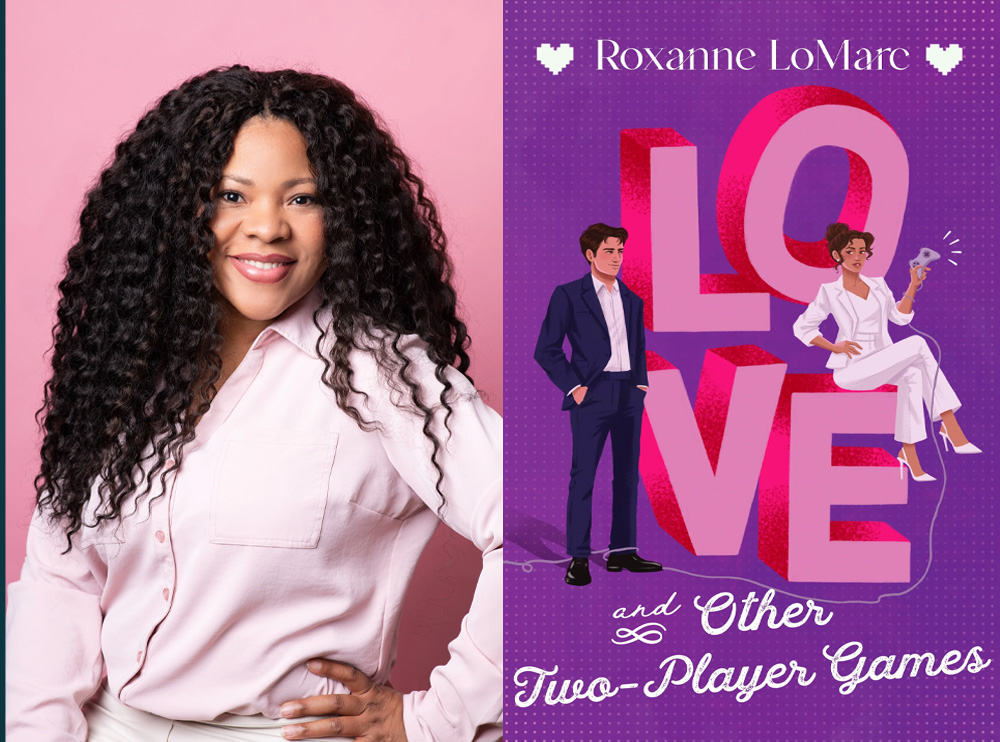
Guest post written by Love And Other Two-Player Games author Roxanne LoMarc
Roxanne LoMarc is a voracious reader, hopeful writer, and part-time poet in a happy and fulfilling long-term relationship with the written word. She lives for complicated characters experiencing heart-melting first glances, swoon-worthy first kisses, and life-changing love. When she isn’t writing, Roxanne can be found taking nature pics; adding trees to her orchard; hanging out with her children at the local lakeside skatepark; or sinking into yet another good book.
About Love And Other Two-Player Games: When CEO Victoria Preston’s business partner lands in a coma, the board installs Nathaniel Hamilton as unwanted reinforcement at her video game development company. She’s determined to get rid of him. He’s determined to stay professional—until a stalker’s escalating messages changes everything. A sharp, swoony enemies-to-lovers workplace romance about trust, control, and learning when to let someone else play on your team. Out December 1st 2026.
I wrote the story before I knew the premise. When my fingers first touched the laptop, to write Love And Other Two-Player Games, I only saw grief, then grief became a woman, and her story was what came pouring out. The concept of sonder meant that side characters also told their own stories of loss. The setting, a game development studio, meant that the plot could be gamified and my main character could be challenged beyond what would be possible in any other setting. Every antagonist was a minor villain pitted against my main character in one crisis after another until she met and dealt with the ultimate antagonist.
When I started, I wanted to explore what it meant to say goodbye. What was unexpected was that love would not only insist on appearing on the page, it would insist on becoming the most important element of the story. It would infuse light and levity into what was meant to be a tear-soaked exploration of grief. The result of writing the storylines before the premise fully revealed itself to me, was that conventions had to be redefined, structure had to be molded to fit story rather than the other way around, and the unexpected genres that emerged, were welcomed and allowed to coexist within a single work of fiction.
I wrote the story before I knew the premise. Seasoned writers come up with a premise first, then they write the novel that tells that story, but I’m so grateful to know Victoria Preston, and Nathaniel Hamilton, and all the characters that found their way unto the page during the telling of their story. I’m grateful for what they revealed to me first about grief, then about love, and especially about writing. I did it backwards, I wrote the story before I understood the premise, but I’m a better writer for it.
Love And Other Two-Player Games is a charming tale of a woman who is generally absented from romance, a woman for whom grief is the beginning and also the ending, but because love insisted on finding her, insisted on coming to her rescue, a high-stakes, bittersweet, genre-blended romance was born.

It is now out in the world, ready and waiting for readers who don’t mind a novel were the story came first, the premise came next, but the promise remains: this is real romance.
In Love And Other Two-Player Games, the losses are real but love wins out in the end.


