
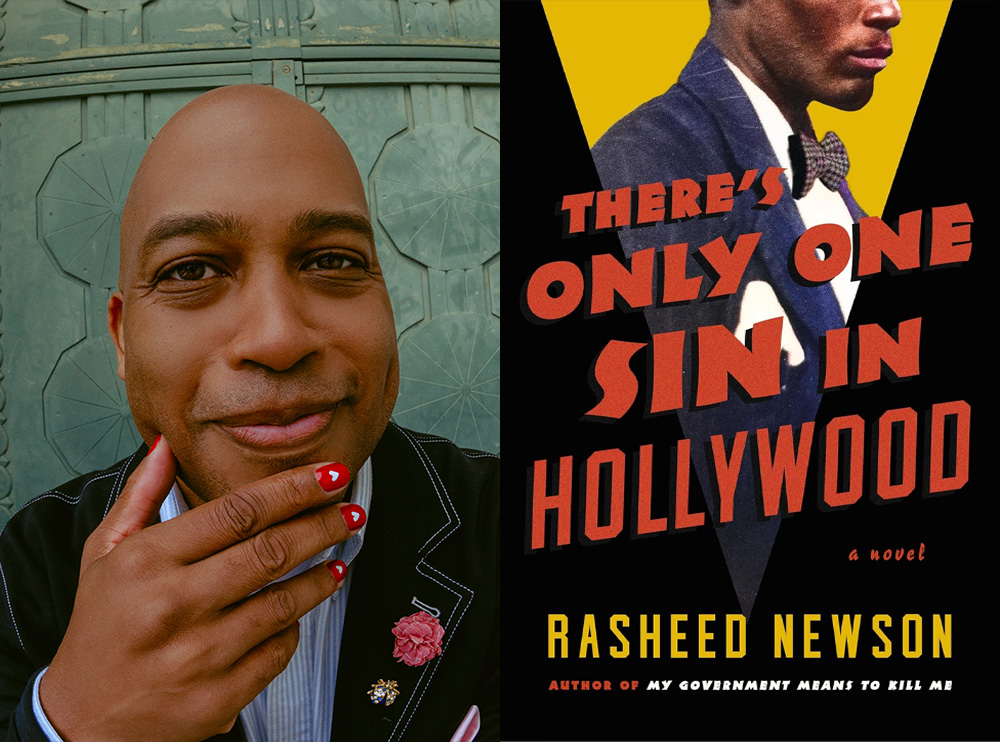
We chat with Rasheed Newson about There’s Only One Sin in Hollywood, which is a cinematic, razor-sharp novel following a backlot fixer’s daring investigation into the suspicious death of a closeted Black actor within the glamorous world of Hollywood.
Hi, Rasheed! Can you tell our readers a bit about yourself?
I am a cinephile, a Hollywood writer, a homosexual and an African American, so it was probably inevitable that I’d write a historical fiction novel titled There’s Only One Sin in Hollywood. My debut novel was My Government Means to Kill Me, and in television, I codeveloped and executive produced Bel-Air. I have a husband and two children. I am being believe in the power of naps.
When did you first discover your love for writing and stories?
My junior year of high school, I criticized Frankenstein by Mary Shelley, and my English teacher, Miss Hafley asked if I thought I could do better. Being a cocky 16-year-old, I said, “Absolutely.” She gave me 10,000 to rewrite Frankenstein. My version has been kindly lost ot history, but I remember the thrill of being in control of a big, long story. I was hooked.
Quick lightning round! Tell us:
- The first book you ever remember reading: Runaway Ralph by Beverly Cleary
- The one that made you want to become an author: The Autumn of the Patriarch by Gabriel García Márquez
- The one that you can’t stop thinking about: Funeral Diva by Pamela Sneed
Your latest novel, There’s Only One Sin in Hollywood, is out now! If you could only describe it in five words, what would they be?
Black queer Hollywood history/politics.
What can readers expect?
A bumpy ride through the Golden Age of Hollywood and the emergence of the Homophile Movement traced along the rise and fall of a Black (closested) gay movie star. The story is purpolsive, yet I also like to deep dive into the histories of cities, industries, and subcultures to show you how the Black queers were living in and out of the shadows.
Where did the inspiration for There’s Only One Sin in Hollywood come from?
Queer people of color have always been part of history, although we are often written out of the stories. I was drawn to the idea of writing about a Black gay actor in the 1950s and 60s who becomes the most daring one of his generation and reaches the conclusion that he should come out publically. I wanted to set the stage for such a decision and follow its reberations.
Were there any moments or characters you really enjoyed writing or exploring?
I enjoyed writing about how the studio system of Hollywood worked in the 1950s and 1960s, and I got a kick out of taking two of my lead characters crusing in Griffith Park. Those subculture have a lot of depth to explore.
Did you face any challenges whilst writing? How did you overcome them?
My greatest challenge always involves deciding how much of my research about the times should go into the book. I fear being research drunk and just rambling on to the reader about everything I’ve learned. I try to cut quite liberally in revisions, and I trust my editor and selected readers to tell me when I’ve gone on too long about an offshoot of history.
What’s next for you?
I’m currently writing my third book of historical fiction, which takes place in San Francisco in the 1970s when there was a serial killer targeting gay men. Because I incorporate real people into my novels, I anticipate appearances by Harvey Milk, Sylvester, and Rock Hudson.
Lastly, what books are you looking forward to picking up? Any you’ve read so far this year that you’ve enjoyed?
The list of books that I hope to read one day grows longer every year. Currently, at the top of the list of books I’m eager to read are A Perfect Hand by Ayelet Waldman; The Double Dutch Fuss: A Memoir by Phill Branch; Long Island Girls by Gabrielle Korn; The Remarkable Life of Reed Peggram by Ethelene Whitmire; and Villa Coco by Andrew Sean Greer.

And the books I’ve read and loved his year are Believe Nothing Until it is Officially Denied: Claud Cockburn and the Invention of Guerrilla Journalism by Patrick Cockburn; Death of the Soccer God by Dimitry Elia Léger; Backtalker: An American Memoir by Kimberlé Williams Crenshaw; and My Bad: A Personal History of the Queer Nineties and Beyond by Hugh Ryan.