

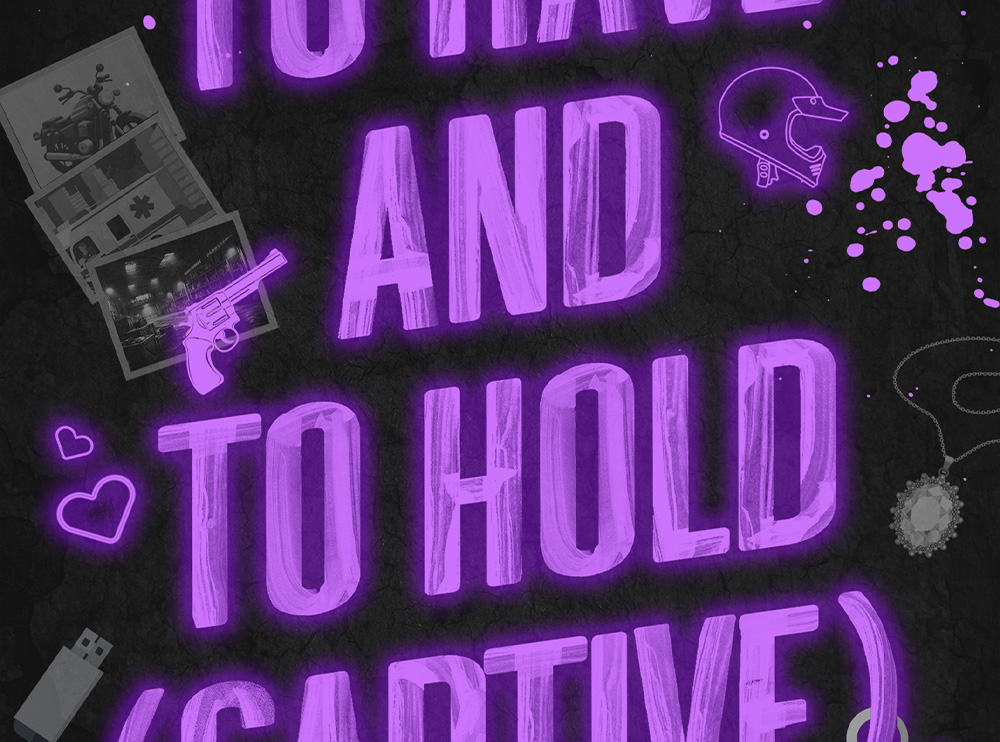
We are delighted to be revealing the cover for To Have and to Hold (Captive) by K.N. Wilder, which marks the third installment in the dark romance series, The Hemlock Society.
The first two books of The Hemlock Society were originally self-published and have been rereleased by Grand Central Publishing with this brand new installment hitting shelves on April 6th 2027.
Read on to discover the cover, synopsis, and an excerpt, and be sure to preorder your copy here!

Reverie Shaw hadn’t planned on becoming a criminal. But when her boss, Leo, steals from Boston’s most dangerous man and leaves her looking like the culprit, it
becomes her problem. Now she must return what Leo took or pay the forfeit—with her life.
With Leo vanished and the bounty with him, Reverie does the only reasonable thing she can to flush him out: kidnap his brother for leverage.
Lazlo Vega is a paramedic, a hypochondriac, and a man who finds a loaded gun at his chest the best time he’s had in months. What could be more entertaining than
allowing the beautiful, fumbling woman who’s zip-tied him to a warehouse chair to think she has the upper hand?
What Reverie doesn’t know is that Lazlo has a very particular skill set, and it has nothing to do with saving lives. He has no intention of leaving until she realizes she doesn’t want him to.
EXCERPT
Chapter 1
Lazlo
I’ve seen a lot of weird shit in my five years as a paramedic, but coming home to find a beautiful woman pointing a gun at me is a first.
And to make it worse, she looks like every fantasy I’ve ever had since I was old enough to dream.
Blond hair. Green eyes. Full mouth, full breasts, wide cheekbones. And her body, even buried under an oversized sweatshirt that swallows her, is doing things to my pulse rate that would concern me if I didn’t have a gun pointed at my sternum right now.
The sweatshirt hides most of her, but physics can’t be helped. It pulls across her chest when she adjusts her grip.
I want to tell that sweatshirt to go to hell.
The gun in her hands shakes.
Hmm. Classic adrenaline tremor. Sympathetic nervous system in overdrive. She’s not used to this.
I was two seconds away from face-planting on my couch and diagnosing myself with whatever Mr. Henderson in apartment 3C had. Pretty sure it was shingles. Or meningitis. Guess that isn’t happening.
“Don’t move.” Her voice hitches.
My hands drift up slowly, the keys in my hand jangling.
Thank God I’m paranoid.
Every criminal knows someone who’s had their place tossed during an investigation, so I keep nothing at home. No souvenirs, no trophies, no tools that can’t be explained as basic first aid.
She won’t find anything.
I put on a smile. “Okay. We’re doing this. Great. Quick question though, is it drafty in here, or am I developing the early stages of hypothermia? Because I’ve been cold all day and that’s a classic sign of—”
“Shut up.”
“Right. Shutting up.” I pause. “Although, for the record, the safety’s on.”
Her eyes drop to the gun and her face goes through confusion, realization, then something that looks like she wants to sink through my floor.
She fumbles with the safety and clicks it off. The gun steadies, but her jaw’s tight now and her cheeks flushed.
“Sit.” She jerks the gun toward my kitchen chair. “Hands behind your back.”
I move, making a show of compliance. My apartment’s small enough that it takes maybe four steps. I sink into the chair, lacing my fingers behind the backrest.
This is going to be fun.
She approaches me from behind, and there’s plastic rustling. She curses.
Something thin and hard presses against my wrist. She yanks it, and the plastic cuts into my skin before popping loose and falling.
“Fuck this,” she curses.
I glance back. Zip ties. The thin ones you use for organizing cables, not restraining a full-grown man.
“Those are pretty small,” I say. “The hardware store keeps the heavy-duty ones in aisle seven, right next to the—”
“Shut. Up.”
I close my mouth.
She tries another zip tie. This one gets around one of my wrists but won’t stretch far enough to catch the clasp. The plastic digs in, then snaps again.
“Need help?” I ask. “I mean, I’ve got bigger hands if you know what I mean,” I wink, “so maybe if you—”
“I said shut up!”
She moves around to face me. Her eyes are wide. Red-rimmed, bruised with exhaustion.
She’s a goddamn mess. And she’s magnificent.
“What do you want?” The tickle in my throat is a distant annoyance. “Money? Because I’ve got maybe forty bucks and some expired Vicodin from when I thought I had appendicitis. Turned out to be gas, but—”
“I don’t want your money.” She’s behind me again. More rustling. She’s trying to loop multiple zip ties together now, creating some kind of makeshift chain.
I could end this in a second. But this is better than the time Mrs. Breen thought she was having a heart attack but it was just that roasted chicken she ate.
Way better.
“Okay, so identity theft? I should warn you, my credit score’s shit.”
The plastic finally, finally catches my wrists. She yanks it tight. The circulation’s already getting fuzzy. She exhales like she just ran a marathon.
She comes back around to face me. The gun’s still up, but her other hand’s braced on her hip. She looks like she might throw up or pass out.
“There,” she says. “Don’t move.”
I test the restraints. They’re terrible. Uneven tension, wrong gauge, probably wouldn’t hold if I really tried. But I settle back against the chair and give her my best helpful smile.
“Wasn’t planning on it. But seriously, what do you want? Because I’ve got another shift in twelve hours and I really need to know if I should call in sick. I think I’m developing early-onset carpal tunnel from all the IV insertions today, and—”
“Call in sick.” She shifts her weight. “Text your boss. Tell them you need a few days.”
“A few days?” My voice goes up an octave. “A few days? Do you have any idea what happens when you call in for multiple shifts? The paperwork alone could kill me. Actually kill me. I’m talking stress-induced heart-attack. And Rodriguez already thinks I’m faking half the time because of that incident with the suspected Ebola exposure that turned out to be a regular mosquito bite.”
The gun doesn’t move.
“Do it.”
I stare at her. She stares back.
Christ on a contaminated crash cart.
“My phone’s in my pocket,” I say. “Which is kind of hard to reach with my hands zip-tied behind my back. Unless you want me to dislocate my shoulder, which, actually, now that I mention it, my left shoulder has been clicking lately and that’s a classic sign of rotator cuff.”
She moves closer, her fingers are quick, impersonal, fishing my phone out of my pocket. She comes back around and holds it up to my face. Face ID unlocks it.
Smart girl.
She navigates to my messages, finds my supervisor’s contact.
“Hey Chief, not feeling great. Gonna need a few days. Sorry for the short notice,” she reads out loud as she types. “Okay?”
I think about tomorrow’s shift. Tuesday, six a.m. Peter is going to lose his mind.
Her thumb hovers over the send button. She looks at me as if she’s expecting me to lunge or scream or object.
I just raise my eyebrows.
She hits send. The whoosh sound feels weirdly final.

She disappears into my bedroom. I hear drawers open and slam shut, then she returns with my leather jacket—the nice one I bought after that last kill went perfectly and I felt invincible for about forty-eight hours.
She tosses it at me.
It hits my chest and slides down to my lap because, you know, hands tied behind my back and shit.
We both stare at it.
“Right.” Her jaw tightens. She picks up the jacket, circles behind me, her fingers brush my shoulders as she drapes it over me, tugging it into place.
“Stand up.”
“Where are we going?”
“Somewhere else.” The gun presses against my spine. “Move.”
I stand. The zip ties bite into my wrists. “That’s not really an answer. I mean, ‘somewhere else’ could be the corner store. Could be Canada. A grave. Pretty big range there.”
She grabs my elbow, steering me toward the door. She has a strong grip. That’s nice.
“Walk.”
The hallway’s empty. Mrs. Miranda is probably already asleep, which is good because this would be hard to explain. The gun stays pressed against my lower back as we take the stairs. My legs feel weirdly loose. My blood sugar might be dropping. I should’ve eaten something before my shift. Hypoglycemia’s no joke.
Her car’s a beat-up Chevrolet that’s seen better decades. The driver’s door is dented. She pops the back door open with her hip.
“Get in. Lie down.”
I duck into the backseat. The upholstery’s rough against my cheek as I stretch out, and the jacket bunches up under my shoulder. She checks the zip ties.
“This seems excessive,” I say into the seat cushion. “I’m not going to jump out of a moving car. I value my femoral arteries too much.”
The door slams. She slides into the driver’s seat, and the engine wakes to life on the third try. The car lurches forward.
Street lights flash across the ceiling in constant intervals.
My shoulder’s already cramping from the angle, and that’s definitely early-onset rotator cuff syndrome. Or maybe thoracic outlet syndrome.
I flex my fingers. Still functional.
Twenty minutes feels like forty when you’re folded into a backseat with your hands tied behind your back. The street lights stop. The road gets rougher—potholes that jar my spine against the seat.
The car slows. Stops.
She kills the engine and exits.
The back door opens and cold air rushes in. I hadn’t realized how stuffy it was until now.
“Out.”
I twist, getting my legs under me. Sitting up with bound wrists is harder than it looks, but I manage. She’s already stepped back, gun up, giving herself space.
Outside, it’s all broken concrete and rust. Warehouse buildings hulk in the darkness, windows shattered or boarded over. This area’s been abandoned since the textile company went under five years ago.
I know because I brought a kill here once. Guy who ran a trafficking ring out of a youth shelter. He’d screamed for three hours before his vocal cords gave out. No one heard him.
She gestures with the gun. “Inside.”
The warehouse door’s already open, hanging crooked on its hinges. She follows close enough that I hear her breathing, quick and shallow.
One battery-powered lantern sits in the middle of the space. It casts harsh shadows up the concrete walls. There’s a metal folding chair next to it.
“Are you going to kill me?”