


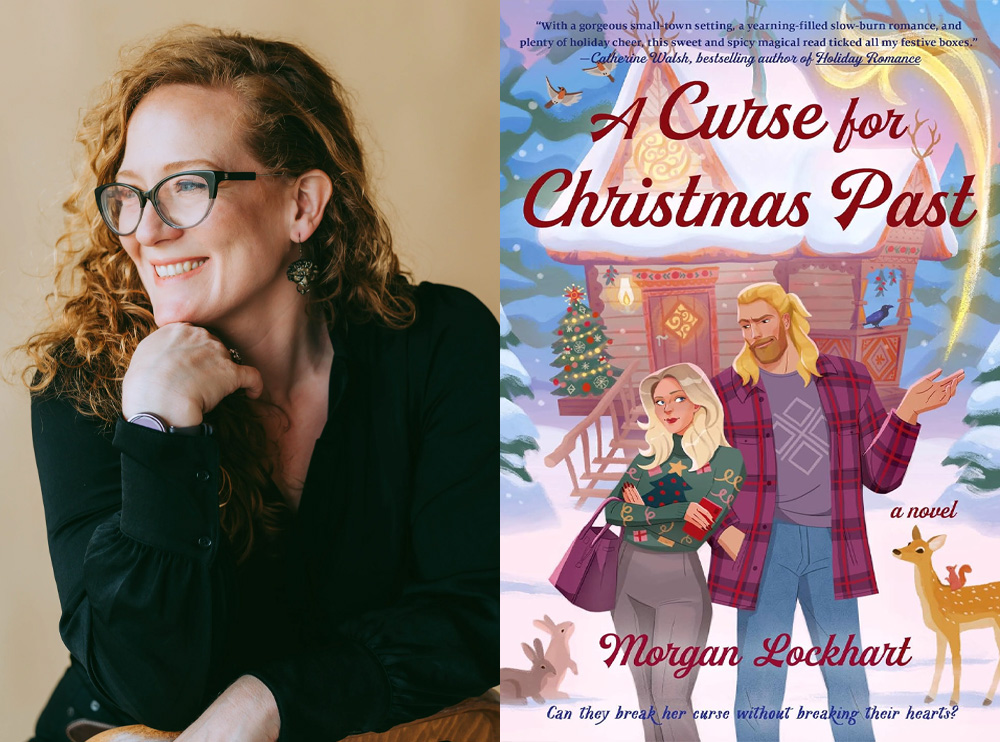
Guest post written by A Curse for Christmas Past author Morgan Lockhart
Morgan Lockhart hails from the Pacific Northwest, where she currently lives with her family, including her partner, two children, and a pack of fur babies. Growing up in the woods of Washington State, Morgan has always been telling and consuming stories in all shapes and sizes. After graduating from the writing department of UC San Diego with highest honors, she began a career writing video games that spanned two decades. Her debut novel, A Spell for Midwinter’s Heart, marked her formal return to the world of prose. In all forms, her work explores the messy business of being human with wit, whimsy, wonder, and a bit of the wyrd.
About A Curse for Christmas Past: For fans of Good Spirits, Hallmark holiday movies, and general witchy shenanigans, this charming holiday romance follows a woman with a curse and the handsome witch she reluctantly enlists to help her break it. Released September 22nd 2026.
As the holidays approach and the lights go up, the decorations come out but so, it seems, do the regrets. Perhaps it’s because the long winter nights invite reflection, or perhaps it’s the way in which they prompt us to look at our life and notice when something’s missing. Usually, the people we want there by our side, but sometimes too of the life we wish we were living under the tinsel. They motivate us to be the best versions of ourselves, but when even our best falls short, that turns into a challenge to take accountability, change, and grow before the New Year.
The following stories all feature characters who start their seasons in dire need of a redemption arc, and whether via helpful spirits, gift giving schemes, or missed alarms, get the opportunity to rise to the challenge and save the day by embracing the life changing magic of the holiday spirit.
Ebenezer Scrooge, The Muppet Christmas Carol
Why the Muppet version? Beyond the fact it is simply the best? Adapting The Christmas Carol is challenging because it’s hard to convince the audience that a real change has taken place, given the short timeline. In many cases, Scrooge ends the story more so as a man who wants to change, rather than someone who actually has, but Michael Caine’s masterful performance transforms the character from the snarling miser who lets Bean Bunny freeze into the gentle man who picks up Tiny Tim in a way that’s truly convincing.
Plus, Muppets.
The Afterlife of Holly Chase by Cynthia Hand
One of my favorite adaptations of the Christmas Carol, because it does totally new with the story. The main character, Holly, is a ghost who works as the Ghost of Christmas Past for a paranormal agency that tries to redeem Scrooges, after having once been a Scrooge who the same agency failed to redeem. While many “Scrooge” adaptations begin with the Scrooge simply being a bit grumpy about the holidays and a little wounded, Hand’s Holly Chase is clearly established as having been a bad person in life. She does significant harm to those around her for spoiled, selfish reasons. Instead of her redemption happening overnight, her redemption occurs over years of working for this agency. Her lessons are hard won, and her ending more than earned.
Edmund Pevensie. The Lion, The Witch, and the Wardrobe by C.S. Lewis
Edmund begins the stories a snot who is almost unforgivably cruel to his sister, but his encounter with the White Witch in Narnia changes him, and he emerges to become the person who would eventually earn the title “Edmund the Just.” His story shows how we often need to have our own cruelty reflected back at us before we wake up and understand the impact of our actions, and how those who go through these journeys of redemption often end up uniquely wise due to the lessons they learn along the way.
Miriam. Season of Love by Helena Greer
Unlike most of my Scrooges here, Miriam is not actually a bad person. That said, Greer does a wonderful job of showing how much hurt she did to her family with her past actions, even if they were sympathetic and understandable. She put distance between them because of the presence of an abusive family figure, and though that distance was necessary for her well-being, the suddenness, and unexplained nature, of her departure from their lives continues to impact her relationships. It is a rocky road toward reconciliation for Miriam, especially with Noelle, the novel’s other main character, who stepped in to fill her shoes after Miriam abandoned her family and their tree farm.
Bettie Hughes. Just Like Magic by Sarah Hoggle
This is another very loose Christmas Carol adaptation, because the main character, Bettie, gets just one Christmas spirit, who she ropes into a fake fiancé scenario. Bettie begins the book a broke grifter hiding in a dead woman’s house who destroys almost everything she touches and treats others as marks in her schemes, but then she is paired up with the absolute cinnamon roll of a holiday spirit, Hall. Spending Christmas with Hall forces her to confront how much she has shut herself off from other people, especially her family, and how much damage that is doing to her. By the end she learns to embrace relationships as more than transactions and to start making the positive changes toward the life she wants.

Katarina. Last Christmas (movie)
Like many complicated holiday movie protagonists, Katarina is haunted by a life that has not turned out the way she wanted it to, and the end result is both holding her own self back and lashing out at others in her hurt, so that she no longer has anyone to help her through it. Enter Tom Webster, a patient man with a heart of gold, who teaches her that sometimes to help ourselves, we need to begin by helping others. Through a series of small, positive steps, she begins to see her life change, as she embraces the alchemy of the spirit of giving and once again has a community to help her heal.
The Caldwell family. Happiest Season (movie)
Going “home for the holidays” with your partner isn’t all it’s cracked up to be when she is still in the closet. This one is challenging because it’s arguable Harper doesn’t quite do enough to earn redemption for how she hurts her girlfriend Abby, but given that she ultimately does come out, and her family is able to accept her sexuality, there is enough moving forward for this family, and this relationship, to make the list. Because if there’s anywhere you deserve to be your most authentic self, it’s with your family at the holidays.
Walter Hobbs. Elf (movie)
James Kaan’s Walter Hobbs begins Elf career obsessed and short-tempered, especially with his estranged son Buddy who has been raised by elves in Santa’s workshop. While he fails many times over to deserve Buddy and the love Buddy offers in the source of the movie, by the end Walter finally realizes that what he has been chasing is not what he truly needs to be happy and takes steps toward mending things with his son.
Kevin McCallister. Home Alone (movie)
Kevin makes a wish at the beginning of Home Alone to spend it without his family, with whom he is constantly at odds, and it happens. At first, it’s as great as any child thinks a life without parents and responsibilities would be, and then the harder realities set in. While the story is somewhat of a redemption for the whole family (whose conflict Kevin is not solely responsible for), we primarily follow Kevin as he learns to understand the way in which families are all about compromise, and how that often means looking beyond our own wants and needs to understand others.
Jasper/the town of Smeerensburg. Klaus (movie)
Klaus is set in the town of Smeerensburg, which at the start of the movie is full of people making themselves miserable by clinging to bitter rivalries. When spoiled, lazy Jasper is appointed their new postmaster, he concocts a gift giving scheme to drum up business for the post office that grows far beyond him and turns into a campaign of kindness that slowly transforms the town, and Jasper in turn. Neither his turn nor the town’s is sudden, but rather it demonstrates how one small action of kindness after another can, eventually, change who we are.


