

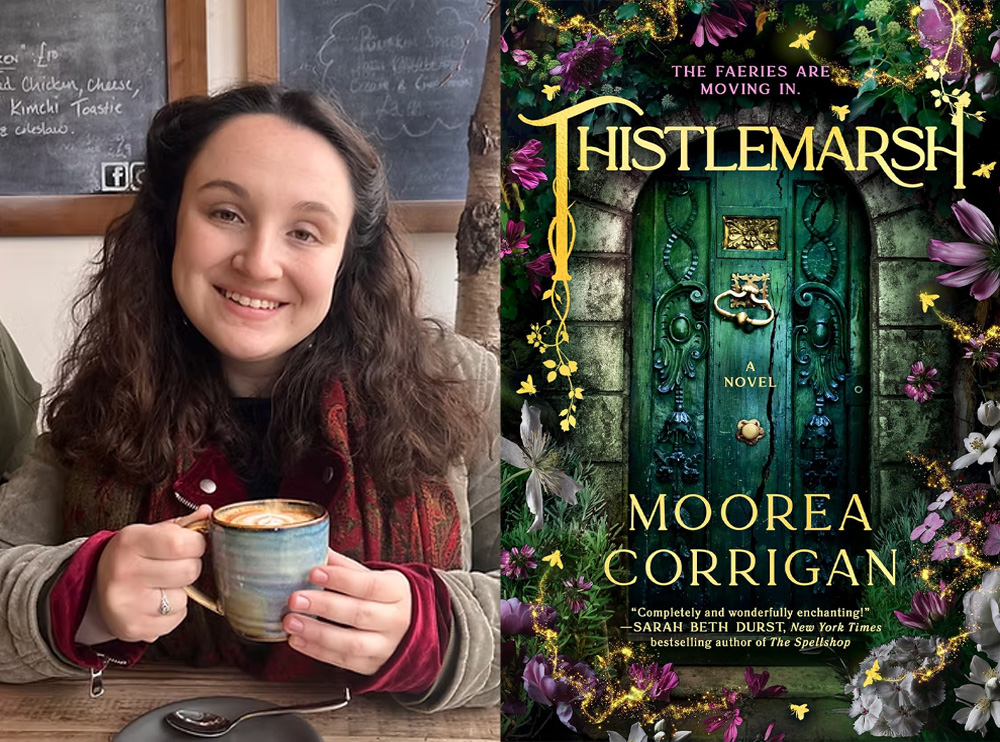
Guest post written by Thistlemarsh author Moorea Corrigan
Moorea Corrigan holds a bachelor’s degree with honors in English literature from the University of Edinburgh and a master of publishing degree from Simon Fraser University, Vancouver. She works at an academic press in Boulder, Colorado. When she is not writing, you can find her singing, spending time with her menagerie of pets, or attending Jane Austen conventions in full Regency regalia. Thistlemarsh is her debut novel.
About Thistlemarsh: Faeries disappeared over one hundred years ago, as suddenly as slipping through a doorway. It was only the very foolish, or the very determined, who held out hope for their return. Welcome to Thistlemarsh—a ramshackle estate where an impoverished orphan and a beguiling Faerie collide in an enchanting novel of love, revenge, and ruin. Out April 21st 2026.
Fairy tales have dominated the public imagination from the courts of ancient China, the salons of sixteenth century France, the glow of Disney’s 1930s Hollywood, and even Netflix’s latest season of Bridgerton.
Retellings of Cinderella, Red Riding Hood, The 1001 Arabian Nights, and Beauty and the Beast arrive in a constant stream, but a few rise to the top. These books twist the tales in innovative ways that engage with both the original material and the modern day.

Beauty by Robin McKinley
This iconic Beauty and the Beast retelling from Robin McKinley pre-dates the Disney film, and it seems McKinley was the first to bring the bookish trait to Belle. Beautifully written, this coming-of-age romance puts the focus on the interiority of fairy tale characters at a time when the mainstream still portrayed princesses as one note. Standalone.

Thornhedge by T. Kingfisher
T. Kingfisher brings a folkloric touch to the story of Sleeping Beauty with this delightful novella. Switched at birth with a Faerie child, our main character a Toadling grows up amongst the Faeries and only returns to grant a gift to her own dangerous replacement. Focusing on finding strength in strangeness and acceptance, this is a stunning take on an old tale. Standalone.

Spin the Dawn by Elizabeth Lim
This is a Mulan retelling that turns the story on its head with a “project runway” style challenge. The heroine, Maia, must disguise herself as a man to compete for the title or royal tailor. Packed with Chinese folklore and engaging characters, Spin the Dawn is a fresh twist that stands out from the fairy tale retelling crowd. Duology.

Jonathan Strange & Mr. Norrell by Susanna Clarke
Coming in at just over a thousand pages, this historical fantasy by Susanna Clarke seems intimidating, but it is packed with British folklore that keeps the reader wanting more. The extensive footnotes alone are treasures, written in a pastiche Austen-esque style that really makes one feel as though they are diving into a historical account from another world. The Faerie-lore in particular stands out, as it merges Irish and English traditions into something mysterious and intriguing. Standalone.

Spinning Silver by Naomi Novik
A powerhouse of the fantasy genre, Naomi Novik’s retelling of Rumpelstiltskin brings more to the story than a simple rehash of the plot. The story deals with antisemitism, domestic violence, and political marriages while staying uplifting and beautiful. Novik layers elements of other fairy tales throughout the narrative seamlessly in ways that enhance the plot and delight fairy tale fans. Standalone.

The River Has Roots by Amal El-Mohtar
This gorgeous novella is one part retelling of the British folk song The Two Sisters and one part an investigation in family and romantic relationships. The prose reads like a song itself, and it feels like a spell as you read it. Standalone.

The Bear and the Nightingale by Katherine Arden
The first in a trilogy, The Bear and the Nightingale is a gorgeous retelling of the Slavic folk tales Vasilissa the Beautiful and Morozko (aka, Father Frost). Full of stunning imagery, entrancing folkloric characters, and immaculate historical research, this story shines as an example of how old stories can be made fresh for modern readers. Trilogy.

Starling House by Alix E Harrow
Set in contemporary Kentucky, Harrow’s gothic fantasy Starling House engages tropes from Beauty and the Beast, the myth of Hades and Persephone, and Southern mining folklore. It is a novel that seamlessly blends its story about corruption and injustice with its fairytale tropes, making it an extremely satisfying read. Standalone.

The Star-Touched Queen by Roshani Chokshi
Inspired by Indian folklore, Chokshi’s first novel revolves around Princess Maya, a woman cursed by her horoscope to marry death and destruction. The novel incorporates the Hindi belief of reincarnation into the story in an exhilarating way that one does not see often in popular fantasy novels. Duology/Companion Book.

Emily Wilde’s Encyclopedia of Faeries by Heather Fawcett
The first in a trilogy, this gorgeous novel integrates epistolary journal entries with the fairy folklore of Europe. The fairies in Fawcett’s world span from dashing love interests, friendly (if frightening) helpers, and terrifying enemies, mirroring the way that these creatures act in folkloric sources. Trilogy.