


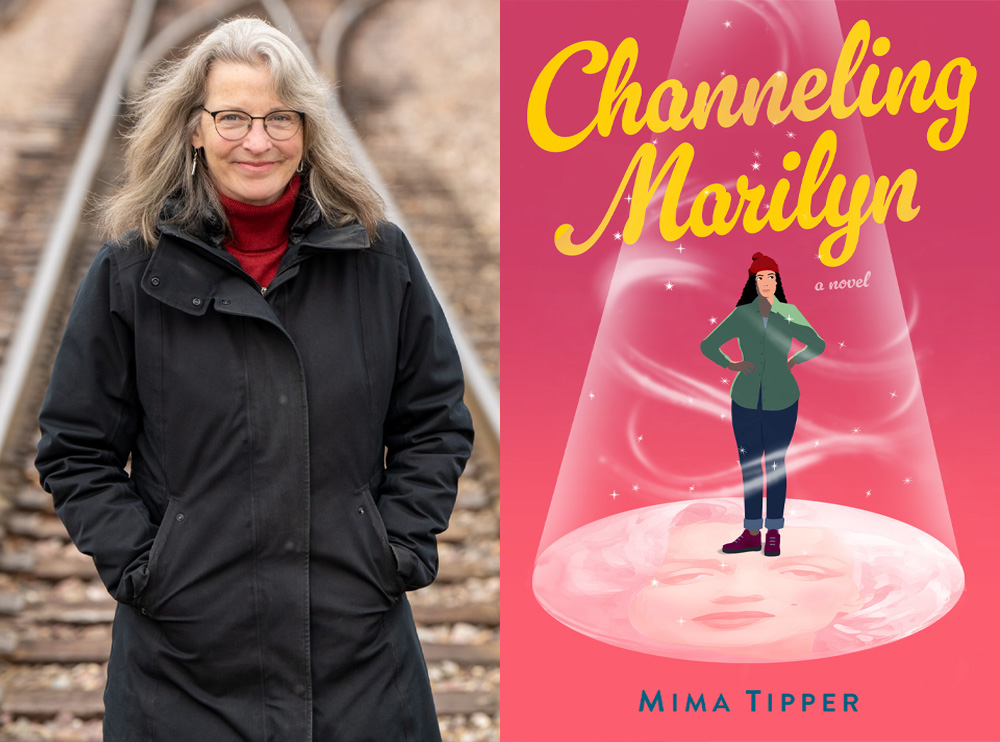
Guest post written by Channeling Marilyn author Mima Tipper
Half Greek, half American, Mima Tipper and her writing reflect her heritage—a little bit old-country, a little bit rock and roll: one foot wandering through the dreamy realms of myths and faerie tales, the other running on the solid ground of fast-paced, contemporary story. She earned her MFA in Writing for Children and Young Adults from Vermont College of Fine Arts, and is the award-winning author of the YA novel Kat’s Greek Summer (SparkPress, ISBN-9781684633067). Mima has also published YA fiction in Hunger Mountain and Sucker Literary Magazine. Her novel Kat’s Greek Summer was the 2025 silver medalist for YA fiction in the 2025 Moonbeam Children’s Book Awards, her YA short story “A Cut-out Face” received an honorable mention from Hunger Mountain’s Katherine Paterson Prize, and her work-in-progress version of Channeling Marilyn came in second place for Paranormal Romance in the Chesapeake Romance Writer’s annual Rudy contest. Beyond devoting most of her time to writing, Mima helps at Inklings Children’s Books in Waitsfield, Vermont, volunteers at her local library, and is committed to promoting literacy and supporting the writing community. Currently, Mima lives in Vermont with her family.
About Channeling Marilyn: Seventeen-year-old Lexa Donovan’s timid, plus-size life goes sideways when the spirit of Marilyn Monroe takes up residence in her body in this laugh-out-loud funny paranormal YA tale perfect for fans of Lisa Schroeder and Ashley Poston. Out June 2nd 2026.
One of the most fun parts of doing research for my YA paranormal fantasy Channeling Marilyn was watching and rewatching a lot of Marilyn Monroe’s films. I enjoyed them when I saw them as a child, and none of them felt tired for me on what had to be a second or even third viewing. Part of why I rewatched a lot of films and added others to my film roster is that I was determined to figure out what it was and is about Marilyn that captured and continues to capture the universe’s attention. There were plenty of gorgeous blondes back in the day, but none of them have even come close to the stature and mystery and obsession as Marilyn Monroe. Why is that? First off, I think it is her beauty for sure, but there’s more. She seems to represent an ideal of what our western culture has deemed perfect female beauty, and has for well over 70 years (not saying this is true, but it comes up again and again, and so many pop culture icons and stars copycat her look). Secondly, beneath that beauty is a sweetness and vulnerability that appeals to men and women alike. Sure, men want to “have” her and take care of her, but women want to take care of her as well. That one-two-punch is the kind of genuine star quality that cannot be manufactured. Maybe it’s as simple as the Norma Jeane under the Marilyn that makes Marilyn Monroe universally loved.
The following three of her films rise to the top for me:
Some Like it Hot (Billy Wilder, 1959)
This is a great film all around, with one of the best final lines in film history. If you don’t know it, I won’t spoil it for you. I feel like this is one of the funniest films ever made, and it just doesn’t get old for me. In brief, it follows two male musicians who witness a mob hit, flee the state in an all-female band disguised as women, only to face further complications. I love the performances and the comedic interplay. All of the characters are just so well-developed and rich. I like the premise and the cross-dressing angle. I feel like Jack Lemmon and Tony Curtis do a really good and fun job of hiding out as women. I liked how their feminine alter-ego mentalities crept into their typical (of that time) male sensibilities. I liked the friendship they made with the women, particularly Marilyn’s Sugar Kane, and how their relationship as men changed when they were in their female roles. It was like they got a little taste of what it’s like to be a woman in a man’s world, good and bad. A great premise for fiction. As for Marilyn, I loved how her character knew herself and knew what she wanted. Ultimately, Sugar wants to be loved. She thinks she wants security, because what could be less secure than being in an all-lady band during prohibition. I also liked how fast she made friends with the two new women, and how fast she came to count on them as buddies. She is so vulnerable and lovely; the two male leads couldn’t help but love her and, ultimately, want to protect her. A fantastic kind of love triangle where one side is romantic and the other is pure buddy film.

Bus Stop (Joshua Logan, 1956)
This is one of those films that just always called to me. In brief, it tells the story of a naive but stubborn cowboy who falls in love with a saloon singer and tries to take her away against her will to get married and live on his ranch in Montana. When I first saw “Bus Stop”, I had no idea it was based on a play, so I didn’t know how the play had been opened up to include more of a back story to saloon singer Cherie’s and cowboy Bo’s story. And with the inclusion of Eileen Heckart as Cherie’s friend Vera there was a lot more going on here than in the play. I think what I love about this film is how Marilyn’s performance captures perfectly the concept of the “tainted angel.” I don’t think any other actress has ever captured that concept as effectively and as engagingly as Marilyn Monroe. She is lovely and vital and sweet, but that vulnerability, well, that is what tugs at the audience in her portrayal of Cherie’s story. Yes, Cherie has made a lot of poor choices, and has had some knocks, but she gets up and gets on that stage anyway. She sings her song. That’s how this character ultimately speaks to Lexa in my novel Channeling Marilyn. Being beautiful or damaged or any of that doesn’t really define Cherie. It’s her desire and her hope. Her willingness to get out there again and again. That’s what captures the audience. Also, that neither she nor Bo are good guys or bad guys. He’s immature in his thinking that he is able to “herd” her into a relationship like one of his cows, but deep down he’s willing to grow and change. He is willing to “see” Cherie as she is. Cherie, too, is willing to look beyond his immaturity and forgive him. Ultimately, she is forgiving herself, and taking the chance at happiness he offers her. It is her choice.
Niagara (Henry Hathaway, 1953)
It took me a long time to watch this film as it was not one I saw as a kid. I don’t know if it was rules and permissions that kept it from being part of my movie-watching youth, but I think I was more drawn to Marilyn’s comedies than to her dramas. So, on a solo movie watching evening during my novel research phase, I cued up this film and gave it a watch. In brief, the film follows two couples visiting Niagara Falls, where tensions between one wife and her husband reach the level of murder. I really liked it! Marilyn is one of the main players, but she is not the star of this story. She plays bad girl Rose Loomis, who is setting up her husband George, played by Joseph Cotton, to be killed so she can escape their loveless marriage. It’s really important for this story that the Rose character is drop dead gorgeous and alluring; that she is appealing not only to men but to women. Both of the other two main characters—the young couple who serve as “witnesses” to the events unfolding—are attracted to Rose. The film and all the characters seem to understand that a woman like Rose is as much of a force as the film’s titular falls. **Spoiler alert**: It’s no surprise that after George’s character kills Rose, he is then sucked under the weight of the falls. There is no escaping a woman like Rose, even in death. I think only an actress with Marilyn Monroe’s power, allure and vulnerability could pull off this role. Any other actress would just seem hard and manipulative, but somehow we feel for Rose. We want her to escape volatile, depressed George. She makes a bad choice, but do we really hold it against her? Is there not some part of us that wishes she could move on? That is the essence that elevates this film, to my mind. There’s only one Niagara Falls and only one Marilyn Monroe.